
A first nurse practitioner contract can shape compensation, scheduling, malpractice obligations, supervision or collaboration requirements, termination rights, and future career flexibility. New graduates are often asked to evaluate unfamiliar productivity formulas and employer-favorable provisions while also managing licensure, credentialing, and the transition into clinical practice.
An offer may appear competitive based on salary alone but create financial or professional risk through unclear bonus calculations, repayment obligations, claims-made malpractice coverage, broad non-compete restrictions, or unilateral scheduling provisions. Those terms can affect take-home pay, personal liability, work-life balance, and the ability to accept another position after employment ends.
Attorney Robert Chelle provides new graduate nurse practitioner contract review for NPs nationwide. Chelle Law evaluates salary and productivity compensation, bonuses, repayment terms, schedules and call duties, malpractice and tail coverage, supervision or collaboration provisions, restrictive covenants, termination rights, credentialing responsibilities, and other terms that may affect an NP’s first years in practice.
Why Contract Review Matters for New Graduate NPs
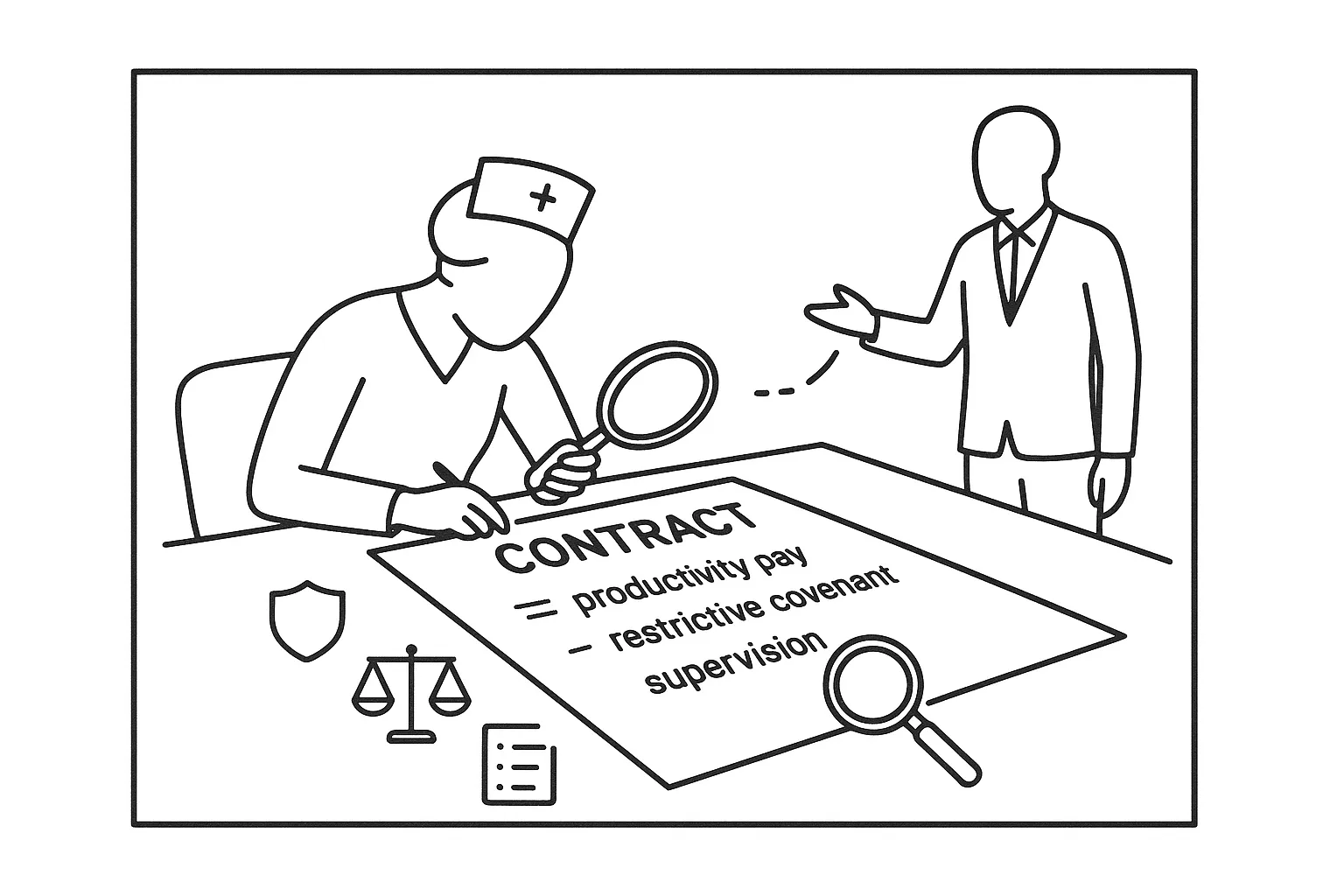
New graduate NPs frequently receive first offers containing unfamiliar productivity pay, collections-based formulas, negative accrual, restrictive covenants, and detailed supervision requirements. A line-by-line review clarifies how the employer calculates compensation, who bears malpractice tail costs, what events trigger repayment, and what degree of clinical autonomy the agreement actually provides.
Contract review also identifies income volatility, licensure concerns created by poorly defined supervision, and long-term restrictions that may limit future employment. Chelle Law explains these provisions in practical terms, identifies potential revisions, and helps the NP assess whether the overall offer aligns with the position described during recruitment.
- Confirm how base pay, productivity compensation, bonuses, and reconciliation are calculated and paid.
- Identify whether malpractice coverage is claims-made or occurrence-based and who must purchase tail coverage.
- Clarify schedules, call duties, clinical FTE expectations, work locations, and the employer’s ability to change them.
- Evaluate repayment provisions, termination rights, restrictive covenants, and post-employment compensation.
- Define employer responsibilities for credentialing, collaboration arrangements, licensure support, and onboarding.
Compensation, Bonuses, and Financial Obligations

Compensation should be evaluated as a complete system rather than a salary number. The contract must explain how the NP earns compensation, when payments are made, which data the employer controls, and whether later adjustments can reduce previously expected earnings.
Base Salary, Productivity, RVUs, and Collections
NP compensation may consist of a guaranteed salary, hourly pay, base salary plus productivity, collections-based pay, an RVU formula, or a combination of these methods. A guaranteed base generally provides more initial stability, while productivity and collections models tie part of the NP’s income to measured output or employer receipts. A thorough NP compensation review examines the formula, thresholds, conversion factors, exclusions, and payment schedule.
For example, a contract may provide a guaranteed annual salary plus a percentage of collections above a stated threshold. The actual value depends on whether the formula uses gross charges, billed amounts, adjusted collections, or net collections, as well as how often the employer reconciles the account. Delayed collections, chargebacks, opaque reporting, and negative accrual language can materially reduce expected earnings or carry a deficit into a future period.
Bonuses, Loan Assistance, Relocation, and Repayment
Bonuses may depend on productivity, quality, revenue, patient access, or other performance measures. The contract should define each metric, identify the measurement period, explain when the payment is earned, and limit the employer’s ability to withhold an otherwise earned bonus through unexplained discretion.
Signing bonuses, loan assistance, relocation reimbursements, and some professional expenses may be subject to repayment if employment ends before a specified date. Review should determine whether the obligation is prorated, whether it applies after termination without cause, and when repayment becomes due. New graduates receiving an upfront incentive should pay particular attention to signing bonus repayment terms that could create an immediate financial obligation after departure.
Work Expectations and Professional Liability
A compensation package cannot be assessed accurately without understanding the work required to earn it. Scheduling, location, call, administrative duties, and malpractice obligations can significantly change the practical value and risk of an offer.
Schedule, Call, Float, and Clinical FTE Requirements
Contracts commonly address clinical full-time equivalent status, expected hours, weekends, holidays, call duties, and floating between facilities. Ambiguous language may permit unilateral changes to assignments, increasing commute time, patient volume, or hours without a corresponding compensation adjustment.
The agreement should identify regular work locations, anticipated shifts, administrative time, call frequency, and whether additional coverage is separately compensated. New graduates should also review any incorporated handbook or policy because important call coverage requirements may appear outside the main employment agreement.
Malpractice Insurance, Tail Coverage, and Indemnification
Occurrence policies generally cover incidents that occur during the policy period regardless of when a claim is filed. Claims-made policies generally require the policy to be active when the claim is reported, which may make extended reporting coverage, commonly called tail coverage, necessary after employment ends.
The contract should identify the policy type, applicable limits, named insureds, premium responsibility, and who pays for any required tail coverage. Because tail costs can be substantial, Chelle Law’s malpractice and tail insurance review also considers coverage gaps, indemnification language, and whether defense obligations may extend beyond available insurance.
Termination Terms and Future Career Mobility
A first position may not develop as expected, making exit provisions especially important. Notice requirements, repayment obligations, final compensation, and post-employment restrictions determine how easily an NP can leave and transition to another role.
Termination Rights, Final Pay, and Post-Termination Compensation
Termination provisions should state the agreement’s term, renewal process, without-cause notice period, and events permitting immediate termination for cause. Broad cause definitions can allow an employer to end employment without a cure period, while a long notice requirement may delay the NP’s ability to begin another position.
The agreement should also address final salary, earned bonuses, unused leave where applicable, and outstanding productivity reconciliation. A focused termination provision review can identify whether repayment, tail insurance, or restrictive covenants change depending on how employment ends.
Non-Compete and Non-Solicitation Restrictions
Restrictive covenants may limit where an NP can practice, which services the NP can provide, and whether the NP can contact patients or employees after separation. The practical impact depends on the duration, geographic area, covered facilities, restricted activities, termination circumstances, and applicable state law.
An overbroad restriction can force a new graduate to commute, relocate, change specialties, or remain in an unsuitable position. A non-compete review evaluates both the wording of the covenant and how it could affect realistic employment options in the relevant clinical market.
Supervision, Scope of Practice, and Credentialing Support
NP practice requirements vary by state and may involve supervision, collaboration, prescribing, credentialing, or other regulatory obligations. The employment agreement should be consistent with the applicable rules and clearly allocate responsibility for required agreements, physician participation, licensure expenses, DEA registration, payer enrollment, and facility credentialing.
Vague language can shift regulatory or administrative burdens to the NP without confirming that the employer will provide the people, documentation, or financial support needed to begin work. Chelle Law reviews whether the employer’s obligations are explicit, whether productivity expectations account for onboarding delays, and whether the stated duties align with the intended role. Where collaboration is required, a separate supervision and collaboration agreement review may also be appropriate.
Benefit provisions should also specify health coverage, retirement contributions, paid leave, continuing education support, professional dues, and reimbursement of licensing or credentialing expenses. The NP should determine whether these commitments are contractual promises or benefits the employer may change through a separate policy.
Negotiation Priorities and Common Contract Red Flags
Negotiation should focus on the provisions creating the greatest financial, regulatory, or career risk. For many new graduates, the priorities are a meaningful base guarantee, transparent productivity accounting, objective bonus criteria, defined malpractice and tail responsibility, reasonable repayment triggers, dependable credentialing support, and manageable restrictions after termination.
Common warning signs include:
- Negative accrual or catch-up language that carries productivity shortfalls into future compensation periods.
- Undefined terms such as collections, production, net revenue, or clinical FTE.
- Discretionary bonuses without objective performance measures or a payment deadline.
- Repayment obligations that apply even after employer-initiated termination without cause.
- Broad termination-for-cause language with no notice or opportunity to cure a correctable issue.
- Malpractice provisions that do not identify the policy type, coverage limits, or responsibility for tail insurance.
- Large non-compete areas, lengthy restrictions, or language covering locations where the NP never worked.
- Supervision or collaboration provisions that shift compliance responsibilities without confirming employer support.
Not every unfavorable provision carries the same weight. An attorney can distinguish language that primarily needs clarification from terms that may warrant a proposed revision or materially affect whether the offer is acceptable.
When to Seek Attorney Review
The best time to obtain legal review is after receiving the complete written agreement but before signing or formally accepting the position. Review is particularly important when the offer includes productivity compensation, repayment obligations, claims-made malpractice coverage, significant call duties, multiple work locations, a non-compete, or unclear supervision and credentialing responsibilities.
Chelle Law’s process includes secure document submission, attorney review, a consultation to discuss findings, and written feedback identifying high-impact provisions. Flat-fee review helps avoid hourly-billing uncertainty while allowing the new graduate to evaluate compensation mechanics, professional liability, termination exposure, and practice restrictions with more complete information.
Frequently Asked Questions
What should a new graduate nurse practitioner review before signing a first employment contract?
A new graduate NP should review compensation, productivity formulas, bonuses, repayment obligations, work schedule, call requirements, malpractice insurance, tail coverage, supervision or collaboration terms, restrictive covenants, termination rights, credentialing responsibilities, benefits, and professional development support. These provisions can affect both short-term income and long-term career flexibility.
How is compensation commonly structured for a new graduate nurse practitioner?
Compensation may be based on salary, hourly pay, productivity, wRVUs, collections, quality incentives, or a combination of these methods. The agreement should explain how compensation is calculated, when bonuses are paid, whether thresholds or guarantees apply, how productivity is measured, and whether deficits or adjustments can affect future earnings.
What malpractice insurance terms should a new graduate NP understand?
The contract should identify whether coverage is occurrence-based or claims-made, the applicable policy limits, who pays the premium, whether tail coverage is required, and who is responsible for tail costs after employment ends. The NP should also review indemnification and defense obligations that could create liability beyond the malpractice policy.
What scheduling, call, and workload terms should be included in a new graduate NP contract?
The agreement should address expected weekly hours, clinical FTE, call responsibilities, weekends, holidays, float or multi-location requirements, administrative time, and productivity expectations. New graduates should pay particular attention to language allowing the employer to change schedules, locations, or duties without defined limits.
What restrictive covenants should a new graduate nurse practitioner review?
NP agreements may include non-compete, non-solicitation, confidentiality, and non-interference provisions. The contract should define the duration, geographic scope, covered locations, restricted activities, and the types of termination that trigger each restriction. These provisions can significantly affect the ability to change employers or remain in the same community.
When should a new graduate NP have an employment contract reviewed by an attorney?
A new graduate NP should consider attorney review before signing or formally accepting the position. Review is especially important when the agreement includes productivity-based compensation, repayment obligations, claims-made malpractice coverage, a non-compete, significant call duties, multiple locations, or unclear supervision, termination, and credentialing responsibilities.
Understand Your First NP Contract Before You Sign
A new graduate nurse practitioner contract can affect your income, schedule, professional liability, repayment obligations, and ability to move to another position. Chelle Law can identify the terms that deserve clarification or negotiation before you commit.
Request an NP Contract ReviewExplore More Nurse Practitioner Contract Guidance
Review additional services, practical resources, and state-specific guidance for nurse practitioner employment agreements.