
Employment agreements for nurse practitioners (NPs) commonly use compensation structures that affect income stability, regulatory compliance, and future career mobility. This guide explains how common NP compensation models operate, which contractual mechanics drive income and liability risk, and why a line-by-line review can identify income exposure, insurance gaps, and long-term restrictions before you sign.
Key Takeaways
- NP compensation is more than a headline salary. Base pay, productivity formulas, RVU conversion factors, bonuses, benefits, and reimbursements must be evaluated together.
- Definitions such as “net collections,” attributable collections, and wRVUs can materially affect actual pay.
- Measurement periods, reconciliation provisions, negative accrual, and chargeback windows can create unexpected deductions or cash-flow risk.
- RVU and collections models should provide clear reporting, audit rights, coding rules, and limits on unilateral formula changes.
- Malpractice coverage, tail obligations, repayment provisions, restrictive covenants, and termination terms can change the overall economic value of an offer.
How Nurse Practitioner Compensation Packages Work
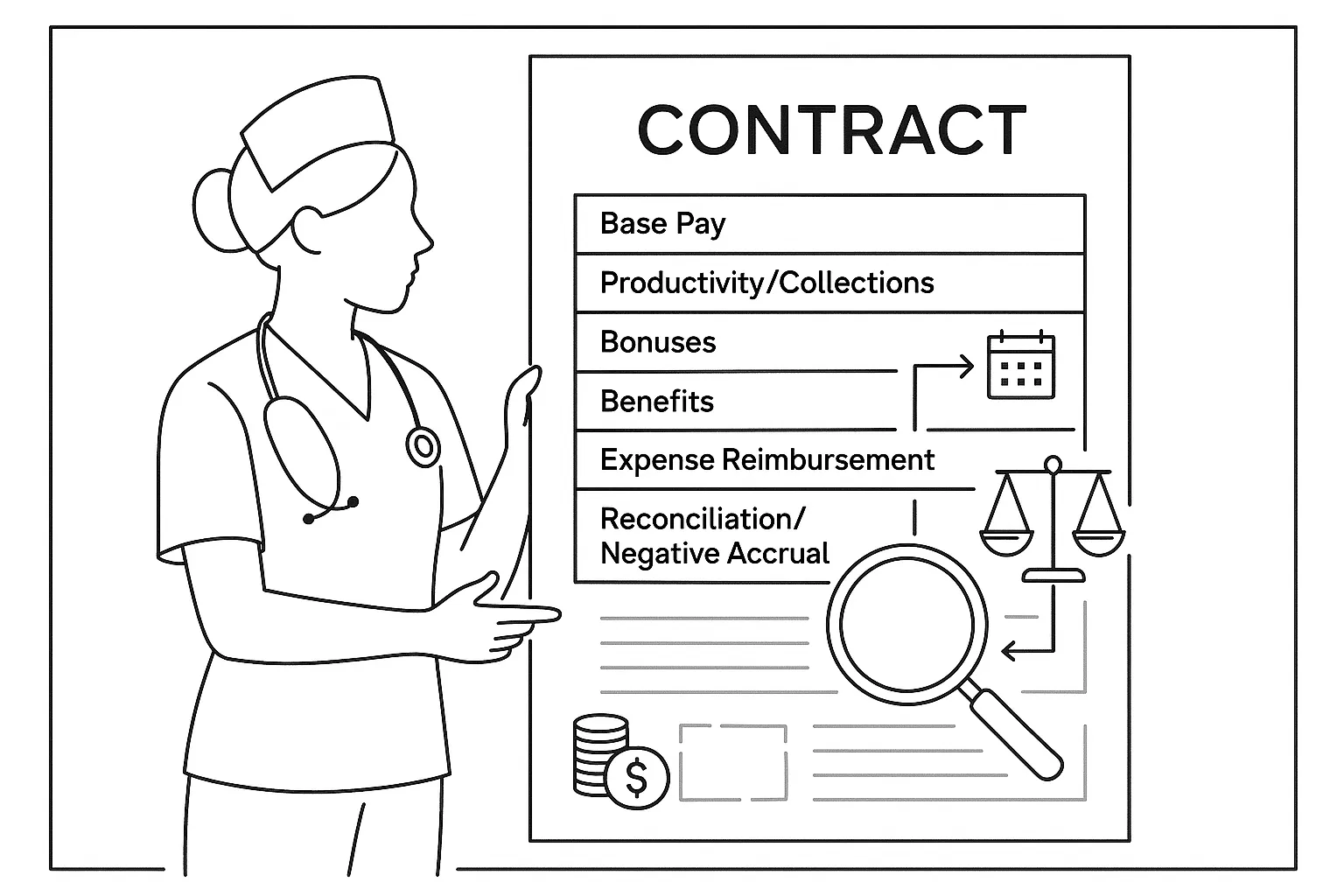
Compensation in an NP agreement is rarely a single number. Employers may combine guaranteed base pay, productivity or collections adjustments, bonuses, benefits, expense reimbursements, and malpractice coverage. Each component may follow a different calculation and payment schedule, so a complete NP compensation review should evaluate how the provisions interact rather than viewing them separately.
Important mechanics to examine include:
- Measurement period: Determine whether productivity is measured monthly, quarterly, or annually and when reconciliations occur.
- Calculation basis: Confirm whether pay is based on billed charges, allowed amounts, net collections, or work relative value units.
- Reconciliation and negative accrual: Identify whether a shortfall or prior payment can be carried forward and deducted from future compensation.
- Payment timing: Establish when productivity compensation is paid and whether the employer can make retroactive deductions.
- Reporting and audit rights: Determine whether the NP can review the billing, collections, coding, and productivity data used in the calculation.
Most compensation packages also address salary payment frequency, incentive thresholds, benefits, CME and licensing expenses, signing or relocation payments, and malpractice insurance. A high base salary may be offset by broad clawback provisions, negative accrual, limited benefits, or significant post-employment obligations.
Base Salary Plus Productivity Compensation
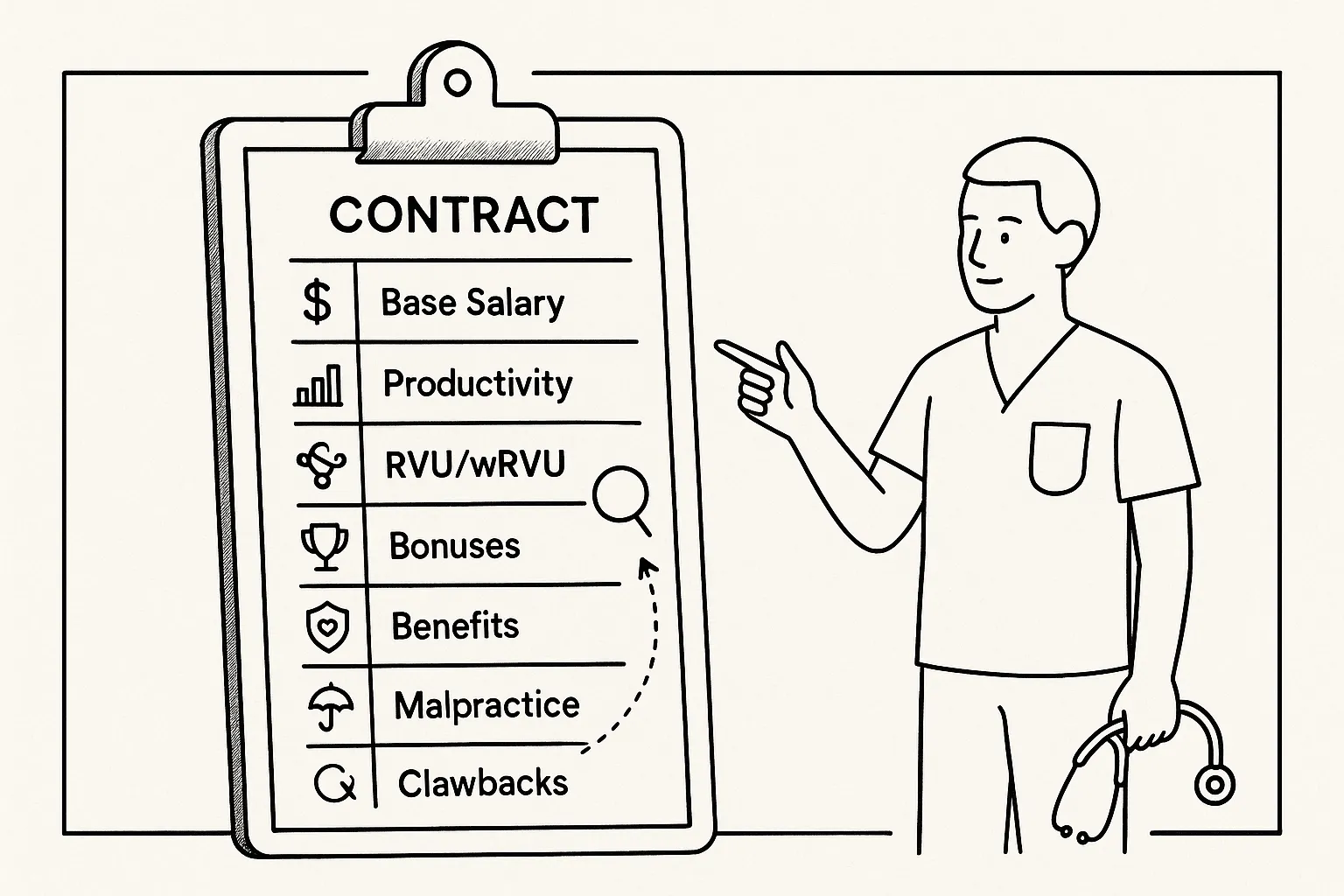
A base-plus-productivity model generally provides guaranteed compensation with additional pay when the NP exceeds a stated performance threshold. For example, an agreement might provide a $95,000 annual base salary and pay 30% of net collections above a $300,000 annual threshold. The practical value of that formula depends on how “net collections” is defined, when collections are credited, and which payer adjustments or expenses may be deducted.
The primary advantage is income stability with potential upside when patient volume and payer reimbursement support additional earnings. However, some contracts describe the base salary as an advance against productivity or allow shortfalls to become negative accrual. That can turn an apparently guaranteed salary into compensation that is subject to later recovery.
- Confirm whether the base is genuinely guaranteed or recoverable against future earnings.
- Define the threshold, payment percentage, measurement period, and reconciliation schedule.
- Require access to the underlying reports used to calculate productivity.
- Identify whether missed shifts, leave, credentialing delays, or employer-controlled scheduling can reduce the guarantee or threshold credit.
Formula definitions, reconciliation timing, and reporting limitations can make a nominal base-plus-bonus offer materially different from the compensation an NP ultimately receives.
Collections-Based Pay and Chargeback Risks
Collections-based compensation ties pay to amounts the employer actually receives from payers. Common variations include a straight percentage of attributable collections, tiered percentages that change at stated thresholds, and net-collections formulas that subtract allocated practice expenses. Because the employer generally controls billing and collection activity, the agreement should clearly allocate responsibility for delays, denials, coding changes, and payer recoupments.
- Attribution: Explain how collections are assigned when services are co-billed, billed under a group NPI, or divided among clinicians.
- Deductions: Identify every expense, refund, contractual adjustment, or administrative fee that can reduce net collections.
- Payment lag: State when received collections will be reported and paid to the NP.
- Chargebacks: Limit retrospective deductions and require supporting documentation and notice before recoupment.
- Trailing collections: Address whether the NP receives compensation for money collected after employment ends.
For example, if a payer reverses a prior payment months after the employer credited it, an unrestricted chargeback clause may allow the employer to deduct the corresponding amount from current or future compensation. Reviewing the agreement for broader collections-based pay risks can help identify vague attribution rules, extended recoupment windows, and expenses that may reduce expected earnings.
RVU-Based Compensation and Productivity Benchmarks
RVU-based models commonly use work relative value units (wRVUs) and a dollar conversion factor. If an agreement pays $40 per wRVU and the NP generates 4,000 credited wRVUs, the formula produces $160,000 before applying any guarantee, threshold, cap, reconciliation, or excluded-service provision.
A complete review of an RVU compensation formula should address:
- The dollar conversion factor and whether the employer can change it unilaterally.
- The codes and services that generate wRVU credit for the NP.
- Who controls coding, billing, corrections, and appeals.
- The productivity threshold and how it affects guaranteed or incentive compensation.
- Any exclusions, caps, or special rules for telehealth, shared visits, procedures, or administrative work.
- The NP’s right to review reports and challenge calculation errors.
Administrative controls matter because coding, payer policies, patient scheduling, support staffing, and employer billing practices can affect credited wRVUs even when the NP performs the underlying work. Contracts should not give the employer unrestricted authority to change a conversion factor or benchmark after the NP has accepted the position.
Bonuses, Benefits, Reimbursements, and Repayment Terms
Bonuses may be discretionary, formulaic, or tied to productivity, quality, patient satisfaction, or other metrics. A discretionary bonus gives the employer more control and may not create the same entitlement as a defined formula. A formulaic NP bonus structure should identify the measurement period, data source, eligibility rules, payment date, and what happens if employment ends before the payout date.
Benefits and expense reimbursements can also materially affect total compensation. The contract should identify responsibility for health and retirement benefits, malpractice premiums, CME, licensing fees, DEA registration, professional dues, relocation expenses, and other practice costs. It should also explain whether the employer pays an expense directly or reimburses the NP and whether reimbursement is conditioned on continued employment.
Signing bonuses, relocation allowances, student-loan assistance, and training payments often include repayment obligations if employment ends early. The agreement should define the triggering events, repayment period, and whether the amount decreases on a pro rata basis. Broad provisions requiring full repayment after substantial service can create significant financial exposure.
Offers of future partnership, equity, or buy-in opportunities require more than a general promise. Relevant terms may include eligibility conditions, timing, valuation methodology, capital requirements, dilution provisions, and exit rights. If those terms are not stated, the NP may have little contractual certainty about the opportunity.
Contract Terms That Can Change Actual Compensation
Malpractice Coverage and Restrictive Covenants
Malpractice provisions should identify whether coverage is claims-made or occurrence-based, applicable limits, premium responsibility, and who pays for tail coverage when required. These obligations are part of the economic package because an NP who must fund post-employment coverage may face a substantial expense. A focused malpractice and tail insurance review can clarify when the obligation applies and whether the employer contributes.
Noncompete, nonsolicitation, and confidentiality provisions can also affect the value of compensation by limiting future practice options. Enforceability depends on applicable law and the agreement’s facts, but geographic scope, duration, restricted activities, and termination triggers should be reviewed carefully. A review of the NP noncompete can help identify restrictions that may affect career mobility after the compensation arrangement ends.
Supervision, Scope of Practice, and Classification
Contracts may require supervisory relationships, collaboration agreements, protocols, or delegated-function lists. The agreement should align with applicable state requirements and clarify responsibility for maintaining supervising or collaborating professionals, credentialing, and required documentation. Vague obligations can expose the NP to disruptions in scheduling, billing, or compensation.
Employee or independent contractor classification affects taxes, benefits, expense responsibility, and liability. An agreement labeled as an independent contractor arrangement may still impose significant control over scheduling, systems, and clinical operations. Reviewing the independent contractor terms helps the NP understand how the proposed compensation compares with the costs and obligations shifted away from an employer.
Termination and Final Compensation
The agreement should define termination for cause, termination without cause, immediate termination events, and required notice. These provisions determine whether salary continues during the notice period and whether the employer can apply reconciliations, negative accrual, or repayment obligations to final compensation.
Earned but unpaid incentives, trailing collections, accrued bonuses, and final productivity calculations should be expressly addressed. A termination provision review can identify whether compensation is forfeited merely because payment occurs after the last day of employment or because the NP is not employed on the scheduled payout date.
Frequently Asked Questions
Which nurse practitioner compensation model offers the most income stability?
A genuinely guaranteed salary generally provides more predictable income than compensation based entirely on collections or productivity. However, the agreement must be checked for reconciliation, negative accrual, missed-shift deductions, and other terms that may make the stated salary recoverable or conditional.
How can an NP verify productivity compensation calculations?
The contract should provide regular reports and access to the billing, collections, coding, or wRVU data used in the formula. It should also establish a process and reasonable timeframe for questioning errors or disputed calculations.
What does negative accrual mean in an NP compensation agreement?
Negative accrual generally means a compensation shortfall or prior overpayment can be carried forward and deducted from later earnings. The contract should explain how the balance is calculated, whether it is capped, and whether it remains owed when employment ends.
How is collections-based pay different from RVU compensation?
Collections-based pay depends on money the employer receives from payers, while RVU compensation generally uses credited units for specified services and a dollar conversion factor. Both models require clear attribution rules, reporting rights, payment timing, and limits on unilateral changes.
What happens to earned bonuses when an NP’s employment ends?
The result depends on the contract’s eligibility, termination, and payout provisions. The agreement should state whether an earned bonus, trailing collection, or productivity payment is forfeited if the NP is not employed on the scheduled payment date.
Should malpractice and tail insurance be considered part of compensation?
Yes. Premium responsibility and any post-employment tail obligation can materially change the financial value of an offer. The contract should identify the policy type, coverage responsibility, and circumstances under which the employer or NP must pay for tail coverage.
Understand Your NP Compensation Before You Sign
Chelle Law can review your salary, productivity formula, bonuses, repayment obligations, insurance provisions, and termination terms so you understand the financial risks in your agreement.
Contact Chelle LawExplore Nurse Practitioner Contract Guidance
Review legal services, practical contract resources, and state-specific guidance for nurse practitioners.