
Employment agreements frequently layer bonus programs onto base compensation to align clinical productivity, quality metrics, and organizational goals. For nurse practitioners (NPs), those provisions can materially affect take-home pay, career mobility, and financial exposure. This guide explains common bonus types, calculation methods, contractual risks, and practical scenarios so you can evaluate how incentive compensation may work in practice.
Key Takeaways About Nurse Practitioner Bonuses
- Productivity bonuses may depend on collections, charges, encounters, or RVUs. Confirm the threshold, conversion factor, split, exclusions, and reconciliation method before signing.
- Quality and patient-satisfaction incentives should identify the applicable metrics, data source, measurement period, attribution rules, and payout formula.
- Signing, retention, and relocation payments frequently include repayment obligations triggered by resignation or early termination.
- Regular production reports, access to supporting data, and a defined dispute process make bonus calculations easier to verify.
- Bonus provisions should be evaluated as part of total compensation, including benefits, tax treatment, termination rights, and post-employment repayment risk.
Common Nurse Practitioner Bonus Structures
Productivity, Collections, and RVU Bonuses
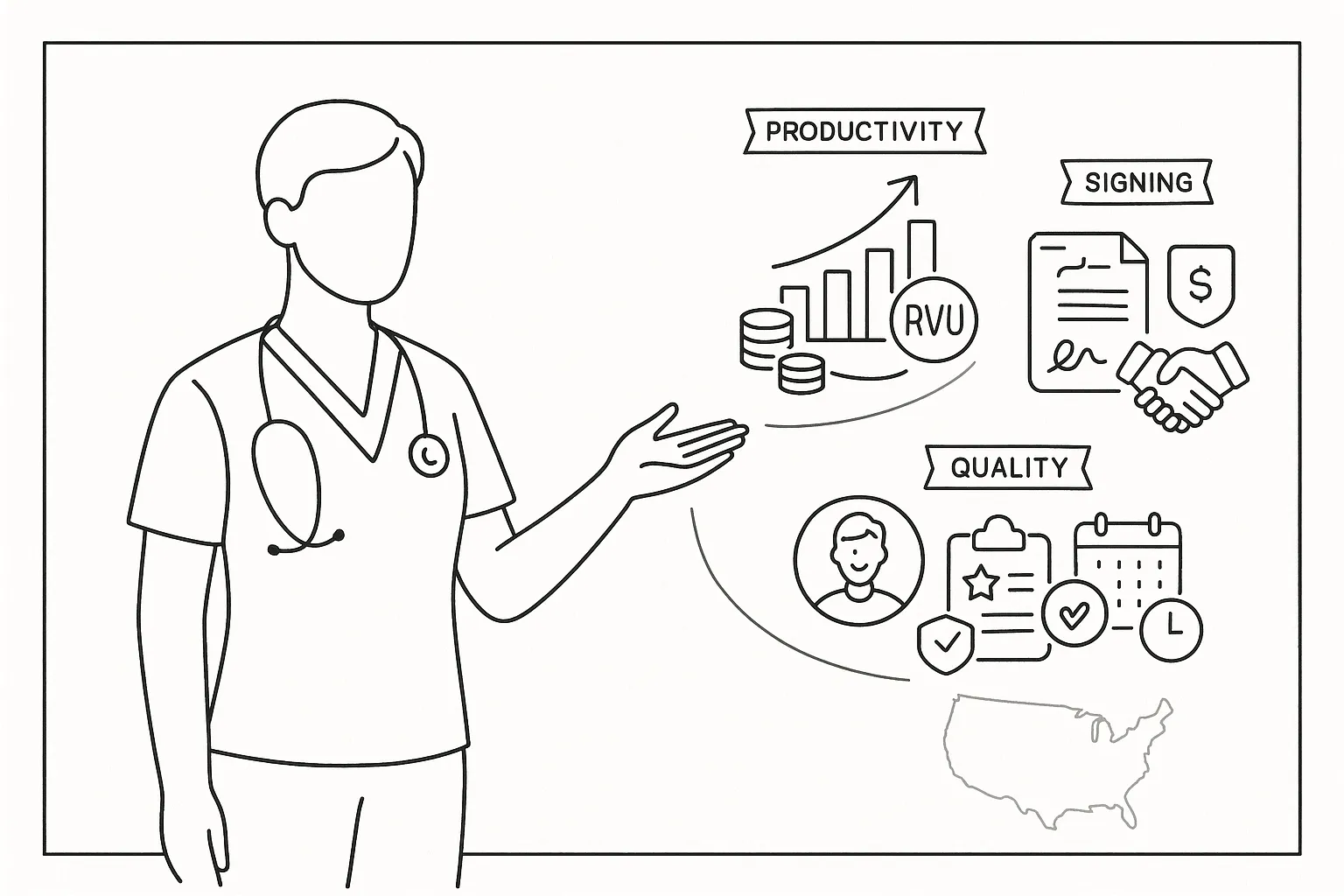
Productivity incentives are among the most common components of NP compensation. Employers may use a percentage of collections, a share of revenue above a threshold, encounter volume, or an RVU model with a stated conversion factor. Each approach shifts some revenue and operational risk to the clinician, so the contract should explain how production is credited, when a bonus is earned, and whether later reconciliations can reduce a prior payment.
The formula should also address billing delays, payer denials, coding changes, administrative duties, and periods when patient volume is outside the NP’s control. Reviewing the broader range of productivity and quality incentives can help place an individual bonus formula in context.
Quality and Patient-Satisfaction Incentives
Organizations may tie incentives to patient satisfaction, preventive care, readmission rates, care coordination, documentation, or other value-based measures. These arrangements can be individual, departmental, or pooled across a larger group. The agreement or incorporated bonus plan should identify the data source, measurement window, attribution method, target levels, and whether the employer retains discretion to modify the standards.
Signing, Retention, Relocation, and Referral Bonuses
Signing, retention, relocation, and referral bonuses are discrete awards rather than recurring productivity compensation. They often carry repayment obligations if employment ends before a specified date. Some provisions require full repayment, while others reduce the obligation over time; the trigger may also differ depending on whether the NP resigns, is terminated without cause, or cannot begin work because of credentialing issues.
Because these payments can create substantial post-employment liability, the repayment schedule should be reviewed alongside notice and termination language. A closer examination of signing bonus repayment provisions can clarify the issues that frequently require negotiation.
How NP Bonus Calculations Work
Base Salary, Productivity Thresholds, and Splits
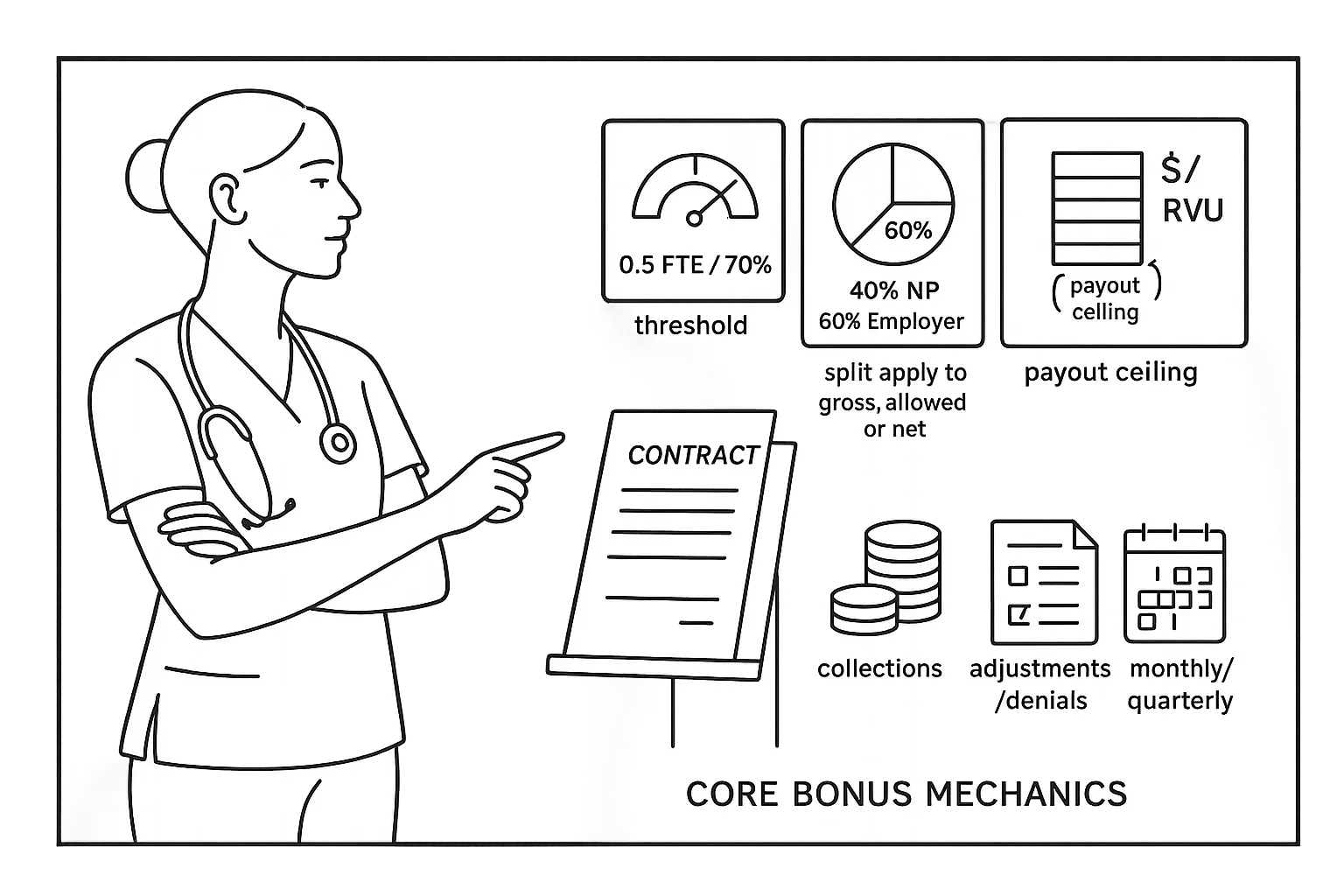
A common structure guarantees a base salary and pays additional compensation after the NP reaches a productivity threshold. Once that threshold is met, the NP may receive a stated percentage of incremental revenue or a fixed amount for each unit above the target. The contract should explain whether the threshold resets monthly, quarterly, or annually and whether underperformance in one period offsets production in another.
Thresholds should be evaluated against expected patient volume, specialty, schedule, administrative responsibilities, and ramp-up time. Comparing the formula with other nurse practitioner compensation models can reveal whether the incentive creates realistic upside or merely makes a portion of expected pay difficult to earn.
Gross Charges Versus Net Collections
Collections-based bonuses may reference billed charges, allowed amounts, or cash actually received. Net-collection models more closely track revenue but can make the NP’s compensation dependent on the employer’s billing performance, payer mix, collection timing, and write-off policies. The agreement should identify permitted deductions, treatment of refunds and denials, reporting frequency, and whether collections received after termination still count toward the final bonus.
NPs considering this arrangement should understand the specific collections-based compensation terms that determine which revenue is credited and when payment becomes due.
RVU Conversion Factors, Benchmarks, and Caps
RVU models convert clinical work into standardized units and apply a dollar conversion factor. Important terms include the applicable RVU type, benchmark, threshold, conversion rate, payout cap, and credit for split or shared visits. The calculation should also address coding changes, panel assignments, administrative time, call coverage, and services that generate work but do not receive equivalent RVU credit.
A detailed review of RVU compensation for nurse practitioners can help determine whether the benchmark and conversion factor are internally consistent.
Contract Risks That Can Reduce or Eliminate a Bonus
Bonus language may allow an employer to recoup payments because of billing errors, payer denials, early termination, or a later reconciliation. Broad clawback language and long reconciliation periods can expose an NP to repayment demands well after compensation was received. The contract should distinguish between an accounting correction, an advance subject to reconciliation, and compensation that becomes fully earned once stated conditions are met.
Eligibility language also deserves close review. A provision may require the NP to remain employed on the payout date even though the work was completed months earlier, or it may give the employer sole discretion to determine whether a target was met. When employment ends, the treatment of earned but unpaid compensation should be reviewed with the agreement’s notice requirements and other provisions governing termination of an NP contract.
- Unilateral authority to change the formula, benchmark, conversion factor, or attribution rules during a measurement period
- Retroactive reductions or offsets that are not limited to documented calculation errors
- Forfeiture of an earned bonus solely because the NP is not employed on the later payment date
- Undefined quality standards or data controlled exclusively by the employer
- Negative accrual that carries a deficit from one period into future bonus calculations
- No right to receive production reports or challenge an apparent calculation error
Negotiating Clear and Verifiable Bonus Terms
Predictable bonus language begins with objective definitions. The agreement or attached compensation plan should identify each metric, threshold, calculation period, payout date, and source of data. It should also explain how leave, credentialing delays, schedule changes, staffing shortages, practice relocation, and material changes in clinical duties affect the target.
Regular production reports and access to supporting data allow the NP to identify problems before an annual reconciliation. A defined process for raising calculation disputes is also preferable to language giving the employer final and unreviewable discretion. Depending on the position, negotiation points may include a guaranteed ramp-up period, prorated targets, a minimum incentive, protection against retroactive formula changes, and a deadline for final reconciliation after termination.
Bonus terms should not be reviewed in isolation. A line-by-line nurse practitioner contract review can evaluate how incentive compensation interacts with termination, malpractice coverage, restrictive covenants, duties, and repayment obligations.
Total Compensation and Real-World Bonus Scenarios
Bonuses may affect retirement contributions, loan-repayment calculations, PTO-related formulas, and other benefits depending on how the plan defines eligible compensation. They are also taxable income, and the withholding shown on a lump-sum payment may differ from the clinician’s ultimate tax liability. Independent contractors generally must account for bonus income without relying on standard employee withholding, so tax questions should be directed to a qualified tax professional.
New Graduate NP With a Signing Bonus and Productivity Ramp
A new graduate may receive a signing bonus, base salary, and productivity threshold that begins shortly after employment starts. If patient volume builds slowly, a threshold designed for an established panel may be difficult to reach. A guaranteed supplement, delayed measurement period, or prorated target can reduce volatility, while a declining repayment obligation may limit the financial consequences of leaving before the end of the initial term.
Experienced NP Moving to an RVU and Quality Model
An experienced NP transitioning to hospital employment may receive a blended incentive based on individual RVUs and departmental quality measures. Conversion factors, treatment of shared visits, pooled metrics, administrative time, and call responsibilities can substantially change the expected payout. The written terms should make clear which components the NP can control and how organizational performance affects individual compensation.
Telehealth or Independent Contractor Compensation
Telehealth and 1099 arrangements may pay by encounter, collection, or completed documentation. Delayed collections, rejected claims, credentialing problems, and retrospective adjustments can shift substantial payment risk to the clinician. An independent contractor agreement review should examine payment timing, classification language, documentation requirements, offsets, indemnification, and the records available to verify compensation.
Frequently Asked Questions
What should a nurse practitioner bonus formula define?
The formula should define the metric, threshold, conversion factor or percentage, measurement period, payout date, exclusions, reconciliation process, and treatment of compensation when employment ends. It should also identify the reports or data used to verify the calculation.
Can an employer change an NP bonus plan after the contract is signed?
The answer depends on the agreement and any incorporated compensation plan. Language giving the employer unilateral amendment authority can make future compensation uncertain, particularly if changes may apply during an active measurement period. The contract should state when and how revisions become effective.
What happens to an earned bonus when an NP leaves the employer?
The contract may provide for payment, proration, reconciliation, or forfeiture. NPs should check whether they must remain employed on the payout date, whether post-termination collections count, and when the employer must complete the final calculation.
How does an RVU bonus threshold work?
An RVU threshold is the production level an NP generally must reach before additional compensation begins. The contract should identify the applicable RVU measure, calculation period, conversion factor, payout cap, and whether deficits from one period carry into another.
Are signing bonus repayment obligations negotiable?
They may be negotiable depending on the employer and circumstances. Possible revisions include monthly proration, exceptions for termination without cause, a shorter repayment period, and repayment based on the amount actually received rather than the gross award.
How should a 1099 nurse practitioner evaluate a bonus?
A 1099 NP should review the payment trigger, collection risk, documentation requirements, offsets, reconciliation rights, and access to billing data. The clinician should also account for taxes, expenses, benefits, insurance, and other obligations that may not be covered by the contracting entity.
Review Your NP Bonus Terms Before You Sign
Chelle Law reviews nurse practitioner compensation provisions, productivity formulas, clawbacks, and termination-related bonus risks so you can understand the financial consequences of the agreement.
Contact Chelle LawExplore Nurse Practitioner Contract Guidance
Review legal services, practical contract resources, and state-specific guidance for nurse practitioners.