
Choosing between private practice and hospital employment is a foundational career decision for nurse practitioners. Each setting presents distinct contract mechanics, compensation models, liability exposures, and long-term career implications. An attorney-led comparison can clarify how employer-favorable provisions affect income, workload, professional mobility, and the cost of leaving a position.
Key Takeaways
- Private practice may offer greater autonomy and revenue-based upside, while hospital employment commonly provides a more predictable salary, institutional support, and broader benefits.
- Compensation formulas involving collections, RVUs, bonuses, negative accrual, or clawbacks should be quantified before an agreement is signed.
- Malpractice policy type, tail insurance responsibility, restrictive covenants, and termination obligations can materially affect the cost of changing jobs.
- Schedule, call, floating, supervision, and productivity expectations should be stated clearly rather than left to policies the employer can change.
- A line-by-line contract review can identify financial and professional risks that are not apparent from the stated salary or benefits summary.
Private Practice vs. Hospital Employment: Core Tradeoffs
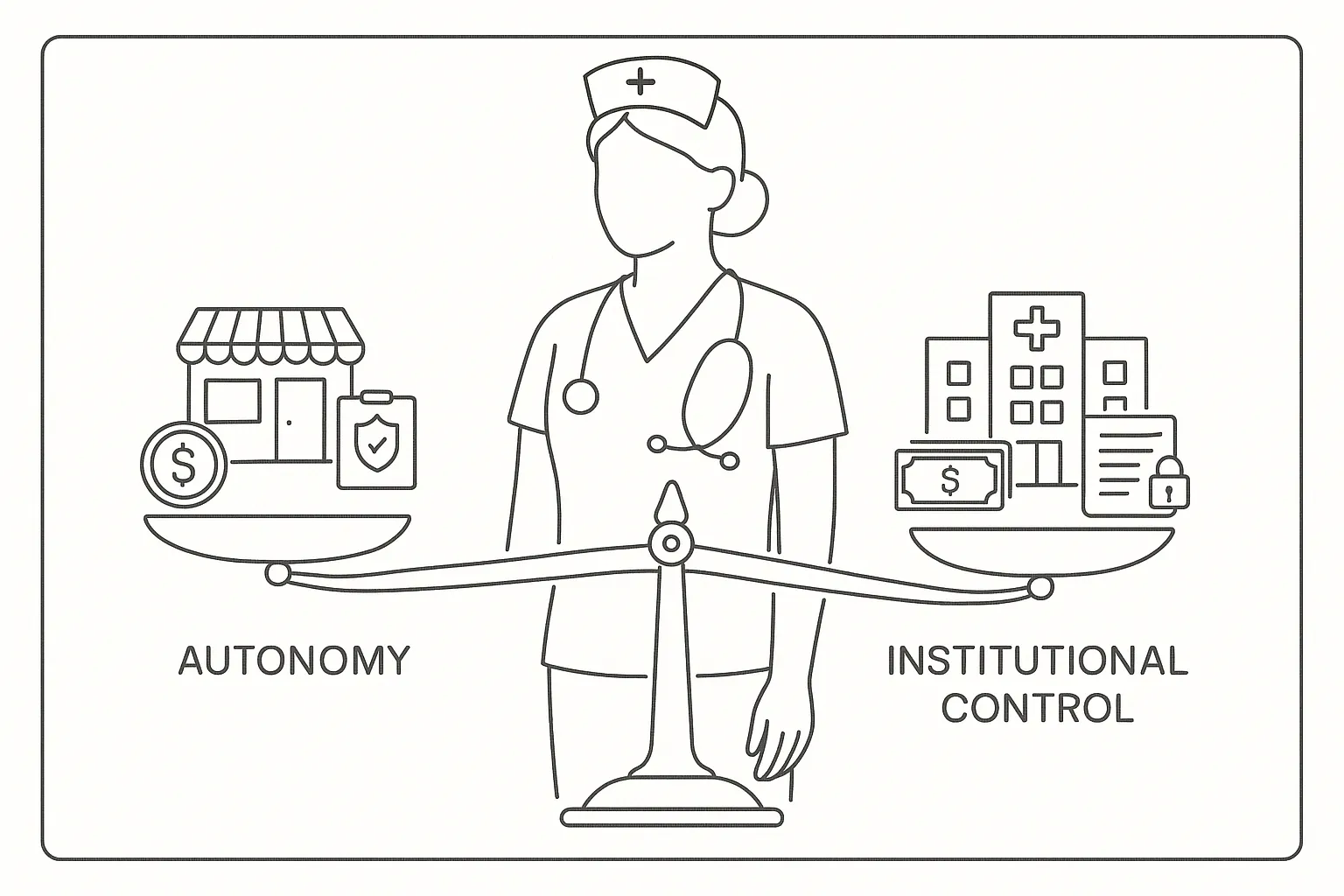
Private practice and hospital employment differ in the balance between income variability and predictability, professional autonomy and institutional control, and individual versus employer responsibility for operational risk. Private practice may give an NP more influence over scheduling, clinical protocols, staffing, and revenue opportunities, but it can also shift administrative, billing, compliance, and business responsibilities to the clinician.
Hospital employment generally offers established infrastructure, a defined salary, group benefits, and access to specialists and diagnostic resources. Those advantages may come with rigid policies, productivity benchmarks, call obligations, floating requirements, and employer-directed clinical processes. The better setting depends not only on the compensation offered but also on how the agreement allocates risk and control.
Private Practice Employment: Autonomy, Revenue, and Risk

Clinical Autonomy and Operational Responsibility
Private practice frequently provides greater flexibility in scheduling, clinical protocols, and practice patterns. However, autonomy may be accompanied by responsibility for billing oversight, credentialing, compliance, staffing, vendor relationships, and patient administration. Ownership, partnership, or buy-in provisions can add governance obligations and financial exposure that do not appear in a standard employee compensation summary.
The agreement should explain who controls business decisions, which expenses may be deducted from compensation, and whether the NP has access to financial and billing records. Vague expense-allocation language can produce unexpected deductions or disputes over responsibility for compliance failures.
Collections-Based Pay and Practice Liability
Private practices often use collections percentages, tiered splits, or practice-profit distributions instead of a fixed salary. Because collections depend on billing performance, payer timing, denials, refunds, and contractual adjustments, the stated percentage does not by itself establish expected take-home pay. NPs considering these arrangements should understand the broader risks of collections-based compensation, including how expenses and uncollected charges affect the calculation.
Private practices may provide occurrence or claims-made malpractice coverage, but policy limits, defense control, and tail obligations vary. Owners and partners should also examine indemnification, entity liability, and obligations triggered by withdrawal, dissolution, or sale. A separate malpractice and tail insurance review can clarify who bears post-employment coverage costs.
Hospital Employment: Support, Predictability, and Institutional Control
Clinical Resources and Scope-of-Practice Requirements
Hospitals commonly provide consultative support, on-site specialists, diagnostic access, established protocols, and administrative infrastructure. Employment agreements may incorporate supervision or collaboration requirements, chart-review procedures, and delegated functions that must remain consistent with applicable state law. These provisions can reduce uncertainty when drafted clearly but may also create documentation or performance obligations that affect discipline and productivity.
Because the practical requirements vary by role and jurisdiction, the contract should identify the parties responsible for maintaining any required relationship and associated costs. A focused review of supervision and collaboration terms can reveal obligations that extend beyond ordinary clinical support.
Salary, Benefits, Call, and Hospital Policies
Hospitals often offer a guaranteed base salary, health coverage, retirement benefits, paid leave, and continuing education support. They may also impose on-call rotations, overnight coverage, floating between units or facilities, and productivity requirements. The agreement should define call pay, shift differentials, work locations, scheduling authority, and whether additional coverage affects productivity expectations.
Hospital contracts frequently incorporate handbooks and institutional policies by reference. Those documents may address discipline, leave, performance evaluation, professional conduct, and termination, and they may be amendable by the employer. The agreement and incorporated policies should therefore be reviewed together rather than treating the contract as the only controlling document.
Comparing Compensation, Benefits, and Workload
Salary, RVUs, Collections, and Bonus Formulas
A salary provides predictable base compensation, while RVU and collections models tie some or all earnings to measured productivity or revenue. An RVU plan should identify the conversion factor, threshold, measurement period, attribution rules, reporting process, and treatment of coding changes. The same level of detail is necessary for collections plans and quality or productivity bonuses.
Negative accrual, reconciliation, and clawback provisions can convert an attractive incentive into contingent income or future debt. Before signing, an NP should compare the entire compensation model and obtain a detailed productivity and compensation review when the formula depends on RVUs, collections, or employer-controlled data.
Benefits, Repayment Terms, and Actual Workload
Private practices may offer limited group benefits or stipends, while hospitals often provide broader health, retirement, leave, and continuing education packages. Signing bonuses, relocation allowances, and student loan benefits should be evaluated together with their repayment provisions. Important terms include whether repayment is prorated, which events trigger it, and whether the full balance becomes immediately due.
Benefits should also be weighed against the actual workload. Patient volume, administrative time, chart completion, call, weekend coverage, and travel between facilities can materially change the value of the offer. Productivity expectations should account for duties that do not generate billable encounters but are still required by the employer.
Contract Terms That Affect Liability and Career Mobility
Malpractice Coverage and Tail Responsibility
Occurrence coverage generally applies based on when the incident occurred, while claims-made coverage depends on when the claim is reported and whether coverage remains in effect. If the employer uses a claims-made policy, the agreement should state who purchases tail coverage after termination, whether exceptions apply, and how coverage is handled if the employer changes carriers. These details should appear in the contract rather than remain an informal assurance.
Non-Compete and Non-Solicitation Restrictions
Restrictive covenants may limit where an NP can practice, the services the NP can provide, and whether the NP may communicate with patients or employees after departure. Enforceability varies, but the practical burden can be significant even before a court evaluates the provision. A non-compete review should assess the duration, geographic scope, restricted activities, triggering events, and available exceptions.
Termination, Final Compensation, and Repayment
Termination provisions define notice requirements, immediate termination events, patient-transition duties, and what happens to compensation and benefits when employment ends. The agreement should address final salary, earned bonuses, accrued paid time off, outstanding collections, and repayment obligations. Undefined transition duties or aggressive clawbacks can create financial and professional risk after the NP has already accepted another position.
NPs should also determine whether termination changes responsibility for malpractice tail coverage or activates a restrictive covenant. A dedicated contract termination review can identify overlapping obligations before notice is given.
Evaluating an Offer or Changing Employment Settings
Documents and Data to Request
For a private practice position, useful due-diligence materials may include compensation reports, payer-mix information, productivity data, expense-allocation policies, malpractice details, and any documents governing ownership or buy-in rights. For a hospital position, request the incentive plan, bonus worksheets, call and scheduling policies, applicable handbooks, malpractice information, and productivity reports relevant to the role.
Negotiation Priorities and Transition Planning
Early-career NPs may prioritize predictable compensation, mentoring, benefits, and institutional support, while experienced clinicians may place greater value on autonomy, schedule control, equity opportunities, or protection from restrictive covenants. In either setting, negotiation should focus on clear formulas, reliable reporting, defined duties, reasonable exit terms, and written responsibility for post-employment costs.
When moving between settings, review how the notice period interacts with credentialing, patient continuity, bonus payment dates, and the start date for the new position. Transition assistance should have a defined scope and duration so it does not become an open-ended unpaid obligation.
Frequently Asked Questions
Do nurse practitioners usually earn more in private practice or hospital employment?
Neither setting automatically produces higher compensation. Private practice may offer greater upside through collections, profit distributions, or ownership, while hospitals may provide a stronger guaranteed salary and benefits package. The comparison should account for expenses, unpaid administrative duties, bonus conditions, call, retirement contributions, insurance, and repayment obligations.
What compensation records should an NP request before accepting a productivity-based offer?
An NP should request the complete compensation plan, relevant productivity reports, sample calculations, measurement periods, conversion factors, attribution rules, and reconciliation procedures. For collections-based pay, information about billing adjustments, denials, refunds, payer timing, and deductible expenses is also important.
Who pays for malpractice tail coverage when an NP leaves?
Responsibility depends on the policy type and the employment agreement. An occurrence policy generally does not require tail coverage, while a claims-made policy may require extended reporting coverage after departure. The contract should state whether the employer or NP pays and whether responsibility changes based on the reason for termination.
Can a hospital change an NP’s duties through an employee handbook?
A contract may incorporate hospital policies or handbooks that address scheduling, discipline, performance, clinical procedures, and other duties. Whether the employer can change a particular obligation depends on the agreement and applicable law, so incorporated policies should be reviewed with the contract before signing.
Are non-compete clauses more common in private practices than hospitals?
Either type of employer may use a non-compete or non-solicitation clause. The practical impact depends on the restricted activities, geographic area, duration, triggering events, and applicable state law rather than the employer’s size alone.
When should an NP have a private practice or hospital contract reviewed?
Review is most useful before the agreement is signed or the NP gives notice at an existing job. Early review provides time to clarify compensation, malpractice coverage, call, restrictive covenants, repayment terms, termination rights, and other provisions that may be difficult to change after acceptance.
Understand Your NP Employment Contract Before You Sign
Chelle Law reviews private practice and hospital agreements for compensation, malpractice, workload, restrictive covenants, termination terms, and other provisions that can affect your career.
Contact Chelle LawExplore Nurse Practitioner Contract Guidance
Learn more about contract review services, practical resources, and state-specific considerations.