
Negative accrual provisions can appear in nurse practitioner employment and independent contractor agreements. These clauses allow an employer to record a compensation deficit when productivity-based pay, collections-based formulas, guarantees, or bonuses produce a shortfall. The employer may then seek repayment, offset future earnings, or carry the balance into another compensation period.
For clinicians focused on patient care rather than contract mechanics, negative accrual language can create unexpected income volatility, cash-flow problems, and post-termination liability. This guide explains how negative accrual works, where it appears in NP compensation models, and which contract terms deserve careful review.
Key Takeaways
- Negative accrual can turn a compensation guarantee or advance into a repayable balance when production or collections fall short.
- These provisions commonly appear in collections-based, RVU, productivity, guarantee true-up, and bonus compensation plans.
- Ambiguous definitions of collections, reconciliation timing, chargebacks, and allowable deductions can materially increase an NP’s exposure.
- Defined lookback periods, recovery caps, written notice, audit rights, and limits on payroll offsets can reduce risk.
- An attorney should review negative accrual, true-up, or clawback language in the context of the complete compensation and termination provisions.
What Negative Accrual Means in an NP Contract
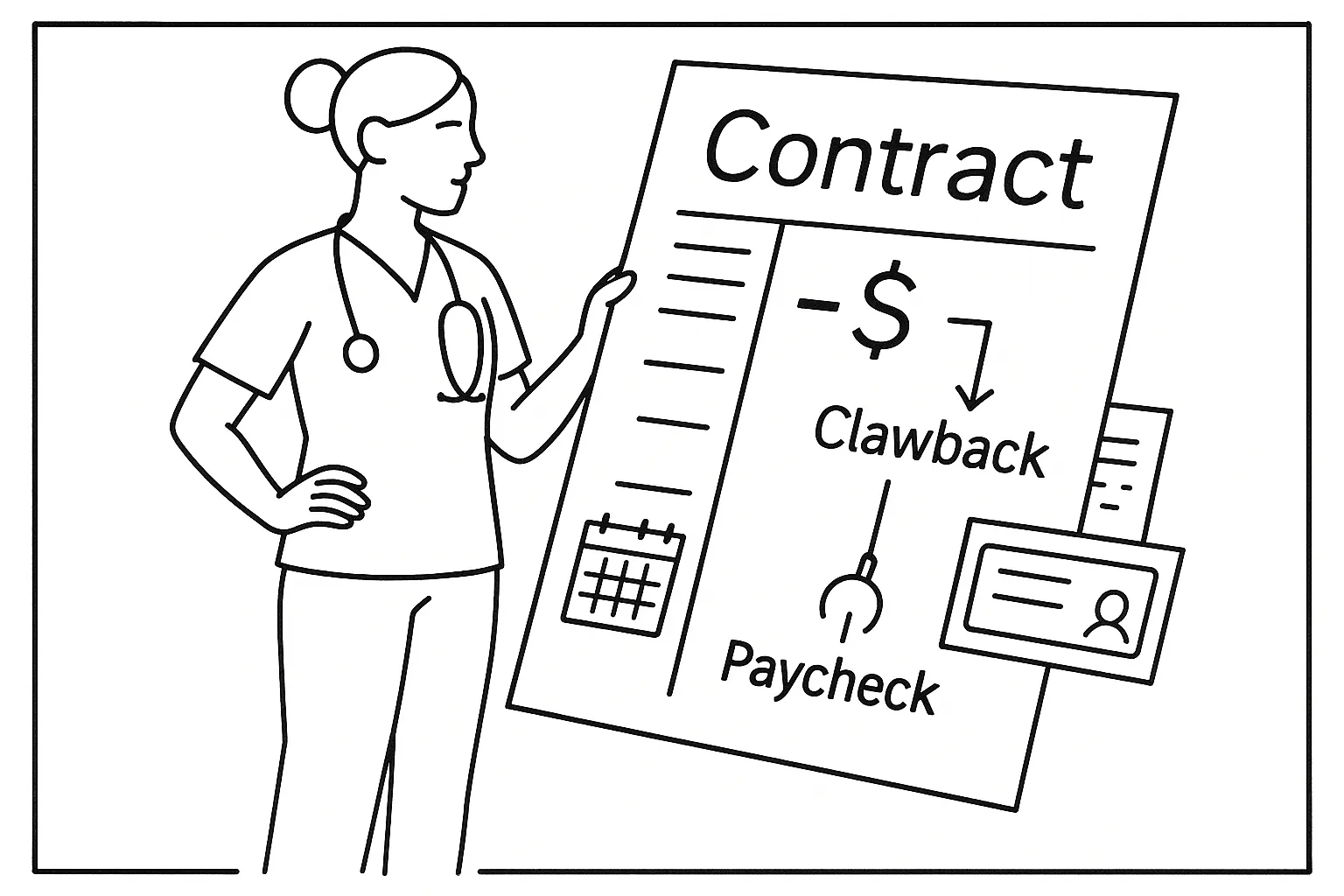
Negative accrual is contract language permitting an employer to record a compensation deficit when the NP’s calculated earnings fall below guaranteed pay, advances, bonuses, or prior payments. Depending on the agreement, that deficit may remain on the employer’s accounting records, reduce later compensation, or become an amount the NP is expected to repay.
- Income risk: Pay presented as a guarantee may function as an advance that becomes recoverable if production or collections do not meet the stated target.
- Cash-flow exposure: An NP may receive compensation in one period and face deductions or repayment demands after a later reconciliation.
- Career-transition risk: A deficit may affect final compensation or create a repayment dispute while the NP is moving to another position.
A negative accrual provision should not be evaluated in isolation. A thorough NP compensation review considers the compensation formula, employer-controlled billing variables, reconciliation process, wage-deduction language, and termination provisions together.
Where Negative Accrual Appears in Compensation Models
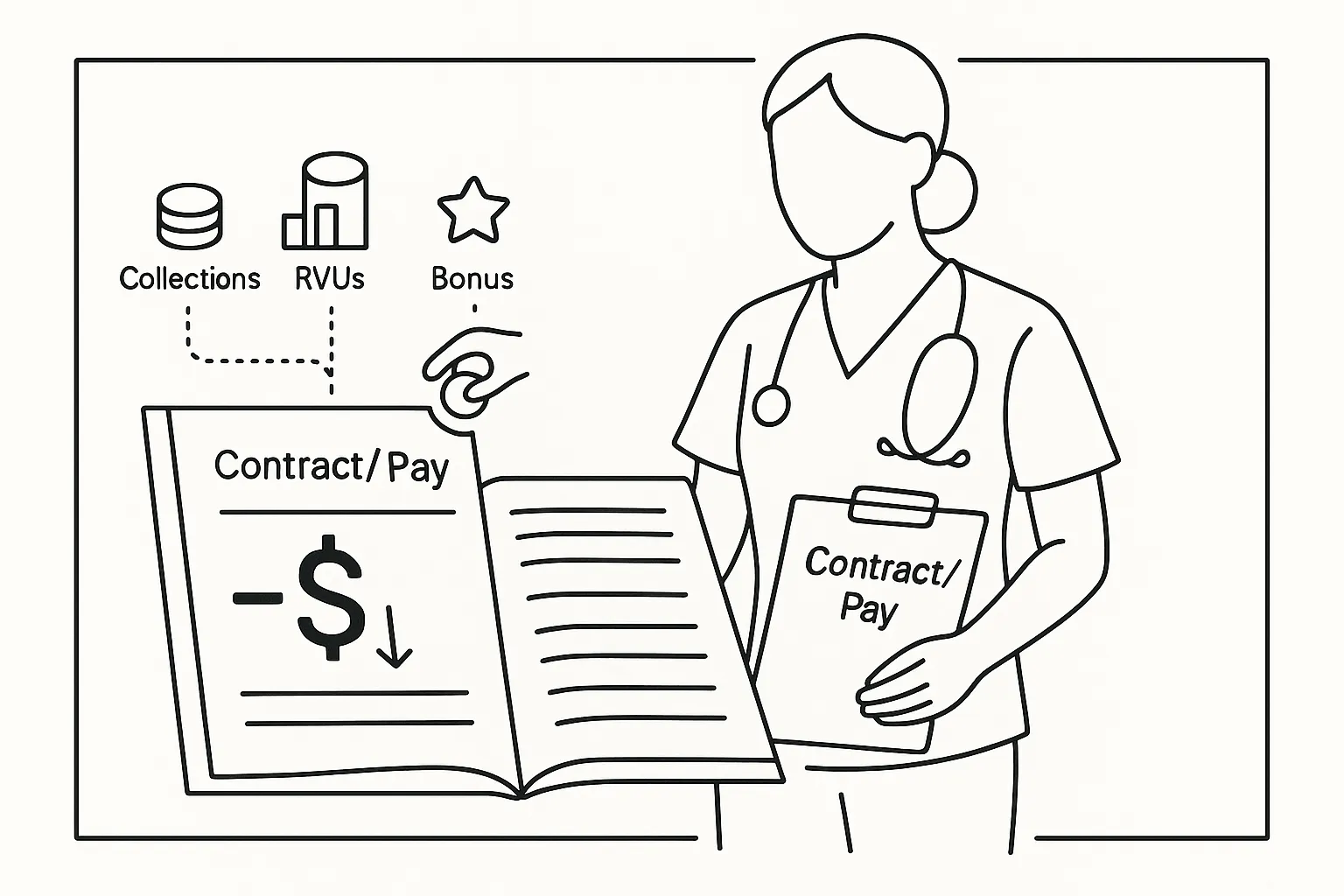
Negative accrual is not limited to one compensation structure. It can appear in collections-based systems, productivity or RVU models, guaranteed-pay arrangements with true-ups, and bonus plans. The practical risk depends on how earnings are calculated and which party controls the inputs.
Collections-Based and RVU Compensation
Under a collections-based model, the employer may pay a percentage of collections attributable to the NP while providing a monthly draw or guarantee. If attributed collections do not support the amount already paid, the reconciliation may create a deficit. Definitions of net collections, payer adjustments, refunds, billing expenses, and attribution rules are therefore critical. NPs considering this structure should understand the broader risks of collections-based compensation.
An RVU or productivity model may set a production threshold that the NP must meet before earning additional compensation. If the contract treats base pay as an advance against expected production, a shortfall can become negative accrual. The conversion factor, threshold, reporting method, and treatment of work that does not generate an RVU should be examined alongside the agreement’s broader RVU compensation terms.
Guarantees, True-Ups, and Bonus Adjustments
Some agreements provide guaranteed compensation during an initial ramp-up period but later compare that pay against actual earnings. A true-up provision may characterize the difference as a balance that carries forward or becomes repayable. The word “guarantee” is therefore not enough; the contract must explain whether the payment is fixed compensation, a draw, or an advance.
Bonus plans can create similar issues when incentives are paid before all productivity, quality, or collection data is final. Payer denials, patient refunds, coding changes, and billing adjustments may retroactively reduce credited results. Reviewing the applicable bonus structure helps reveal whether previously paid incentives can be reversed or charged against future earnings.
Financial Impact and an Illustrative Calculation
Negative accrual clauses create both measurable financial exposure and uncertainty about future pay. Before signing, an NP should model likely and lower-production scenarios using the contract’s actual formula, reconciliation periods, and repayment terms.
Example of a Negative Accrual Balance
Consider an illustrative arrangement in which an NP receives a $7,000 monthly guarantee for six months and the production formula pays 30% of net collections:
- During months one through three, collections are $10,000 per month. Formula-based earnings are $3,000 per month, compared with the $7,000 monthly payment. The difference is $4,000 per month, or $12,000 after three months.
- During months four through six, collections are $15,000 per month, producing $4,500 per month under the formula. Total formula-based earnings for six months are $22,500, while total payments are $42,000.
- The resulting $19,500 difference could be treated as negative accrual if the contract authorizes the employer to carry forward or recover the shortfall.
How that balance is handled depends entirely on the agreement. Possible mechanisms include future offsets, a repayment schedule, an invoice after termination, or a reduction in later incentive compensation.
Cash Flow, Classification, and Tax Questions
Retroactive deductions or repayments can complicate cash-flow and tax planning, particularly when a reconciliation occurs after year-end. The process may also differ between an employee who receives wages and an independent contractor who is invoiced for an alleged deficit. NPs should consider how the agreement’s compensation terms interact with the distinctions between W-2 and 1099 arrangements and should seek tax advice when repayment affects previously reported income.
Legal and Post-Termination Risks
Negative accrual provisions can intersect with contract interpretation, wage laws, payroll authorization requirements, and termination rights. The legal analysis varies by jurisdiction and by whether the NP is classified as an employee or independent contractor.
Payroll Deductions and Repayment Demands
An employer may claim authority to deduct a deficit from later paychecks, but state law may regulate wage deductions or require specific authorization. Contract review should determine whether the provision clearly creates a repayment obligation, whether the employer has unilateral calculation authority, and whether the proposed collection method is consistent with applicable law.
Final Pay and Liability After Employment Ends
Some agreements make an accrued balance immediately due when the NP resigns or is terminated. Others permit the employer to complete a later reconciliation, reduce final compensation, or pursue repayment after employment ends. Because these provisions can materially affect an exit, they should be evaluated with the agreement’s notice, without-cause termination, final-pay, and repayment language. A focused termination provision review can identify how those clauses work together.
Contract Terms That Can Limit Negative Accrual Risk
The most important protections define how the balance is calculated, how long the employer may look back, and what process applies before money can be withheld or demanded. The appropriate revisions depend on the compensation model and applicable law.
Defined Metrics, Reconciliation Periods, and Audit Rights
- Define collections, net collections, RVUs, attribution rules, chargebacks, and allowable deductions.
- Specify when reports must be provided and when reconciliations become final.
- Limit how far back the employer may recalculate compensation.
- Provide access to the records needed to verify the calculation.
- Establish a reasonable period in which the NP may dispute an alleged deficit.
Caps, Carve-Outs, and Repayment Procedures
Potential protections include a cap on total recovery, limits on the percentage that may be withheld from a payment, written notice before collection, and a defined repayment schedule. The parties may also address deficits caused by matters outside the NP’s control, such as delayed credentialing, employer billing errors, inadequate staffing, scheduling limitations, or payer action occurring after termination.
A dispute provision should explain whether collection is paused while the calculation is reviewed and whether interest, collection costs, or attorney fees can be added. It should also restrict unilateral changes to compensation policies that are incorporated into the contract but maintained outside the signed agreement.
Preparing for Attorney Review
Negative accrual language can hide significant risk in an otherwise standard-looking agreement. An attorney-led nurse practitioner contract review can evaluate the provision against the full compensation formula, referenced policies, termination rights, and applicable state law.
Provide counsel with the complete offer and all attachments, including compensation exhibits, bonus plans, productivity formulas, billing policies, and chargeback schedules. If the issue arises during an existing relationship, also gather relevant compensation reports, pay statements, written explanations of the guarantee, and prior reconciliation notices.
- Ambiguous definitions of collections, production, or attributable revenue
- An unlimited reconciliation lookback period
- Unrestricted payroll offsets or immediate repayment demands
- Acceleration of the full balance when employment ends
- No audit rights, supporting reports, or dispute process
- Employer authority to change compensation policies unilaterally
Frequently Asked Questions
Is negative accrual the same as a compensation clawback?
Not always. Negative accrual describes a deficit recorded under the compensation formula, while a clawback is a mechanism used to recover compensation already paid. A contract may use both concepts by recording a negative balance and then authorizing repayment or offsets.
Can an employer deduct a negative balance from an NP’s paycheck?
The answer depends on the contract, the NP’s classification, and applicable state law. Wage-deduction rules may require authorization or limit what an employer can withhold, so the contract language and proposed deduction method should be reviewed by counsel.
Does negative accrual automatically disappear when employment ends?
No. Some contracts forgive the balance, while others accelerate repayment, reduce final compensation, or permit a post-termination reconciliation. The termination and repayment provisions determine whether the alleged deficit survives the employment relationship.
What records should an NP request to verify a negative accrual calculation?
An NP should request the compensation reports, collections or RVU data, attribution records, payer adjustments, chargebacks, and calculations used for the reconciliation. The contract should provide enough access and time to evaluate and dispute the employer’s figures.
Can negative accrual language be negotiated before signing?
It may be possible to negotiate clearer definitions, a limited lookback period, recovery caps, carve-outs, notice requirements, audit rights, and a structured dispute process. Whether an employer accepts a particular revision depends on the circumstances and the overall compensation arrangement.
Why can collections-based pay create a deficit even when the NP is busy?
Collections can be affected by billing delays, payer denials, credentialing, coding, refunds, attribution rules, and employer-controlled collection practices. Patient volume alone may not produce enough credited collections to satisfy a contractual threshold or offset an advance.
Have a Negative Accrual Provision in Your NP Contract?
Chelle Law can review the compensation formula, reconciliation process, repayment language, and termination terms before you sign or respond to a disputed balance.
Contact Chelle Law