
Supervision and collaboration agreements frequently appear alongside nurse practitioner employment and independent contractor contracts. These documents can define clinical authority, physician availability, chart review, prescribing, billing, credentialing, liability, and what happens if the supervising or collaborating physician leaves. Because the practical and legal effect varies by state and practice setting, the agreement should be reviewed together with the NP’s primary contract before signing.
Key Terms to Review Before Signing
- Confirm that delegated duties, prescribing authority, chart review, physician availability, and escalation procedures align with applicable state law and the NP’s actual clinical role.
- Identify who must maintain licenses, payer enrollment, hospital privileges, DEA registration, and other credentials needed for the position.
- Use measurable supervision standards, such as a defined chart-review frequency or physician response time, instead of open-ended employer discretion.
- Clarify malpractice coverage, indemnification, and responsibility for tail insurance if the policy is claims-made.
- Review termination rights, repayment obligations, restrictive covenants, and the consequences of losing a supervising or collaborating physician.
How Supervision Agreements Affect an NP’s Practice
Clinical Authority, Prescribing, and Liability
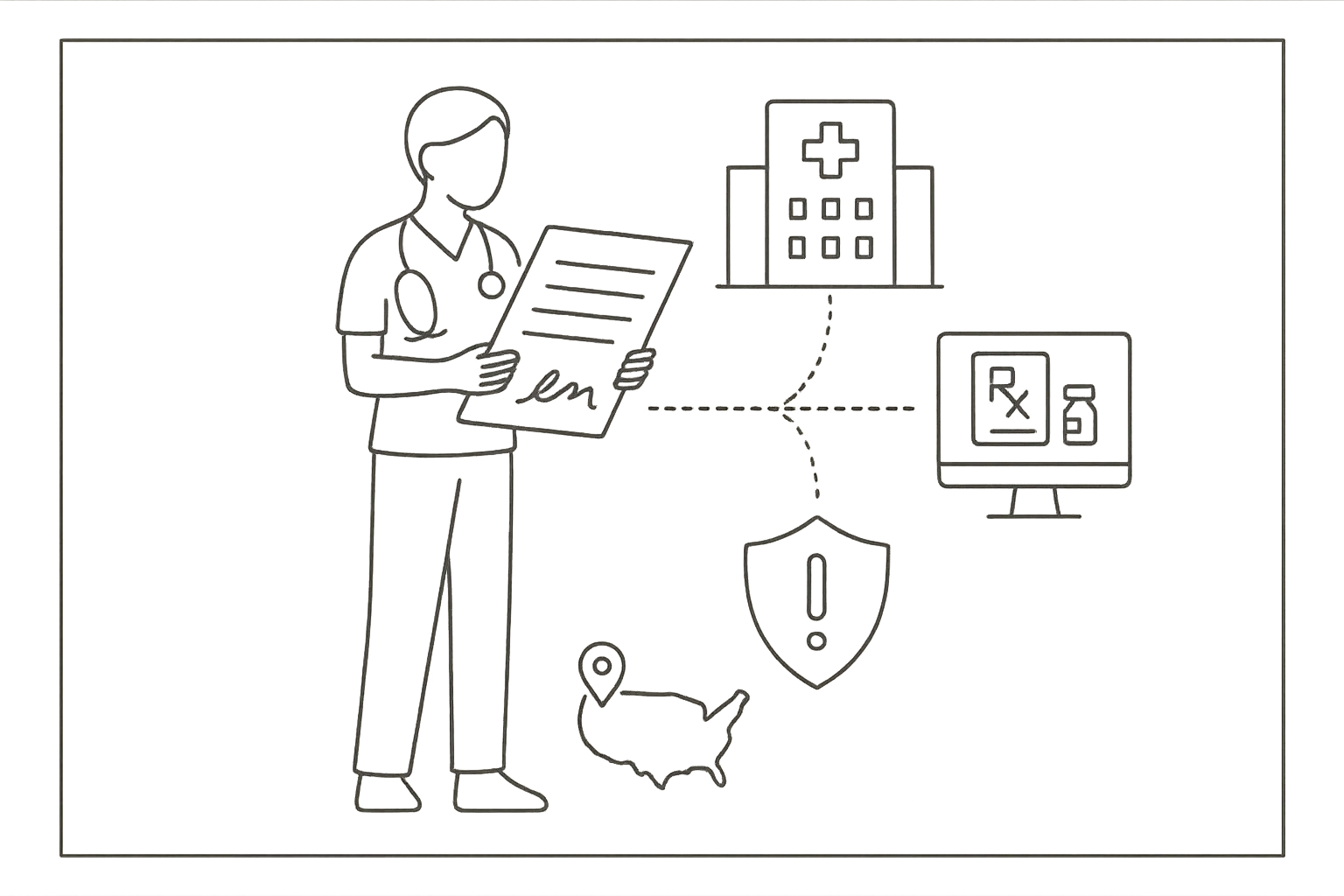
Supervision or collaboration language may determine who can delegate services, review charts, co-sign records, approve procedures, or respond when a clinical issue must be escalated. It may also affect prescribing authority and the handling of controlled substances. Ambiguous requirements can create employment, licensing, or malpractice exposure if the NP’s assigned duties exceed the authority recognized by the agreement or applicable law.
The document should be consistent with the NP’s authorized role and the employer’s written protocols. A broader review of scope-of-practice provisions in NP contracts can also identify duties, patient populations, or procedures that require clarification before employment begins.
Practice Setting, Specialty, and Physician Availability
Hospital-employed acute care NPs may be subject to medical staff bylaws, credentialing committees, and privileging requirements in addition to a written agreement. Outpatient practices may rely more heavily on chart review, scheduled meetings, and documented physician availability. Specialty practices can also impose protocols tied to particular procedures, medications, patient populations, or hospital privileges.
The agreement should explain how the supervising or collaborating physician will be available, who provides backup coverage, and what happens when that physician is absent. If the NP works at multiple facilities, the document should identify the approved sites and whether the same supervision arrangement applies at each location.
State Law and Telehealth Requirements
Independent Practice and Required Collaboration Models
State law determines whether an NP may practice independently or must maintain a supervision or collaboration arrangement. In a state that requires such an arrangement, the contract should accurately reflect the governing requirements without using vague language that unnecessarily expands employer control. Even where state law permits greater independence, hospital bylaws, payer policies, credentialing standards, or an employer’s internal protocols may create additional operational requirements.
The agreement should identify which requirements arise from law and which are private employment conditions. That distinction matters when evaluating whether a term can be changed through negotiation and what could happen if the employer’s policies change during the relationship. NPs can also use Chelle Law’s state contract review guides to locate information relevant to the state where they will practice.
Telehealth and Cross-State Practice
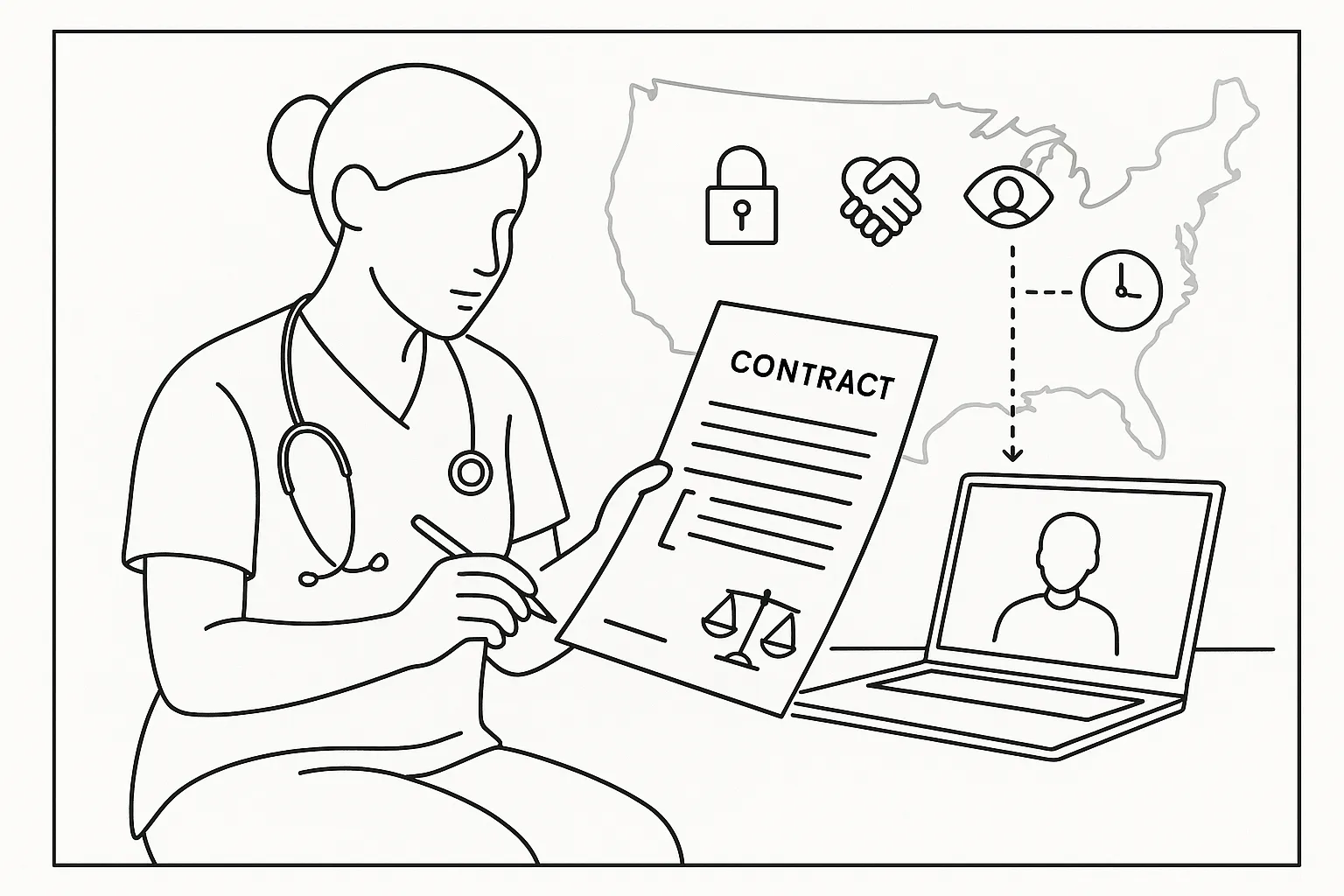
Telehealth can involve patients located in states with different licensure, prescribing, and collaboration requirements. The agreement should not assume that one state’s supervision model automatically authorizes practice elsewhere. It should identify the permitted jurisdictions, responsible supervising physicians, documentation standards, communication platforms, and procedures for obtaining assistance during remote patient care.
Cross-state work may also affect payer enrollment and billing. Before accepting a remote role, the NP should compare the collaboration document with the employer’s telehealth contract terms, including location expectations, equipment responsibilities, scheduling, credentialing, and state-specific compliance obligations.
Core Contract Provisions in a Collaboration Agreement
Defined Duties and Measurable Supervision Standards
The agreement should define clinical duties, delegation limits, documentation requirements, chart-review frequency, required meetings, escalation procedures, and physician response expectations. Language requiring oversight “as the employer deems necessary” gives the employer broad discretion and may create uncertainty about performance standards. A measurable requirement, such as a stated review frequency or response procedure, provides a clearer basis for compliance.
The document should also address schedule coverage, approved practice locations, patient populations, and specialty-specific restrictions. If the physician can change protocols unilaterally, the NP should understand whether those changes could materially increase duties, reduce autonomy, or make performance impracticable.
Credentialing, Billing, and Compensation
Responsibility for hospital privileges, payer enrollment, professional licenses, controlled-substance registrations, and other credentials should be assigned clearly. The agreement should also explain whether services are billed under the NP’s NPI, a physician’s NPI, or a group billing structure and who is responsible for denials, audits, recoupments, and coding support.
These obligations can directly affect income. If a physician’s departure or credentialing delay prevents the NP from working, the contract should state whether salary continues and how productivity is calculated during the interruption. A focused NP compensation and productivity review can evaluate how supervision-related downtime, collections, RVUs, bonuses, and reconciliation provisions interact.
Malpractice Coverage and Liability Allocation
Malpractice provisions should identify the policy type, coverage limits, named insureds, responsibility for premiums, and any exclusions relevant to the NP’s services. An occurrence policy generally covers incidents that occur during the policy period, while a claims-made policy may require tail coverage after the relationship ends. The agreement should state who must obtain and pay for any required tail coverage.
Indemnification provisions also deserve careful review. A broad clause may require the NP to reimburse the employer or physician for losses beyond the NP’s own negligence or misconduct. The collaboration agreement, employment contract, and insurance policy should use compatible language so that one document does not create an uninsured obligation under another. Chelle Law’s malpractice and tail insurance review addresses coverage gaps, post-termination obligations, and one-sided indemnity terms.
Restrictive Covenants and Termination Risks
Noncompete and Nonsolicitation Restrictions
Some agreements include noncompete, nonsolicitation, confidentiality, or practice-location restrictions. Their enforceability depends on applicable law and the specific facts, but an overly broad geographic area, lengthy duration, or expansive definition of patients and referral sources can still create substantial practical risk. These terms may be especially restrictive when the NP’s supervision arrangement is tied to a particular physician, facility, or community.
The NP should determine which events activate the restriction and whether it applies after resignation, termination without cause, expiration, or the loss of a supervising physician. A nurse practitioner noncompete review can assess the covenant together with the agreement’s termination and practice-location provisions.
Physician Departure, Repayment, and Exit Obligations
The documents should explain what happens if the supervising or collaborating physician resigns, loses privileges, becomes unavailable, or no longer qualifies for the role. Relevant terms include who must locate a replacement, whether the NP may continue working, how long the employer has to restore coverage, and whether compensation continues during the interruption.
Termination provisions should also address notice, final compensation, credentialing cooperation, records, malpractice reporting, and repayment of signing bonuses, relocation benefits, or other advances. Reviewing the agreement alongside the contract’s termination and repayment terms helps identify conflicting obligations and financial exposure before separation occurs.
Supervision Agreement Review Checklist
- Does the agreement accurately identify the NP, physician, employer, approved practice sites, and effective term?
- Are clinical duties, prescribing authority, chart review, meetings, availability, and escalation procedures defined objectively?
- Does the document assign responsibility for licenses, DEA registration, payer enrollment, hospital privileges, and renewal costs?
- Are billing methods, coding support, audits, recoupments, and supervision-related work interruptions addressed?
- Do the malpractice, tail coverage, and indemnification provisions align with the insurance policy and primary contract?
- What happens if the supervising physician becomes unavailable or the arrangement ends before the employment contract?
- Do noncompete, nonsolicitation, repayment, and termination provisions create obligations that continue after the collaboration ends?
A review should compare all related documents rather than treating the collaboration agreement as a stand-alone form. Inconsistent terms can leave an NP employed but unable to practice, responsible for costs not stated in the primary contract, or subject to post-termination restrictions that were easy to overlook.
Frequently Asked Questions
What is the difference between NP supervision and collaboration?
The terminology and legal requirements vary by state. Supervision may describe a more direct oversight relationship, while collaboration may refer to consultation, availability, chart review, or jointly established protocols. The agreement and applicable state law determine the actual obligations, regardless of the label used.
Can an employer require more oversight than state law requires?
An employer, hospital, or payer may impose operational requirements beyond the minimum requirements of state law. Whether a particular provision is permissible or enforceable depends on the governing law and contract language. The agreement should distinguish legal requirements from employer policies and explain how policy changes affect the NP’s duties.
What happens if the supervising or collaborating physician leaves?
The answer should be stated in the contracts. Important terms include who must find a replacement, whether the NP can continue treating patients, whether compensation continues during the interruption, and whether either party may terminate if replacement coverage is not obtained within a defined period.
Who should pay fees associated with a collaboration agreement?
There is no universal allocation that applies to every arrangement. The documents should identify who pays physician collaboration fees, credentialing expenses, licensing costs, insurance premiums, and administrative charges. Any deduction from the NP’s compensation should be described clearly rather than left to later employer discretion.
Does one collaboration agreement cover telehealth patients in every state?
Not necessarily. Licensure, prescribing, supervision, and collaboration requirements may depend on the state where the patient is located. A telehealth agreement should identify the states in which the NP may practice and the physician arrangements, credentials, and protocols applicable to each jurisdiction.
Should the collaboration agreement and employment contract be reviewed together?
Yes. The documents may address the same duties, compensation, malpractice coverage, restrictive covenants, and termination events. Reviewing them together helps identify conflicting terms, missing protections, and situations in which the collaboration arrangement could end while the employment contract remains in effect.
Have Your NP Agreement Reviewed Before You Sign
Chelle Law reviews supervision and collaboration terms together with employment or independent contractor agreements so you can understand the effects on authority, compensation, liability, and termination.
Contact Chelle Law