
Independent contractor agreements are common for nurse practitioners working with outpatient clinics, telehealth platforms, urgent care chains, and specialty practices. These arrangements can offer flexibility and higher apparent compensation, but they may also shift tax obligations, benefit costs, insurance responsibilities, and contractual risk to the practitioner. An attorney-led independent contractor agreement review can help an NP understand how the written terms affect income, liability, compliance, and career mobility before signing.
Key Takeaways
- An independent contractor agreement may make the NP responsible for self-employment taxes, benefits, business expenses, and insurance obligations that an employer would otherwise cover.
- The agreement should clearly define compensation, collections, productivity calculations, chargebacks, reconciliation periods, and payment timing.
- Malpractice provisions should identify the policy type, coverage limits, premium responsibility, and who must purchase tail coverage when the relationship ends.
- Supervision, billing, and scope-of-practice provisions should be consistent with applicable state requirements and the intended degree of contractor autonomy.
- Termination rights, restrictive covenants, assignment provisions, and post-termination payment terms can substantially affect an NP after the agreement ends.
When an Independent Contractor Relationship May Make Sense

An independent contractor arrangement may suit an NP who wants schedule flexibility, provides services to multiple organizations, or works in a telehealth or locum tenens model where employer-sponsored benefits are limited. The arrangement is generally a trade-off: greater operational autonomy and potential compensation upside in exchange for assuming costs and responsibilities that would ordinarily fall on an employer.
For example, an NP joining a telehealth company on a 1099 basis may receive a higher per-encounter rate but become responsible for estimated taxes, benefits, and potentially malpractice tail coverage. An NP contracting with a private practice for weekend coverage may value predictable shifts and professional independence, but the written agreement must accurately describe that relationship.
The contract title does not control how the relationship will be treated. Courts, tax authorities, and regulators may look at operational facts such as control over working hours, billing practices, required systems, supplied equipment, exclusivity, and the ability to provide services to other clients.
1099 Contractor Status Compared With W-2 Employment
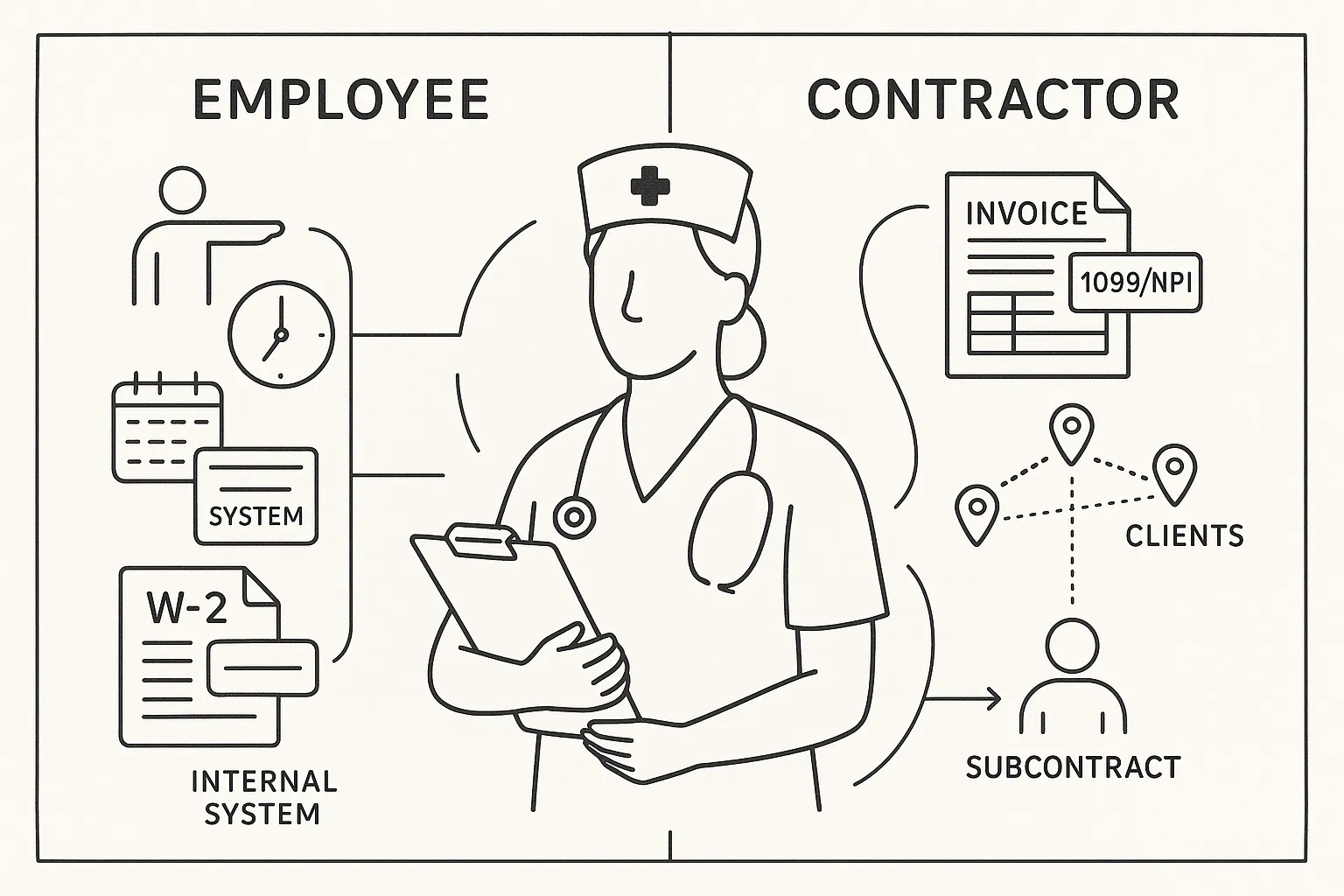
Understanding W-2 versus 1099 status for nurse practitioners is important because classification affects taxes, benefits, workplace protections, and business expenses. Although the applicable legal tests vary, agreements commonly address several practical distinctions:
- Control and autonomy: Employees commonly have employer-directed schedules, workflows, and supervision. A contractor generally retains more control over how services are performed.
- Billing and collections: Employees usually receive wages without assuming collection risk. A contractor may be paid from collections or required to comply with separate billing procedures.
- Taxes and benefits: W-2 employees generally receive payroll withholding and may receive employer-sponsored benefits. A 1099 contractor ordinarily receives gross fees and handles applicable taxes and benefits independently.
- Multiple clients and subcontracting: The ability to serve other clients may support contractor independence, while strict exclusivity and extensive operational control may point in the other direction.
A contract review should identify provisions that conflict with the 1099 label, including mandatory hours, detailed employer-controlled workflows, one-client-only restrictions, or broad authority to direct the manner of clinical work. Potential misclassification can create tax, wage, benefit, and regulatory concerns for the parties.
Compensation, Billing, and Tax Terms
Compensation language should explain not only the stated rate but also how earnings are calculated, adjusted, and paid. A focused NP compensation and productivity review can identify definitions or reconciliation mechanics that materially reduce expected net income.
- Base fee plus productivity: The agreement should define the guaranteed amount, productivity metric, measurement period, payment schedule, and treatment of denied claims.
- Collections-based compensation: The contract should define whether compensation uses gross or net collections and disclose deductions, refunds, chargebacks, and reconciliation rules.
- RVU compensation: The agreement should state the RVU methodology, conversion factor, applicable modifiers, attribution rules, and the NP’s access to supporting reports.
- Bonuses: Bonus provisions should include objective metrics, measurement periods, payout dates, and the effect of termination before the payment date.
Contractors may also be responsible for self-employment taxes, estimated payments, professional expenses, and benefits. Billing language should identify the entity submitting claims, the tax identification number and NPI arrangements being used, responsibility for coding or documentation errors, and whether the NP can audit the data used to calculate payment.
A percentage split can appear favorable until the agreement applies extended reconciliation periods, payer-denial chargebacks, or negative accrual. Clear definitions, reporting rights, and reasonable limits on retroactive adjustments help an NP evaluate the actual economic value of the arrangement.
Scope of Practice, Clinical Autonomy, and Supervision
The agreement should reflect the scope-of-practice and professional requirements applicable where the NP provides care. Provisions addressing physician involvement, chart review, co-signatures, prescribing, protocols, and quality oversight should be reviewed alongside the relevant state rules. If the arrangement requires a separate collaborative document, the contract should be consistent with the applicable supervision or collaboration agreement.
Where supervision or collaboration is required, the documents should identify the responsible parties, expected duties, documentation standards, availability requirements, and responsibility for associated expenses. Vague provisions or unilateral authority to change clinical obligations can increase regulatory and financial risk.
Clinical autonomy language must also be considered alongside contractor classification. An organization may establish legitimate quality and compliance standards, but extensive control over the manner and means of work may be inconsistent with the intended independent relationship. The agreement should distinguish professional standards from day-to-day employer-style control.
Malpractice Coverage, Termination, and Final Payments
Malpractice Insurance and Tail Coverage
Malpractice insurance provisions should specify who obtains and pays for coverage, the required limits, the policy type, and any right to approve the carrier. An occurrence policy generally covers incidents occurring during the policy period regardless of when a covered claim is filed. A claims-made policy generally requires the policy to remain active when the claim is made, which can create a need for tail coverage after termination.
A detailed malpractice and tail insurance review should determine who pays for tail coverage under different termination scenarios. The agreement should also address defense obligations, cooperation requirements, notice of claims, indemnification, and access to proof of coverage.
Termination Rights and Post-Termination Compensation
The contract should clearly define its initial term, renewal procedure, without-cause notice period, and grounds for immediate termination. For-cause provisions should be specific enough for the NP to understand what conduct triggers termination and whether there is an opportunity to cure a correctable breach.
Because compensation may depend on claims collected after services are performed, the agreement should explain whether the NP continues receiving payment after departure, how long reconciliation continues, and whether the practice may retain reserves or offset alleged debts. Reviewing termination and final-payment terms can reveal income, repayment, and insurance obligations that arise when the relationship ends.
Restrictive Covenants, Assignment, and Telehealth Terms
Non-compete and non-solicitation provisions can restrict where an NP works, which patients or referral sources the NP may contact, and what services may be offered after termination. Enforceability depends on the language, facts, and applicable state law. A nurse practitioner non-compete review should consider the restricted activities, duration, geography, triggering events, and any exceptions for existing professional relationships.
Assignment provisions determine whether the organization can transfer the contract to an affiliate, purchaser, or successor without the NP’s consent. A broad assignment right may leave the practitioner working under a new organization or business model while remaining bound by the original agreement. Subcontracting and outside-work clauses should also be consistent with the flexibility expected from an independent contractor relationship.
For telehealth services, the agreement should identify the jurisdictions in which the NP may treat patients, responsibility for maintaining required licenses, approved technology, billing procedures, scheduling expectations, and responsibility for cross-state compliance. The document should also address what happens if a required license, credential, payer enrollment, or platform relationship is delayed or lost.
Contract Red Flags and a Pre-Signing Checklist
Before signing, an NP should identify terms that give the other party broad discretion over compensation, clinical obligations, or termination. Common red flags include undefined compensation terms, uncapped chargebacks, unilateral fee changes, vague supervision requirements, missing insurance details, one-sided indemnification, broad restrictive covenants, and assignment without notice or consent.
- Confirm whether the arrangement is intended to be 1099 or W-2 and evaluate whether the operational terms support that classification.
- Request written definitions for compensation, collections, RVUs, bonuses, deductions, reconciliation, and chargebacks.
- Verify the malpractice policy type, coverage limits, premium responsibility, and tail obligations.
- Compare supervision, collaboration, prescribing, and scope-of-practice terms with applicable state requirements.
- Review non-compete, non-solicitation, confidentiality, exclusivity, and outside-work restrictions.
- Check termination notice, cure rights, repayment triggers, final reconciliation, and post-termination payment provisions.
- Examine assignment, subcontracting, change-of-control, and telehealth provisions.
- Obtain all documents incorporated by reference, including policies, fee schedules, compensation plans, and clinical protocols.
A line-by-line legal review can connect these provisions and explain their combined effect. For example, termination language may determine whether the NP owes tail insurance, forfeits a bonus, remains eligible for collections, or becomes subject to a restrictive covenant.
Frequently Asked Questions
What should a nurse practitioner independent contractor agreement include?
The agreement should define the services, compensation method, billing responsibilities, schedule expectations, professional expenses, insurance obligations, termination rights, confidentiality duties, restrictive covenants, and post-termination payment procedures. It should also identify any policies or fee schedules incorporated into the contract.
Does a 1099 label automatically make an NP an independent contractor?
No. The label and tax form are relevant, but the actual working relationship also matters. Applicable authorities may examine control over scheduling and work methods, exclusivity, financial arrangements, supplied tools, and the NP’s ability to serve other clients.
How should compensation be defined in a contractor agreement?
The contract should state the rate or formula, payment schedule, attribution rules, reporting rights, and treatment of refunds, denials, chargebacks, and reconciliation. Productivity or collections-based compensation should use objective definitions and identify when earnings become final.
Who pays for malpractice and tail insurance in a 1099 arrangement?
The written agreement should allocate those responsibilities. Either party may agree to pay, but the contract should identify the policy type, required limits, premium responsibility, and who purchases tail coverage after each type of termination.
Can an independent contractor agreement contain a non-compete clause?
It can contain a non-compete, although enforceability depends on the agreement, the circumstances, and applicable state law. An NP should review the restricted activities, geographic area, duration, termination triggers, and any patient or existing-business exceptions before signing.
What happens to unpaid collections after the contractor relationship ends?
The answer depends on the contract. The agreement should state whether the NP receives post-termination collections, how long billing and reconciliation continue, when final reports are provided, and whether the organization may withhold reserves or apply offsets.
Get Your NP Independent Contractor Agreement Reviewed
Chelle Law reviews compensation, classification, insurance, termination, and restrictive covenant terms so you can understand the practical risks before signing.
Contact Chelle LawExplore Nurse Practitioner Contract Guidance
Review legal services, practical contract resources, and state-specific information for nurse practitioners.