
Employment and independent contractor agreements shape a nurse practitioner’s compensation, liability, and career mobility. Yet many agreements use employer-favorable language, ambiguous metrics, and hidden financial obligations that materially affect income and practice options. This guide explains common nurse practitioner contract mistakes and why a line-by-line attorney review can protect income, licensure, and long-term career flexibility.
Key Nurse Practitioner Contract Mistakes to Avoid
- Vague compensation metrics and reconciliation clauses can reduce pay months later, so the agreement should define billable encounters, collections credit, productivity calculations, and payment timing.
- Bonus and productivity formulas should include clear definitions and sample calculations to reveal deductions, caps, negative accrual, or repayment obligations.
- Malpractice provisions should identify the policy type and specify who must purchase tail coverage when claims-made coverage ends.
- Non-compete and non-solicitation restrictions should be evaluated for their duration, geographic scope, restricted activities, and practical effect on future employment.
- Termination, signing bonus, relocation, and loan repayment provisions should be reviewed together because separation may trigger several financial obligations at once.
- The complete contract, offer letter, bonus plan, job description, and relevant written promises should be reviewed before signing.
Why Nurse Practitioner Contract Review Matters

Nurse practitioner contracts are rarely neutral. Employers and staffing companies often use standardized agreements that allocate financial risk, compliance obligations, and post-employment restrictions to the clinician. What looks like a simple guarantee or bonus may contain reconciliation language, negative accrual, or chargebacks that reduce take-home pay later. Ambiguous supervision, scope-of-practice, and indemnification terms can also create employment, regulatory, or licensure risk.
A thorough nurse practitioner contract review identifies income exposure, insurance gaps, mobility restrictions, and compliance concerns that clinical training may not prepare an NP to evaluate. The goal is to explain how each clause operates in practice, estimate its likely effect where possible, and recommend protective revisions before the agreement is signed.
Compensation, Bonuses, and Payment Pitfalls
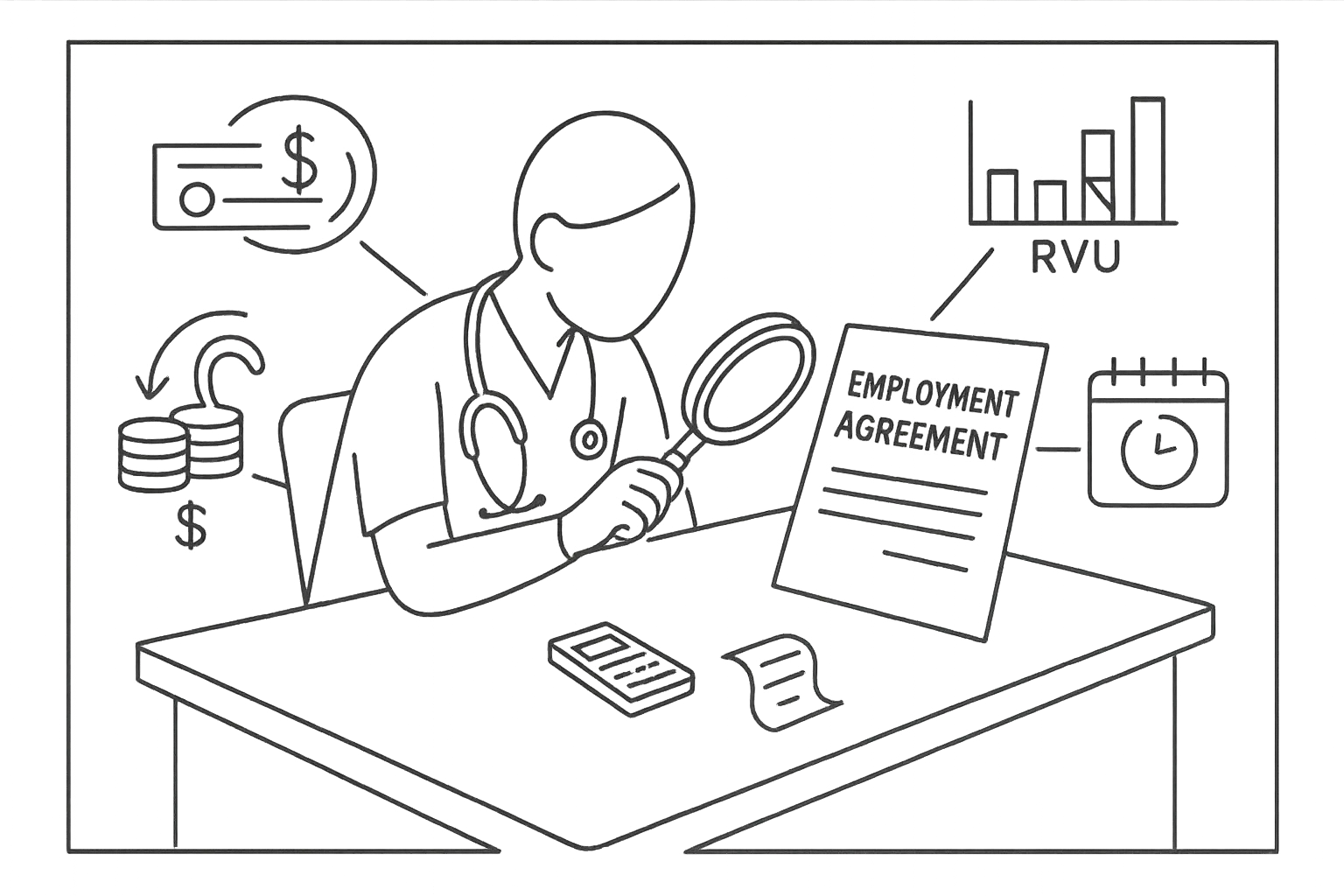
Compensation provisions are among the most consequential and frequently misunderstood parts of an NP agreement. Problems commonly arise from imprecise definitions, delayed reconciliations, and formulas that give the employer substantial control over how productivity is measured.
Undefined Salary and Productivity Metrics
An agreement may promise a base salary while tying final compensation to productivity, collections, or minimum encounter volumes without defining the relevant terms. Common ambiguities include what qualifies as a billable encounter, who bears responsibility for denied claims, how shared encounters are credited, and whether administrative duties count toward performance expectations. Without precise definitions, the employer may interpret the metrics in a way that reduces reported productivity or deferred pay.
Bonus and Productivity Formula Errors
Bonus plans may reference a percentage of collections, an RVU threshold, or another formula without providing a sample calculation. Even when the headline formula appears favorable, expense deductions, billing lag, payer mix, excluded encounters, caps, and employer-controlled reporting can materially change the result. Comparing the agreement against common nurse practitioner compensation models can help reveal questions that should be resolved in writing.
For example, an RVU model may state a conversion amount per RVU but exclude certain encounter types or rely solely on employer-reported counts. A collections formula may credit revenue only after the employer receives payment, leaving the NP exposed to billing delays and collection practices outside the clinician’s control.
Collections, Negative Accrual, and Clawbacks
Collections-based pay should identify which collections are credited to the NP, when incentive compensation is paid, and how refunds, reversed payments, write-offs, and chargebacks are handled. Negative accrual or reconciliation language may allow an employer to offset future compensation or seek repayment of an earlier bonus when later collections fall short.
The agreement should also address monthly or quarterly payment timing, look-back periods, expense deductions, and what happens to outstanding collections after termination. These mechanics affect cash flow and may leave an NP waiting for compensation or owing money after employment ends.
Malpractice, Indemnification, and Scope-of-Practice Risks
Malpractice insurance and indemnification clauses determine who bears professional liability risk during and after employment. The contract should identify the policy type, applicable limits, whether the NP is an insured, whether defense costs reduce the limits, and who is responsible for coverage after separation.
Claims-Made Coverage and Tail Insurance
Occurrence policies generally cover acts occurring during the policy period regardless of when a claim is made. Claims-made policies generally require the policy to remain active when the claim is reported, which means extended reporting or tail coverage may be needed after employment ends. An agreement may provide claims-made coverage during employment while assigning the tail premium to the NP at separation.
Because the cost and need for tail coverage depend on the policy and circumstances, the contract should state who purchases it, when proof must be provided, and whether responsibility changes based on the reason for termination. A focused malpractice and tail insurance review can identify coverage gaps and unclear cost allocation before they become post-employment disputes.
Indemnification, Supervision, and Collaboration
Indemnification language requiring an NP to protect or reimburse the employer deserves careful scrutiny, especially when it extends beyond the NP’s own conduct. Supervision and collaboration terms must also align with the applicable scope-of-practice rules and accurately describe each party’s responsibilities. Ambiguous provisions can assign the NP responsibility for decisions or administrative failures outside the clinician’s control.
The practical requirements may vary by state and practice setting. Reviewing the proposed supervision or collaboration agreement alongside the employment contract helps identify conflicting duties, unsupported delegation, and responsibility for maintaining the required professional relationship.
Restrictive Covenants and Termination Consequences
Post-employment restrictions and termination provisions should be read together. A short notice period, broad non-compete, patient non-solicitation clause, and repayment obligation can combine to make leaving a position significantly more difficult and expensive than any single provision suggests.
Non-Compete and Non-Solicitation Restrictions
A non-compete should be evaluated for its duration, geographic scope, restricted activities, covered locations, and effect on realistic job opportunities. Enforceability varies by state and the facts involved, but even a disputed provision can affect an NP’s willingness or ability to accept another position. The same review should address non-solicitation, confidentiality, and patient relationship language because those clauses can extend the restriction beyond the formal non-compete.
Patient lists, electronic records, telehealth platforms, prescribing accounts, and other practice data may also be addressed as employer property. Understanding how NP non-compete clauses work is only one part of evaluating whether the complete set of restrictions will limit future in-person or remote practice.
For-Cause and Without-Cause Termination
Contracts often distinguish termination for cause, termination without cause, and resignation. The definition of cause may include licensing, credentialing, policy, conduct, or performance events, sometimes without a meaningful opportunity to cure an alleged breach. Without-cause notice periods determine how quickly either party may end the relationship and whether compensation and benefits continue through the notice period.
A careful review should determine whether the employer can remove the NP from the schedule during notice, stop incentive eligibility, or accelerate the final compensation reconciliation. Additional guidance on terminating a nurse practitioner contract can help place notice, cure, and post-termination obligations in context.
Signing Bonus, Relocation, and Loan Repayment
Repayment provisions frequently attach to signing bonuses, relocation assistance, educational benefits, and loan repayment. The agreement should specify which events trigger repayment, whether the amount is reduced over time, when it becomes due, and whether the employer may deduct it from final compensation. Broad language may require repayment after resignation or termination even when the employer ends the relationship without cause.
Severance provisions, when offered, may soften an income interruption but often require a release of claims. The contract should clarify whether severance affects restrictive covenants, repayment duties, malpractice obligations, outstanding collections, and access to records needed to complete documentation or respond to later professional matters.
Scheduling, Credentialing, and Administrative Traps
Operational language determines how the job functions from day to day. Vague phrases such as “clinical duties as assigned” can permit the employer to expand responsibilities without additional compensation. Schedule, call, weekend, holiday, floating, location, administrative time, and remote-work expectations should be sufficiently clear to evaluate the actual workload.
Credentialing delays can affect the start date and pay commencement. The agreement should address who manages and pays for credentialing and licensing, whether compensation begins before billing approval, and what happens if the process is delayed. Otherwise, an NP may be available to work but unable to bill or receive the expected compensation.
Recordkeeping, EMR access, documentation standards, and responsibility for correcting records should also be addressed. Telehealth workflows require particular attention to platform access, patient messaging, cross-location expectations, and productivity metrics tied to systems the NP does not control.
How to Protect Yourself Before Signing
Contract review is a protective rather than adversarial step. The objective is to identify risk, clarify expectations, and estimate the likely income or mobility effect so the NP can make a well-informed decision. Important warning signs include undefined productivity formulas, employer-only control over collections or RVU reporting, claims-made coverage with unclear tail responsibility, broad post-employment restrictions, repayment obligations, and supervision language that does not match the proposed role.
Requested revisions should be documented in writing, with copies of redlines, emails, offer letters, and plan documents retained. Negotiations are often most effective when they focus on precise definitions, objective calculations, payment timelines, reasonable notice, and allocation of financial responsibility rather than relying on oral assurances.
Before the review, collect the complete agreement, compensation or bonus plan, job description, handbook provisions incorporated by reference, and written communications about promised terms. The attorney should also know the intended practice locations, licensure status, and whether the role is structured as employment or independent contracting. A complete record allows the reviewer to translate the language into measurable financial, professional, and mobility risks.
Frequently Asked Questions
What are the most common mistakes in a nurse practitioner contract?
Common mistakes include accepting undefined compensation metrics, overlooking bonus reconciliation or repayment terms, failing to identify tail insurance responsibility, agreeing to broad restrictive covenants, and not reviewing termination provisions together with their financial consequences.
How should an NP evaluate a productivity compensation formula?
The formula should define the measurement method, threshold, conversion rate, credited encounters or collections, exclusions, payment schedule, reporting source, expense deductions, and reconciliation process. A sample calculation can help reveal how the formula will operate in practice.
Who pays for tail insurance when an NP leaves a job?
Responsibility depends on the malpractice policy and the contract. If the employer uses claims-made coverage, the agreement should clearly state whether the employer or NP must purchase tail coverage and whether responsibility changes based on the reason employment ends.
Should a nurse practitioner sign a contract with a non-compete?
An NP should first evaluate the restriction’s duration, geography, prohibited activities, covered locations, state law, and practical effect on future employment. Related non-solicitation, confidentiality, and patient restrictions should be reviewed at the same time.
What termination terms should an NP review before signing?
Important terms include the definitions of cause, any cure period, without-cause notice, scheduling and pay during notice, final bonus calculations, repayment triggers, malpractice obligations, restrictive covenants, and access to records after separation.
When should a nurse practitioner ask an attorney to review a contract?
The review should occur before the agreement is signed or the NP relies on oral promises. The attorney should receive the complete contract, offer letter, compensation plan, job description, incorporated policies, and written communications concerning important terms.
Have Your Nurse Practitioner Contract Reviewed Before You Sign
Chelle Law can identify compensation, insurance, termination, repayment, and restrictive covenant risks and explain how the proposed terms may affect your practice.
Contact Chelle LawExplore Nurse Practitioner Contract Guidance
Review legal services, practical contract resources, and state-specific information for nurse practitioners.