
When a nurse practitioner accepts a position in Delaware—whether practicing in Wilmington, Dover, Newark, or elsewhere in the state—the employment or independent contractor agreement controls important issues involving compensation, professional responsibilities, malpractice coverage, and post-employment restrictions. These agreements operate within the framework of Delaware law, including oversight by the Delaware Board of Nursing and provisions in Title 24 of the Delaware Code governing advanced practice registered nurses.
Even subtle drafting differences can materially affect productivity compensation, bonus eligibility, restrictive covenants, and termination rights. A Delaware nurse practitioner contract review examines collections formulas, negative accrual provisions, tail insurance responsibility, notice periods, and post-employment limitations with attention to how the language may operate in practice.
At Chelle Law, we provide an attorney-led assessment of the financial, legal, and professional risks in an agreement. We analyze each provision to identify terms that may affect income stability, licensure protection, and long-term career mobility. Learn more about our nurse practitioner contract review services.
Delaware NP Contract Review: Key Takeaways
- Compensation formulas, clawbacks, and retroactive reconciliations can materially reduce take-home pay.
- Malpractice coverage and tail insurance obligations should be clearly allocated to avoid unexpected post-employment costs.
- Non-compete, non-solicitation, and successor clauses can restrict future practice opportunities if their scope is too broad.
- Responsibility for controlled substance registration, credentialing, and required practice documentation should be expressly stated.
- Clear severance terms, audit rights, repayment triggers, and definitions of cause can reduce employer discretion and uncertainty.
Why Delaware Nurse Practitioners Need Focused Contract Review

Employment agreements can appear routine while shaping a nurse practitioner’s earnings and professional options for years. Base pay, productivity models, RVU or collections-based metrics, reconciliation provisions, negative accrual, and clawbacks may all change actual annual compensation. A focused nurse practitioner compensation and productivity review explains the contract math and identifies provisions that could shift ordinary business risk to the nurse practitioner.
The agreement can also create liability and career-mobility concerns. Ambiguous indemnification language or gaps in malpractice coverage may expose an NP to personal expense, while restrictive covenants, patient-related restrictions, and successor provisions may limit realistic employment options after departure. Attorney review converts these provisions into practical information about financial exposure, compliance responsibilities, and potential negotiation priorities.
Delaware Licensing, Scope of Practice, and Credentialing
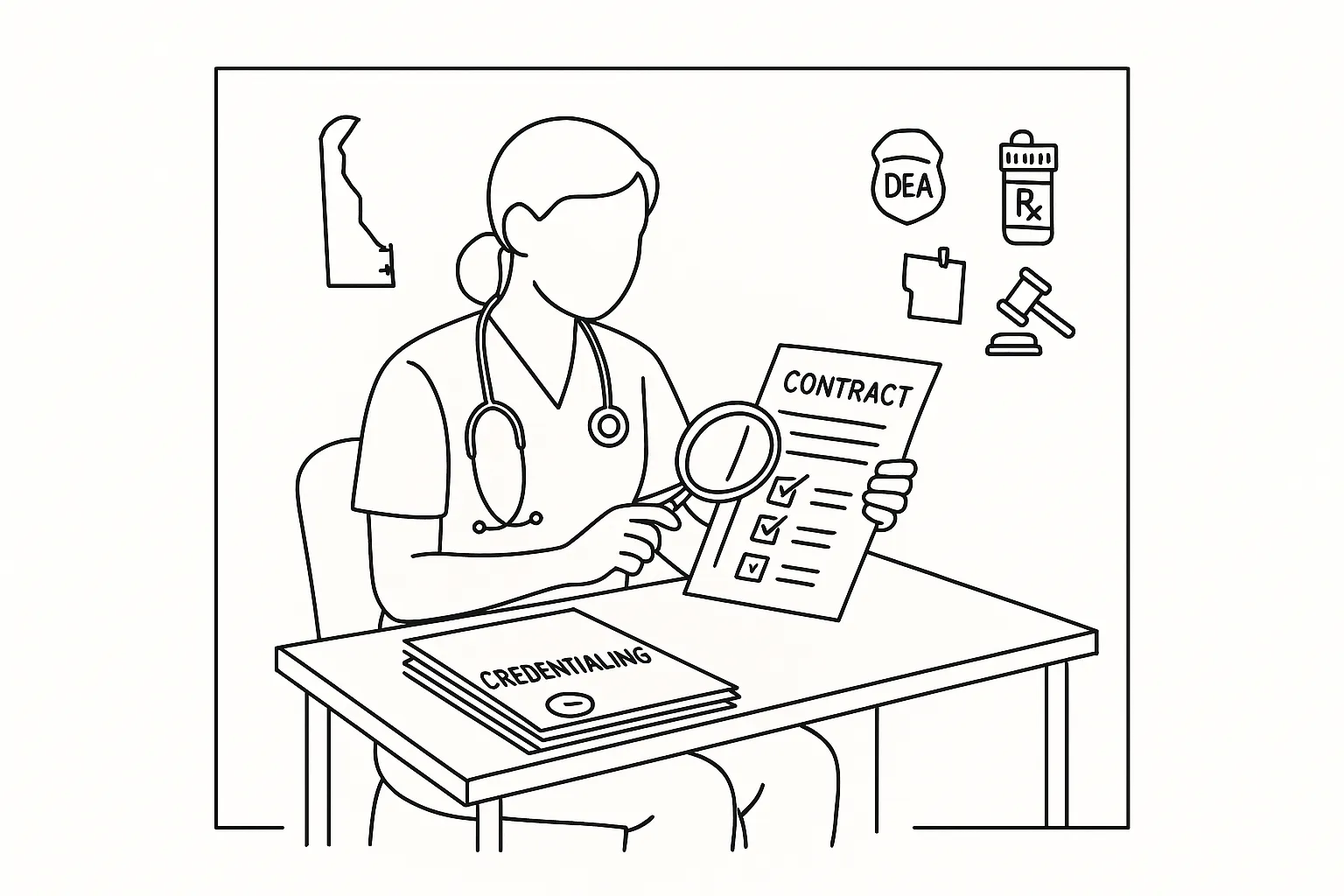
Delaware law governs an NP’s scope of practice and any applicable collaborative or supervisory framework. The agreement’s description of clinical duties should be consistent with licensure requirements and should not require the nurse practitioner to perform services outside authorized practice. The contract should also identify who is responsible for required documentation, delegation arrangements, and employer-dependent steps affecting prescriptive authority. A focused supervision and collaboration agreement review can identify provisions that do not clearly allocate these responsibilities.
The agreement should state who pays for and maintains applicable DEA and state controlled substance registrations, professional credentials, and facility privileges. Credentialing delays can interrupt the ability to work or earn productivity compensation, so deadlines and the consequences of employer-caused delays should be clear. We also examine whether administrative burdens or costs are shifted to the NP without corresponding control over the process.
Compensation, Benefits, and Work Responsibilities
Salary, Productivity, and Bonus Formulas
A contract should distinguish guaranteed salary or stipend payments from compensation tied to productivity. We review the duration of any guarantee and provisions permitting retroactive reconciliation or adjustment. For RVU, collections-based, and bonus models, relevant details include which services count, applicable thresholds, payer-mix adjustments, collection lag, payment periods, administrative deductions, and the employer’s ability to change the formula. Our guide to nurse practitioner compensation models explains how common payment structures operate.
Audit rights, withholding authority, and negative accrual provisions are particularly important. Language allowing an employer to recoup bonuses or advance payments from future earnings can materially affect compensation certainty. The agreement should provide enough information for the NP to verify how compensation was calculated and challenge an error.
Benefits, Scheduling, and Employment Classification
Benefits provisions should address eligibility, employer contributions, vesting, PTO accrual, continuing medical education allowances, and retirement benefits. Signing bonuses, relocation assistance, and student loan support may include repayment obligations tied to employment length, resignation, or the reason for termination. Reviewing the triggers and repayment schedule before signing helps quantify the financial risk of an early departure.
Operational terms may govern scheduling, call responsibilities, work locations, performance metrics, quality review, onboarding, and corrective action. Telehealth provisions can add technology, recordkeeping, credentialing, and interstate practice obligations. When work across state lines is contemplated, the agreement should clearly allocate responsibility for obtaining and maintaining the necessary licenses and credentials.
We also evaluate whether the agreement describes the relationship as employment or independent contracting and whether the operational terms are consistent with that classification. Control over scheduling, billing, benefits, expenses, and tax reporting can have significant practical consequences, regardless of the label used in the contract. A nurse practitioner independent contractor agreement review can help clarify these obligations and risks.
Non-Competes, Malpractice Coverage, and Liability
Non-Compete and Post-Employment Restrictions
Non-compete and non-solicitation provisions may restrict where an NP can work, which patients or referral sources may be contacted, and how long the restrictions remain in effect. Geographic reach, duration, covered services, and the events that trigger a restriction should be carefully reviewed. Broad confidentiality or proprietary-information definitions may also interfere with future practice if they extend beyond the employer’s legitimate confidential information. A dedicated nurse practitioner non-compete review evaluates the practical effect of these restrictions.
Assignment, practice-sale, and successor clauses can transfer obligations to a buyer or require the NP to participate in a transition. These provisions deserve attention because a change in ownership may alter compensation, working conditions, or the practical effect of an existing restrictive covenant.
Malpractice Insurance, Tail Coverage, and Indemnification
Occurrence coverage generally protects against covered incidents occurring during the policy period regardless of when the claim is made. Claims-made coverage ordinarily requires the policy or appropriate tail coverage to remain in place when a claim is reported. The contract should identify the policy type, coverage limits, who pays the premium, and who is responsible for tail insurance after termination. Our malpractice and tail insurance review focuses on these coverage and payment obligations.
Indemnification and duty-to-defend clauses may require the nurse practitioner to cover losses or defense costs arising from specified conduct. We review the scope of those obligations, available liability limits, third-party claims, and carve-outs for intentional misconduct. Ambiguous language can leave an NP exposed to costs that are not covered by the employer or malpractice carrier.
Termination Rights, Disputes, and Contract Red Flags
Termination provisions should distinguish termination for cause from termination without cause and state the notice required from each party. Vague cause definitions can permit immediate termination based on broad employer discretion. The agreement should also address cure opportunities, severance, earned bonuses, unused leave, outstanding collections, and the treatment of compensation after the last day worked. A nurse practitioner contract termination review can help identify unclear notice, payment, and post-employment obligations.
Arbitration, venue, and choice-of-law provisions determine where and how contract disputes will be resolved. Forum selection, fee allocation, limits on available remedies, and class-action waivers can affect enforcement costs and leverage. These terms should be considered alongside the practical expense of pursuing unpaid compensation or defending against an alleged breach.
Common warning signs include undefined or overly broad cause provisions, missing malpractice details, unclear tail obligations, unrestricted clawbacks, one-sided audit rights, and restrictive covenants without meaningful geographic or time limits. Other negotiation priorities may include defined severance after termination without cause, limits on repayment obligations, and a reliable method for verifying productivity compensation.
What a Delaware NP Contract Review Includes
A thorough review examines compensation mechanics, restrictive covenants, insurance, termination, indemnification, dispute resolution, and operational responsibilities. Chelle Law provides attorney-led review intended to explain how the agreement may affect income, compliance obligations, liability exposure, and future employment options.
Deliverables may include written comments, highlighted or redlined contract language, and a consultation addressing the provisions that merit clarification or revision. Rather than relying on generic negotiation tactics, the review identifies priorities such as ambiguous cause definitions, clawback mechanics, tail insurance responsibility, and overly broad post-employment restrictions. Contracts should be submitted as early as possible before signing so there is time to understand the terms and discuss appropriate changes with the employer.
Get Help Reviewing Your Delaware NP Contract
Before signing a new agreement or renewal, have Chelle Law identify the provisions that may affect your compensation, liability, and ability to pursue future opportunities in Delaware.
Contact Chelle Law