
When a nurse practitioner accepts a position in Florida—whether practicing in Miami, Orlando, Tampa, Jacksonville, Tallahassee, or another healthcare market—the employment or independent contractor agreement governs compensation, scope of practice, malpractice allocation, termination rights, and post-employment restrictions. These provisions must be considered alongside Florida law, oversight by the Florida Board of Nursing, and applicable authority under Chapter 464 of the Florida Statutes.
A Florida nurse practitioner contract review helps clarify how employer-drafted terms affect earnings, regulatory responsibilities, and career mobility. Even subtle drafting differences can change productivity compensation, tail insurance obligations, restrictive covenant exposure, or the consequences of leaving a position. Chelle Law conducts an attorney-led, line-by-line assessment of these issues before an NP signs or renegotiates an agreement.
Key Contract Review Takeaways for Florida NPs
- Require clear definitions for base salary, collections, RVUs, bonuses, and negative accrual calculations.
- Confirm the malpractice policy type, coverage limits, named insured, and responsibility for tail coverage.
- Compare supervision, collaboration, prescribing, and scope-of-practice language with applicable Florida requirements.
- Review non-compete, non-solicitation, and confidentiality provisions for their practical effect on future employment.
- Identify notice requirements, termination rights, severance terms, and repayment obligations before signing.
- Retain the final agreement and every policy, compensation plan, or benefit document incorporated by reference.
Why Florida Nurse Practitioner Contracts Require Focused Review
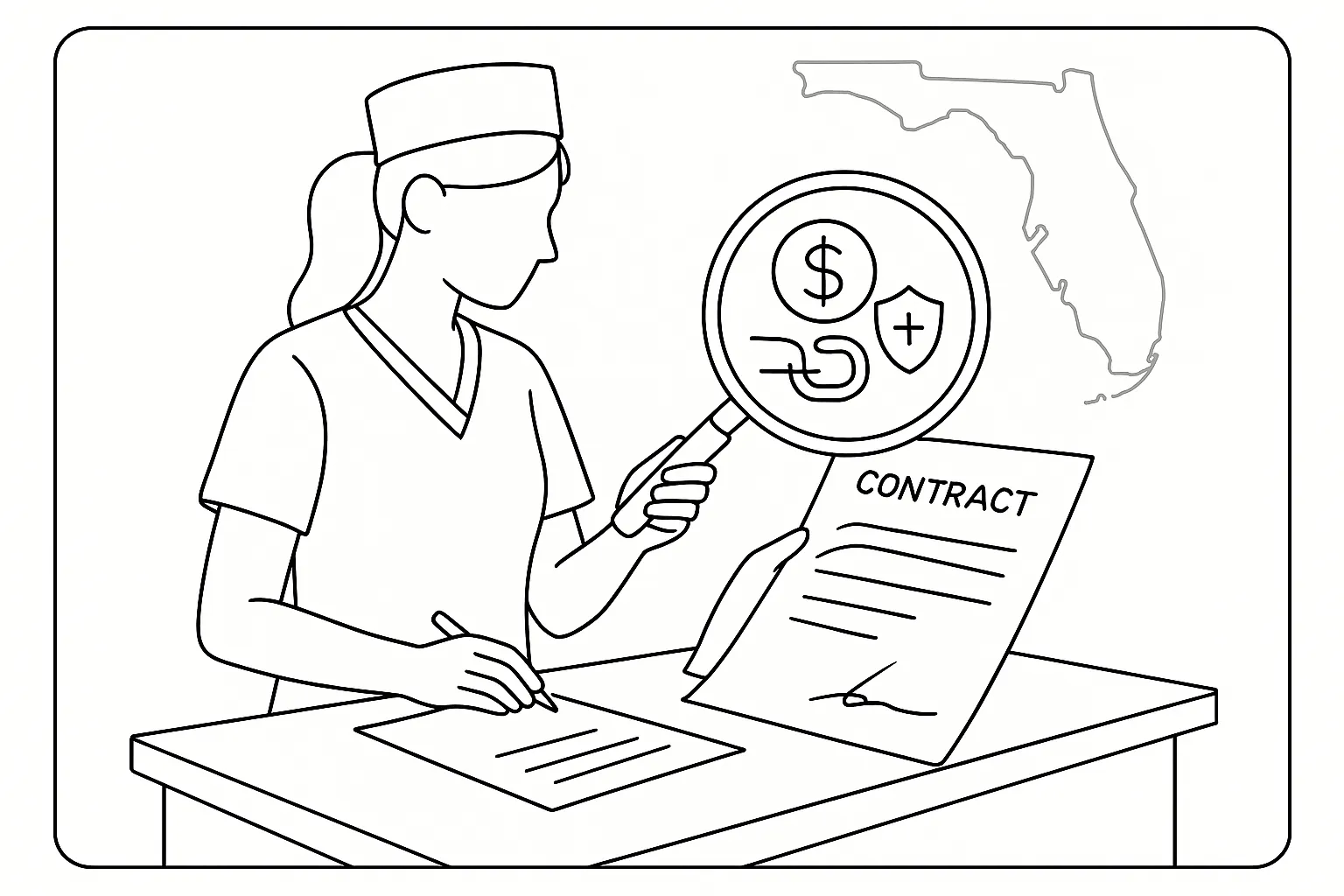
Florida’s regulatory framework and healthcare market create contract risks that may not be apparent from a compensation summary or offer letter. Scope-of-practice provisions, supervisory or collaborative terms, prescribing responsibilities, and employer protocols can affect how an NP performs daily clinical duties. A review should identify language that imposes responsibilities beyond applicable requirements, gives the employer broad authority to change protocols, or shifts regulatory and civil exposure to the NP.
Florida contracts also frequently address restrictive covenants under Section 542.335 of the Florida Statutes. Because a restriction’s practical effect depends on its duration, geography, covered activities, stated business interest, and the circumstances of termination, the written language matters. A focused review translates these provisions into their likely effect on income, licensure responsibilities, and future practice options.
Compensation, Productivity, and Benefits
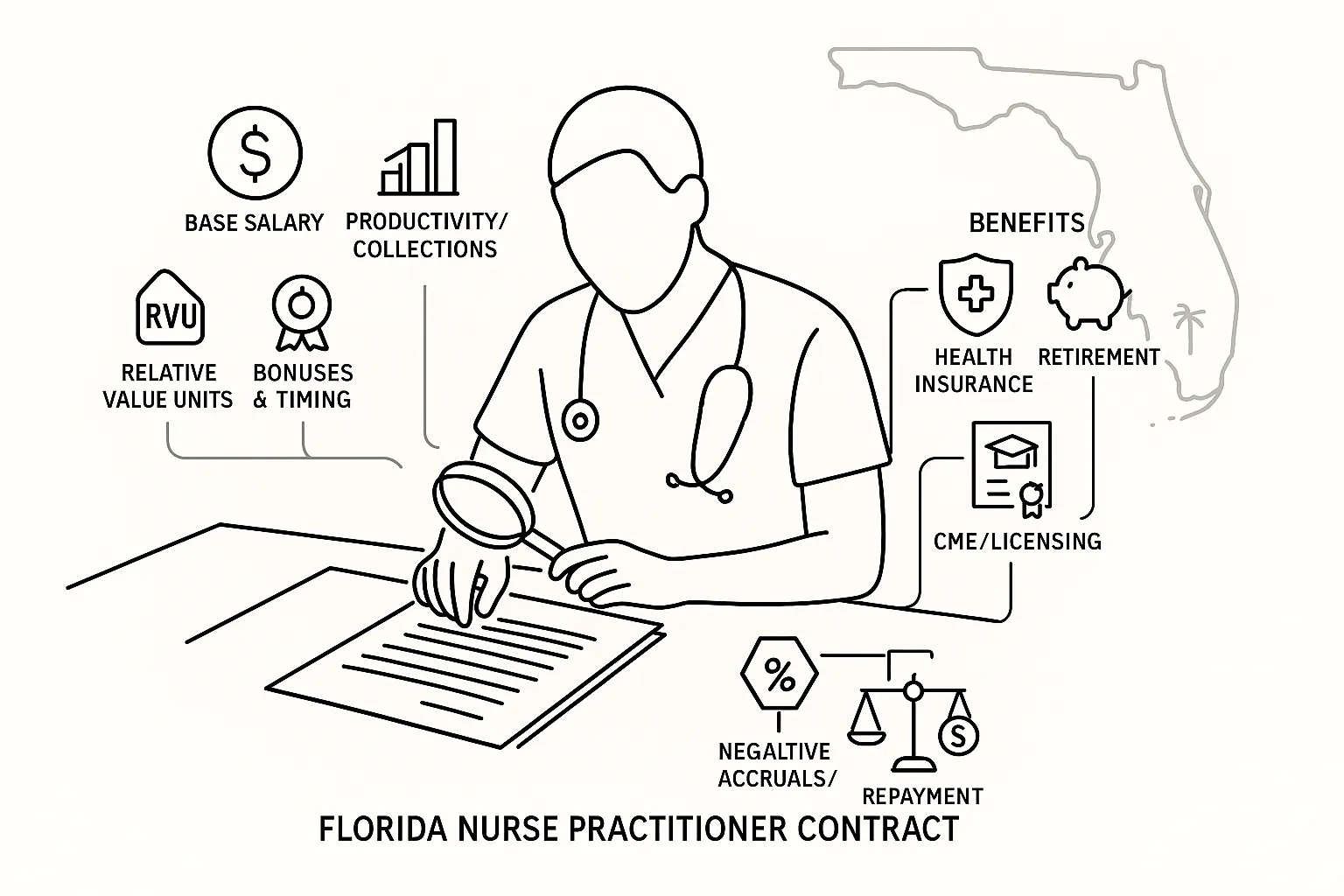
NP compensation commonly includes a guaranteed base salary, base pay plus productivity, collections-based compensation, or an RVU formula. A base salary should state whether it is guaranteed, whether it continues during a notice period or leave, and whether it can later be reconciled against production. When an agreement includes more complex calculations, a dedicated NP compensation and productivity review can help evaluate the formula and its financial consequences.
Collections provisions should define whether compensation is based on billed charges, allowed amounts, or cash actually received. The contract should also explain the treatment of denials, write-offs, refunds, delayed payments, and collections received after termination. Because collections-based pay transfers some billing and payer risk to the clinician, an NP can remain clinically productive while receiving less compensation due to factors outside the NP’s control.
RVU models depend on accurate coding, an identifiable conversion factor, and an auditable RVU schedule. The agreement should explain who controls coding, how work RVUs are verified, and whether overhead or facility expenses reduce compensation. Bonus provisions likewise need objective metrics, payment dates, access to supporting data, and clear rules for bonuses earned before employment ends.
Negative accrual and repayment language deserves particular attention. A reconciliation provision can turn a production shortfall or salary advance into debt, sometimes with offsets, interest, or collection costs. Benefits such as health insurance, retirement contributions, CME funds, licensing and DEA fee coverage, paid leave, relocation assistance, and loan benefits should also appear in the agreement or an identifiable incorporated policy rather than remain verbal promises.
Florida Scope of Practice, Supervision, and Collaboration Terms
The Florida Board of Nursing and applicable state law provide the regulatory context for nurse practitioner licensure and practice. Contract language may address scope of practice, prescribing, delegation, supervision, collaboration, protocols, credentialing, and billing authority. These terms should be evaluated against the NP’s role and the applicable Florida requirements rather than accepted as routine employment language.
Important questions include whether the employer can unilaterally narrow the NP’s duties, change a supervising or collaborating physician, revise clinical protocols, or impose indemnity obligations tied to another clinician’s directions. Vague requirements to satisfy an undefined “practice standard” can also give the employer broad discretion over performance and termination. A supervision and collaboration agreement review can identify provisions that do not clearly allocate clinical and regulatory responsibilities.
Malpractice Insurance and Tail Coverage
Malpractice provisions should identify whether coverage is occurrence-based or claims-made. Occurrence coverage generally addresses covered acts that occur during the policy period regardless of when a claim is filed. Claims-made coverage generally requires the claim to be reported while the policy is active, making post-employment tail coverage an important contract issue.
An agreement should state who purchases tail coverage, which events trigger that obligation, and whether responsibility changes based on resignation, termination for cause, or termination without cause. It should also identify policy limits, the named insured, covered services, and any exclusions relevant to independent acts or work involving supervising physicians. A focused malpractice and tail insurance review can uncover gaps that might otherwise leave the NP responsible for coverage or defense expenses after departure.
Florida Non-Competes and Other Post-Employment Restrictions
Florida NP agreements may contain non-compete, non-solicitation, confidentiality, and return-of-property provisions. A non-compete should be read for its duration, geographic reach, restricted services, covered facilities, and application after different forms of termination. Restrictions tied to every employer location or broadly defined “similar practice” can affect opportunities across a much larger area than the NP initially expects.
Non-solicitation clauses may cover patients, employees, referral sources, or business relationships, while confidentiality language may extend beyond protected business information. The practical issue is not only whether a provision may ultimately be enforced, but also whether its breadth could discourage a future employer or make a dispute expensive to resolve. An attorney conducting an NP non-compete review can evaluate the written restriction, potential exceptions, and its effect on likely practice locations in Florida.
Termination, Repayment, and Dispute Resolution
Termination provisions determine how either party may end the relationship, how much notice is required, and whether compensation and benefits continue during the notice period. The agreement should distinguish termination for cause from termination without cause and define any opportunity to cure an alleged breach. Cause definitions that are vague or controlled solely by the employer can create significant risk.
Repayment clauses may apply to signing bonuses, relocation funds, education assistance, salary advances, or other incentives. The contract should identify the triggering events, repayment period, proration method, interest, collection expenses, and the employer’s offset rights. NPs assessing an existing departure or notice requirement may benefit from a contract termination review before giving notice.
Arbitration, governing-law, and venue provisions can affect available remedies, discovery, costs, and where a dispute must proceed. These clauses should be reviewed together with severance language, release requirements, post-termination compensation, and any obligation to repay benefits. The complete exit framework matters because several individually manageable provisions can create substantial combined exposure.
Florida NP Contract Checklist Before Signing
Before signing an employment or independent contractor agreement, verify the following terms in the contract and all incorporated policies:
- Compensation: Base pay, guarantee duration, collections definitions, RVU conversion factors, bonus metrics, reconciliation dates, negative accrual, and access to supporting reports.
- Benefits and incentives: Health insurance, retirement, CME, licensing and DEA fees, paid leave, loan benefits, signing bonuses, relocation funds, and repayment schedules.
- Practice requirements: Scope of duties, prescribing authority, supervision or collaboration language, protocols, schedule control, call coverage, telehealth, credentialing, and hospital privileges.
- Malpractice protection: Policy type, limits, named insured, covered services, tail responsibility, and the events that shift costs to the NP.
- Post-employment restrictions: Non-compete radius and duration, restricted activities, covered locations, non-solicitation terms, confidentiality obligations, and available exceptions.
- Termination: Cause definitions, cure rights, without-cause notice, compensation during notice, severance, bonus treatment, and repayment obligations.
- Disputes and documentation: Arbitration, governing law, venue, attorney-fee provisions, incorporated policies, and written confirmation of negotiated changes.
Red flags include undefined compensation metrics, discretionary bonuses without measurable standards, unlimited repayment obligations, broad restrictions tied to multiple locations, employer-only termination rights, and tail obligations that are not clearly allocated. Keep a complete copy of the signed agreement, compensation plan, malpractice policy information, employee handbook provisions referenced by the contract, and any written amendments.
How a Florida NP Contract Attorney Helps
An attorney-led review converts contract language into practical scenarios: expected compensation after reconciliation, events that trigger repayment, the effect of supervision language on professional responsibilities, and the reach of post-employment restrictions. Chelle Law provides a structured assessment of problematic provisions, identifies Florida-specific regulatory references that require attention, and explains potential negotiation priorities before the agreement is signed.
Early review is particularly important when an agreement uses an employer-favorable template, incorporates separate policies, or combines several forms of financial exposure. A comprehensive nurse practitioner contract review allows the NP to evaluate the complete arrangement rather than relying only on the salary, schedule, or headline benefits in the offer.
Review Your Florida NP Contract Before You Sign
Understand how your agreement addresses compensation, Florida practice requirements, malpractice coverage, restrictions, and termination before accepting the position.
Contact Chelle Law