
When a nurse practitioner accepts a position in Idaho—whether practicing in Boise, Meridian, Idaho Falls, or another Idaho healthcare market—the employment or independent contractor agreement governs compensation, professional responsibilities, malpractice coverage, termination rights, and post-employment restrictions. These provisions must also function within Idaho’s regulatory framework, including applicable requirements administered by the Idaho Board of Nursing and statutory authority under Title 54 of the Idaho Code.
An Idaho nurse practitioner contract review examines how employer-drafted terms may affect earnings, professional liability, regulatory compliance, and future career mobility. Subtle differences in productivity formulas, bonus eligibility, tail insurance obligations, restrictive covenants, and termination language can produce materially different outcomes. Chelle Law provides an attorney-led, line-by-line assessment designed to explain those risks before an NP signs or renews an agreement.
Key Idaho NP Contract Review Priorities
- Identify compensation mechanics, termination triggers, malpractice obligations, and restrictive covenants because these provisions can create the most immediate financial and professional risks.
- Confirm whether compensation is based on collections, RVUs, a guaranteed salary, or a hybrid formula, and require clear definitions for reconciliation, deductions, and negative accrual.
- Determine whether malpractice coverage is occurrence-based or claims-made and expressly allocate responsibility for tail insurance after termination.
- Evaluate non-compete and non-solicitation terms based on their duration, geographic reach, triggering events, and practical effect on future Idaho employment.
- Verify that the contract’s clinical, prescribing, supervision, collaboration, and work-location provisions align with applicable Idaho practice requirements.
Contract Terms to Review First
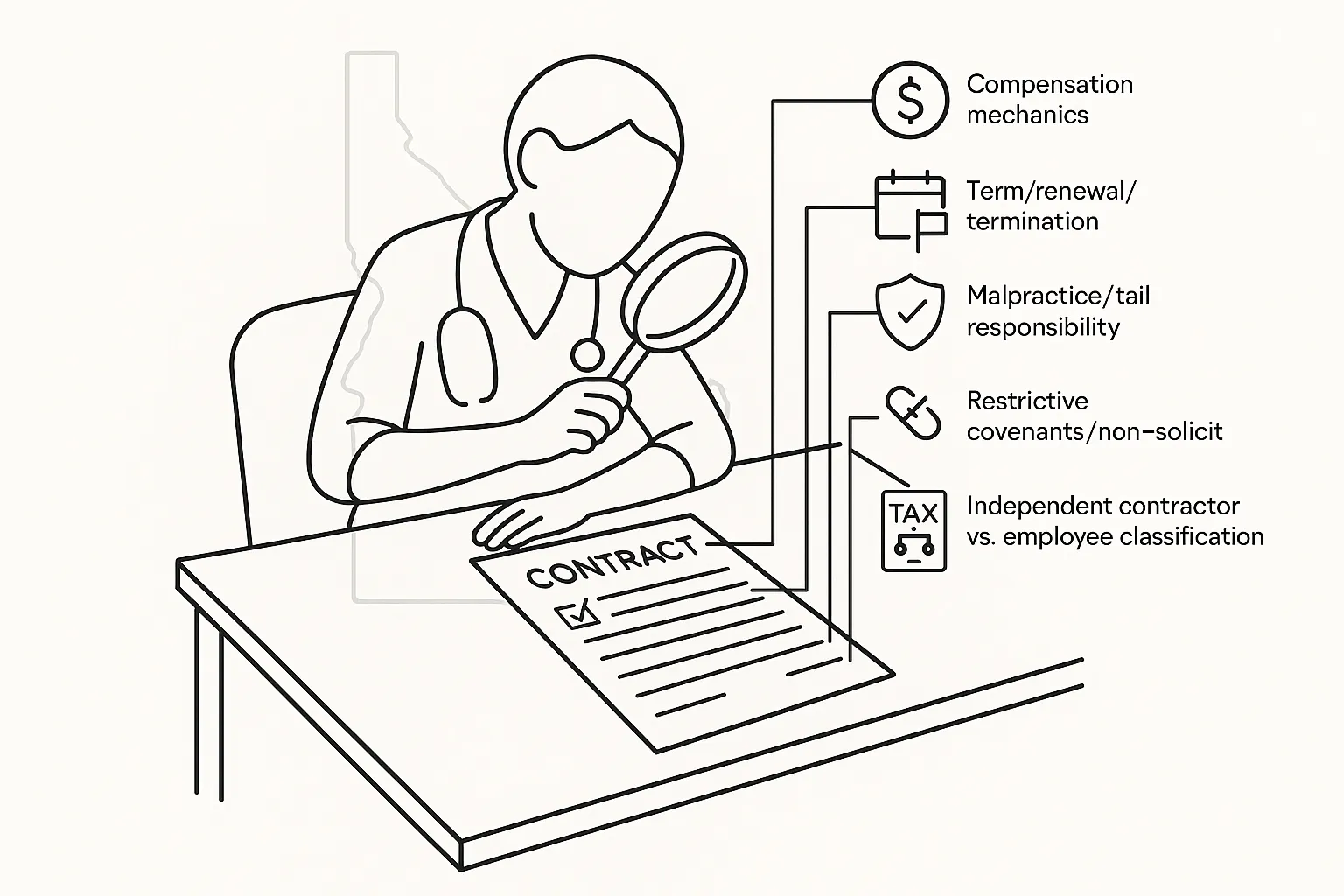
The initial review should focus on provisions that can immediately affect income, professional liability, or the ability to change jobs. Priority terms include compensation calculations, contract duration and renewal, without-cause and for-cause termination, malpractice insurance, restrictive covenants, work locations, call responsibilities, and employee or independent contractor status.
The language must be specific enough to show how each provision will operate. For example, a contract stating that salary is “subject to monthly reconciliation” may permit unexpected deductions or repayment demands if it does not define the reconciliation formula, timing, permitted adjustments, and treatment of deficits. A comprehensive NP employment agreement review translates those technical clauses into practical financial and professional consequences.
Compensation, Benefits, and Financial Protections
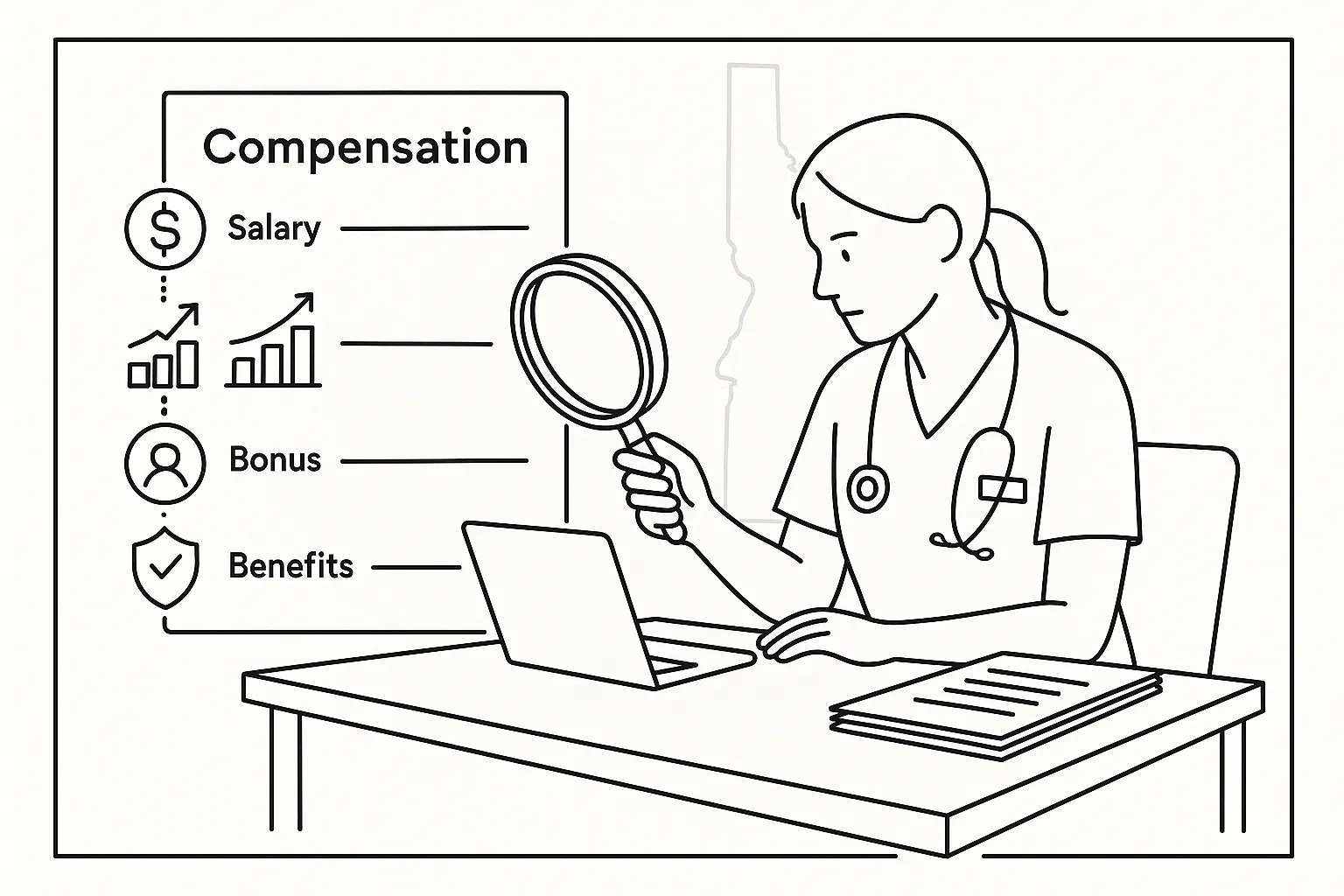
NP compensation may include a guaranteed base salary, collections-based pay, relative value unit compensation, bonuses, or a hybrid arrangement. A base salary should identify the guarantee period, any reduction triggers, and whether the salary can later become a recoverable draw. Collections provisions should define billed and collected revenue, payment timing, write-offs, payer denials, deductions, and chargebacks.
RVU provisions require similar precision. The agreement should identify the RVU schedule, conversion factor, benchmark, excluded services, and procedure for changing the formula during the contract term. An attorney conducting an NP compensation and productivity review can also assess whether bonus metrics are objective, consistently measured, and paired with a clear payment schedule.
Negative accrual deserves particular attention because an apparent salary guarantee may function as an advance against future productivity. The contract should explain whether a deficit carries forward, may be deducted from later compensation, or becomes repayable when employment ends. Benefits should also be reviewed for health coverage, retirement contributions, CME allowances, licensing and DEA fees, relocation assistance, signing bonuses, and student loan benefits, including any repayment obligations tied to departure.
Malpractice Insurance and Tail Coverage
Malpractice provisions should identify whether the employer provides coverage, the applicable limits, and whether the policy is occurrence-based or claims-made. Occurrence coverage generally applies to covered acts occurring during the policy period, while claims-made coverage ordinarily requires the claim to be reported while the policy or an extended reporting endorsement remains active.
If the employer provides claims-made coverage, the agreement should expressly state who purchases tail coverage after termination and whether responsibility changes based on the reason employment ends. It should also address coverage for telehealth, cross-state practice, moonlighting, and other duties contemplated by the position. A focused malpractice and tail insurance review can identify gaps before they become a post-employment expense or coverage dispute.
Idaho Scope of Practice and Work Structure
The contract’s clinical and operational requirements should be evaluated against the Idaho practice framework administered by the Idaho Board of Nursing and other applicable authorities. Provisions addressing scope of practice, prescribing, supervision, collaboration, delegation, credentialing, documentation, or physician co-signature should not create unclear duties or conflict with the requirements applicable to the NP’s role.
Work-location and scheduling language also matters. The agreement should define the primary location, the employer’s authority to assign additional sites, travel expectations, call coverage, floating requirements, and whether additional duties result in compensation or schedule protections. When a separate arrangement governs a professional relationship, a supervision or collaboration agreement review can help determine whether the documents are consistent.
Independent contractor status requires a separate analysis because the classification affects taxes, benefits, insurance, expenses, and control over the work. The agreement’s label should be compared with provisions governing scheduling, equipment, billing, credentialing, clinical policies, and the method of performing services. Chelle Law’s independent contractor agreement review addresses these practical and contractual distinctions.
Non-Competes and Post-Employment Restrictions
Non-compete, non-solicitation, confidentiality, and patient-relationship provisions can materially affect an NP’s ability to accept another Idaho position. A review should examine the restricted activities, duration, geographic area, triggering events, covered facilities, and whether the restriction applies after resignation, termination without cause, or termination for cause.
Non-solicitation clauses may extend beyond patients to employees, referral sources, or business relationships, while broad confidentiality language may restrict access to information needed for lawful continuity-of-care obligations. Because these provisions are often drafted to maximize employer protection, a dedicated nurse practitioner non-compete review can explain their practical reach and identify language that warrants clarification or narrowing.
Termination, Repayment, and Dispute Terms
Termination provisions govern notice, final compensation, continued duties, and post-employment obligations. The agreement should distinguish without-cause termination from immediate for-cause termination, define cause with reasonable specificity, and state whether there is an opportunity to cure certain alleged breaches. It should also explain what happens to accrued bonuses, unpaid productivity compensation, benefits, and scheduled leave during the notice period.
Repayment clauses may apply to signing bonuses, relocation expenses, loan assistance, training costs, or compensation advances. Review the repayment schedule, whether the amount is prorated, the events that trigger repayment, and any right to deduct money from final compensation. Choice-of-law, venue, arbitration, and fee-shifting provisions should also be examined because they affect the cost and procedure for resolving a dispute. An attorney can provide a focused contract termination review when an NP is preparing to leave or has received a termination notice.
What an Attorney-Led Contract Review Covers
Legal review is most useful before the agreement is signed, when unclear or unfavorable language can still be addressed. Chelle Law’s review focuses on explaining the contract rather than merely identifying legal terminology, with attention to how the terms may affect income, liability, regulatory compliance, and future practice options.
- Line-by-line analysis of employer-favorable language and material risk.
- Explanation of compensation formulas, bonus metrics, reconciliation, and repayment exposure.
- Assessment of malpractice coverage and responsibility for tail insurance.
- Review of Idaho-related scope-of-practice and operational provisions.
- Evaluation of termination rights, restrictive covenants, and dispute terms.
- Written comments or proposed revisions and a consultation explaining available options.
Common warning signs include undefined reconciliation methods, broad chargeback rights, claims-made coverage without a clear tail provision, negative accrual that accelerates at termination, vague cause language, expansive non-compete restrictions, and contractor terms that do not match the working relationship. Identifying these issues early helps prioritize the provisions that need clarification before the agreement becomes binding.
Have an Idaho NP Contract Reviewed Before You Sign
Chelle Law can evaluate compensation, malpractice coverage, termination rights, restrictive covenants, and Idaho-related practice terms so you can understand the agreement’s practical risks.
Contact Chelle Law