
When a nurse practitioner accepts a position in Iowa—whether practicing in Des Moines, Cedar Rapids, Davenport, or another Iowa healthcare market—the employment or independent contractor agreement becomes the governing document for compensation, clinical duties, malpractice responsibility, termination rights, and post-employment restrictions. These provisions must be considered alongside Iowa law, the Iowa Board of Nursing’s regulatory authority, and the state requirements that affect nurse practitioner licensure, prescribing, scope of practice, and professional responsibilities.
Subtle drafting differences can materially affect productivity-based pay, workplace expectations, restrictive covenants, repayment obligations, and career mobility. An Iowa nurse practitioner contract review identifies where employer-drafted language creates financial or professional risk and explains how the agreement operates in practice. This includes determining whether contractual supervision or collaboration provisions accurately reflect the position or create obligations beyond applicable requirements.
At Chelle Law, the emphasis is on an attorney-led, line-by-line assessment tailored to the agreement and Iowa practice context. We analyze clauses that may affect earnings stability, regulatory compliance, malpractice exposure, and the ability to change jobs. Nurse practitioners can also learn more about our broader contract review services before deciding how to proceed with an offer.
Key Iowa Nurse Practitioner Contract Risks
- Confirm that clinical duties, prescribing responsibilities, and any supervision or collaboration language align with the position and applicable Iowa requirements.
- Define base pay, RVU or collections formulas, bonus criteria, reconciliation procedures, and limits on clawbacks or negative accruals.
- Identify whether malpractice coverage is claims-made or occurrence and which party must purchase tail insurance when the relationship ends.
- Evaluate non-compete, non-solicitation, confidentiality, and exclusivity provisions for their practical effect on future employment.
- Clarify without-cause notice, for-cause standards, cure rights, repayment obligations, and dispute resolution procedures before signing.
Iowa Scope of Practice and Regulatory Context
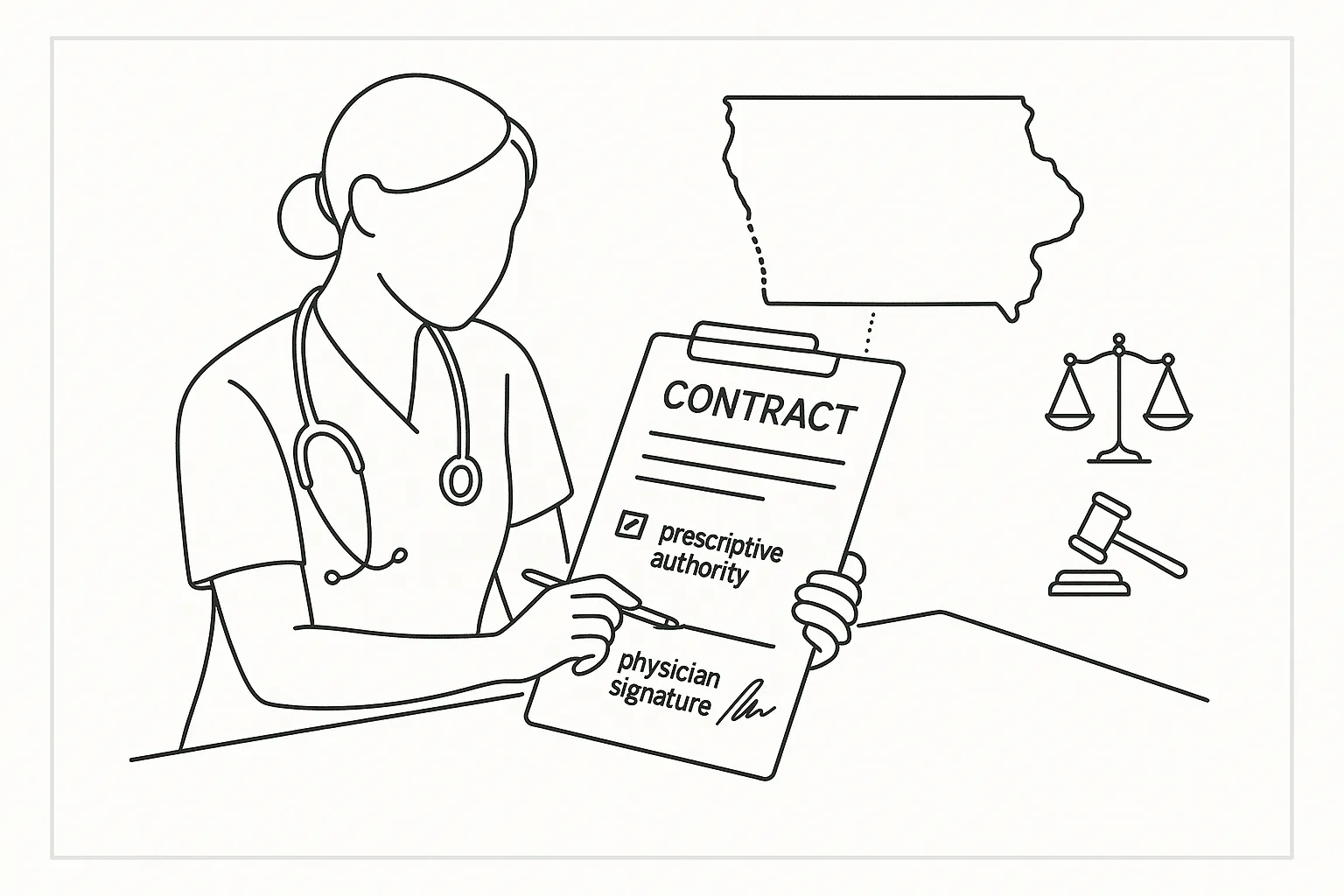
Iowa’s nursing laws and the Iowa Board of Nursing’s regulatory framework affect how clinical duties and professional responsibilities should be described in an NP agreement. Contracts translate those legal and operational requirements into day-to-day obligations involving prescribing, scheduling, patient care, documentation, standing orders, and employer policies. Review should confirm that the agreement does not use vague language to expand the role beyond what the nurse practitioner understood when accepting the position.
Important provisions include whether physician signatures are required for specified activities, how the employer describes clinical oversight, and whether payment or privileges depend on duties outside the stated role. A focused review of supervision and collaboration terms can help distinguish applicable practice requirements from additional contractual obligations imposed by the employer.
Employment and Independent Contractor Agreement Structure
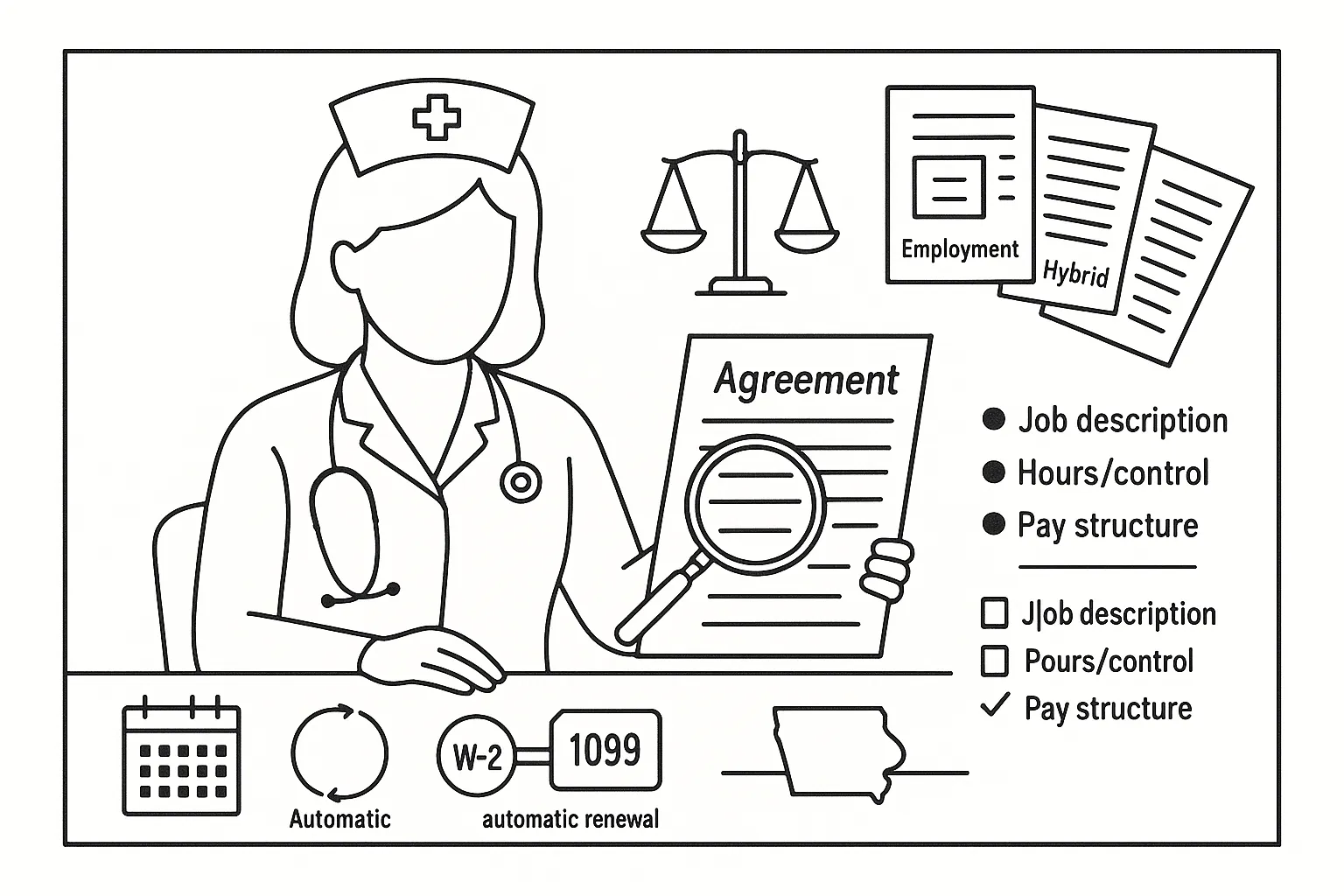
The first step is determining whether the document is an employment agreement, an independent contractor agreement, or a hybrid arrangement. Classification affects taxes, benefits, control over work, insurance responsibilities, and access to employer policies. The written label is important, but the agreement’s actual provisions concerning scheduling, equipment, billing, clinical control, and productivity expectations also require attention.
- Effective date, initial term, renewal process, and any automatic renewal provision.
- Whether the role is structured as W-2 employment or 1099 independent contracting.
- Job description, work locations, schedule expectations, call coverage, and the employer’s ability to change duties.
- Responsibility for taxes, benefits, licensing expenses, professional insurance, equipment, and business costs.
Understanding these structural terms frames the risks found elsewhere in the contract. Nurse practitioners comparing classifications should review the practical differences between W-2 and 1099 arrangements, including how each structure allocates expenses and employment benefits.
Compensation, Benefits, and Productivity Terms
Compensation clauses often create the greatest financial impact in an Iowa NP contract. A guaranteed base salary should identify the payment schedule, guarantee period, and circumstances under which the employer may reduce, offset, or reconcile compensation. If productivity is involved, the contract should explain how performance is measured and when additional compensation becomes earned and payable.
Collections-based arrangements require clear definitions of collections, charges, refunds, denials, and patient payments. The agreement should also address who controls billing and coding, how the nurse practitioner can verify reports, and whether delayed collections remain payable after termination. RVU formulas similarly depend on stated thresholds, conversion factors, attribution rules, calculation periods, and access to supporting data. A detailed NP compensation and productivity review can identify formula gaps that may not be apparent from the stated salary or bonus percentage.
Bonus language should distinguish earned compensation from a discretionary award and explain performance criteria, payment dates, and continued-employment conditions. Negative accrual provisions deserve particular scrutiny because they may allow an employer to carry an earlier shortfall into a later period or offset future earnings. The contract should identify any lookback period, reconciliation method, repayment cap, and treatment of an outstanding balance when employment ends.
Benefits should also be reviewed as part of total compensation. Relevant terms may include health insurance eligibility, retirement contributions, paid leave, continuing education allowances, licensing and DEA-related reimbursements, relocation assistance, signing bonuses, and student loan benefits. The agreement should state whether employer-paid amounts become repayable if the nurse practitioner leaves before a specified date.
Malpractice Coverage and Tail Insurance
Malpractice provisions determine the type of professional liability coverage provided, the applicable limits, and the parties responsible for premiums and post-employment protection. Claims-made policies generally require coverage to remain in effect when a claim is reported, which can make tail or extended reporting coverage important after employment ends. Occurrence coverage generally addresses covered incidents occurring during the policy period even if the claim is reported later.
The agreement should specify who purchases tail coverage, whether responsibility changes based on the reason for termination, and whether the employer will provide proof of coverage. Review should also address per-claim and aggregate limits, exclusions, defense obligations, indemnification language, and whether outside work or moonlighting is covered. A focused malpractice and tail insurance review can clarify obligations that might otherwise arise only after the relationship has ended.
Restrictive Covenants and Termination Rights
Restrictive covenants can have a significant effect on an NP’s ability to continue practicing in an Iowa community after leaving a position. Non-compete provisions may restrict work within a defined area and period, while non-solicitation clauses may limit contact with patients, referral sources, or employees. Confidentiality, exclusivity, patient-list, and outside-activity provisions can also restrict future work even when they are not labeled as non-competes.
Review should examine the restricted territory, duration, covered services, triggering events, and whether the provision applies after every form of separation. It should also consider the practical effect on opportunities in Des Moines, Cedar Rapids, Davenport, and surrounding communities. An attorney performing an NP non-compete review can identify drafting that may be broader than the nurse practitioner anticipated and explain how related non-solicitation or exclusivity terms affect mobility.
Termination provisions determine when compensation stops and which obligations survive. The contract should distinguish for-cause termination from without-cause termination, define notice and cure periods, and state what happens to earned bonuses, outstanding collections, benefits, malpractice coverage, and restrictive covenants. Broad cause definitions or short notice periods can create immediate income exposure.
Repayment clauses may require the return of signing bonuses, relocation assistance, or other benefits following resignation or termination for cause. Dispute resolution language may mandate arbitration, select a venue, allocate attorneys’ fees, or choose governing law. A dedicated contract termination review helps connect these provisions so the financial consequences of ending the relationship are understood before signing.
Contract Red Flags and Attorney Review
A focused legal review prioritizes provisions that materially affect compensation, professional responsibilities, malpractice exposure, and career mobility. Common red flags include:
- Undefined RVU conversion factors, collections terminology, bonus criteria, or reconciliation procedures.
- Broad for-cause termination standards with limited notice or opportunity to cure an alleged breach.
- Discretionary compensation language, uncapped clawbacks, or negative accrual that carries forward indefinitely.
- Employer control over billing and coding without a meaningful right to inspect supporting reports.
- Claims-made malpractice coverage with an unclear or NP-only tail insurance obligation.
- Overbroad non-compete, non-solicitation, exclusivity, or geographic restrictions.
- Vague supervision, collaboration, prescribing, or clinical-duty clauses that do not reflect the position as described.
Legal review is most useful before the agreement is signed or an existing contract is amended. Counsel can verify compensation mechanics, identify ambiguous or employer-favorable language, assess malpractice and termination obligations, and suggest revisions or clarifying language. The goal is to provide a practical risk assessment so the nurse practitioner can make an informed decision about the financial, regulatory, and professional consequences of the agreement.
Review Your Iowa NP Contract Before You Sign
Chelle Law reviews nurse practitioner agreements for compensation risks, malpractice obligations, restrictive covenants, termination terms, and Iowa practice considerations.
Contact Chelle LawExplore Nurse Practitioner Contract Guidance
Review legal services, practical contract resources, and state-specific guidance for nurse practitioners.