
When a nurse practitioner accepts a position in Kansas—whether practicing in Wichita, Overland Park, Topeka, or elsewhere in the state—the employment or independent contractor agreement governs compensation, scope of practice, malpractice responsibilities, and post-employment restrictions. These agreements operate within Kansas law and the professional framework administered by the Kansas State Board of Nursing, including statutory provisions under Chapter 65 of the Kansas Statutes that address advanced practice registered nurses.
Subtle drafting differences can materially affect productivity pay, professional obligations, restrictive covenants, and termination rights. A Kansas nurse practitioner contract review examines how employer-drafted language interacts with state practice requirements and identifies financial or professional risk before the agreement is signed.
Chelle Law provides attorney-led review focused on the practical effect of each provision. The review can address collections formulas, negative accrual, tail insurance responsibility, notice requirements, and post-employment limits while helping the NP understand how the agreement may affect earnings stability, regulatory compliance, and career mobility.
Key Takeaways for Kansas Nurse Practitioners
- Use a line-by-line attorney review to identify potential income exposure, practice-related obligations, and restrictive covenant concerns.
- Confirm how collections, wRVU formulas, negative accrual, bonuses, and repayment provisions are calculated.
- Require clear malpractice and tail coverage language that allocates costs under each termination scenario.
- Review scope-of-practice, prescribing, supervision, collaboration, and credentialing terms against applicable Kansas requirements.
- Evaluate the duration, geographic reach, restricted activities, and triggering events in any non-compete or non-solicitation provision.
Kansas Practice Requirements That Affect NP Contracts
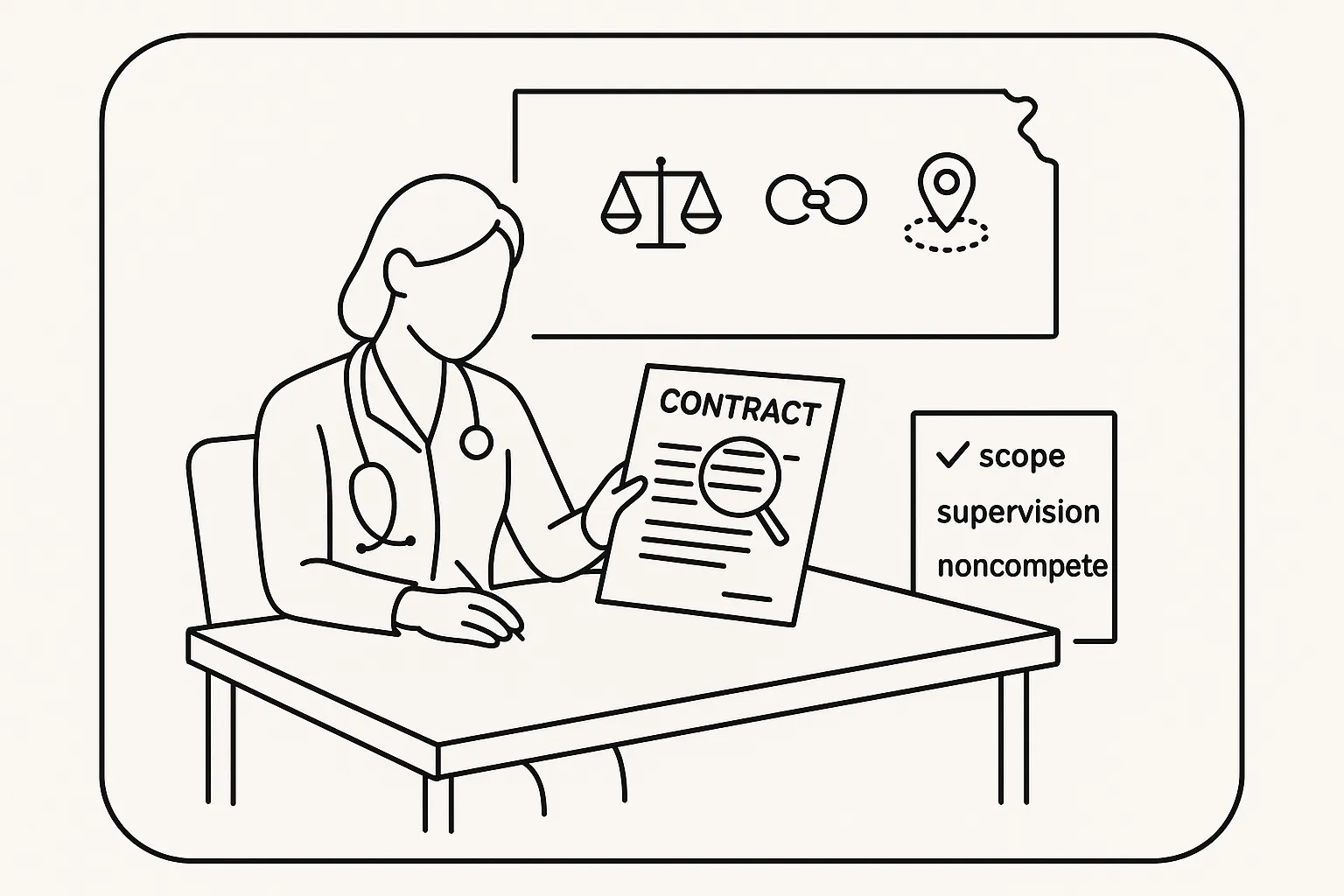
Kansas regulates advanced practice registered nurses, including nurse practitioners, through licensing and practice requirements administered by the Kansas State Board of Nursing. An agreement should accurately reflect the NP’s authorized duties, prescribing responsibilities, required professional relationships, and the employer’s role in maintaining any necessary documentation or operational support.
Contract language should not assign duties or impose restrictions that conflict with applicable law or licensing requirements. Vague provisions can also create uncertainty about who is responsible for required agreements, signatures, credentialing steps, and compliance tasks. A review should therefore compare the written obligations with the actual position and relevant scope-of-practice considerations.
Kansas law also provides the broader context for restrictive covenants and other employment terms. The practical effect of a restriction depends on its language and circumstances, including its duration, geographic scope, restricted activities, and the interests the employer seeks to protect. Careful review is important because a provision that appears routine may materially limit where or how an NP can practice after leaving.
Important Provisions in a Kansas NP Contract
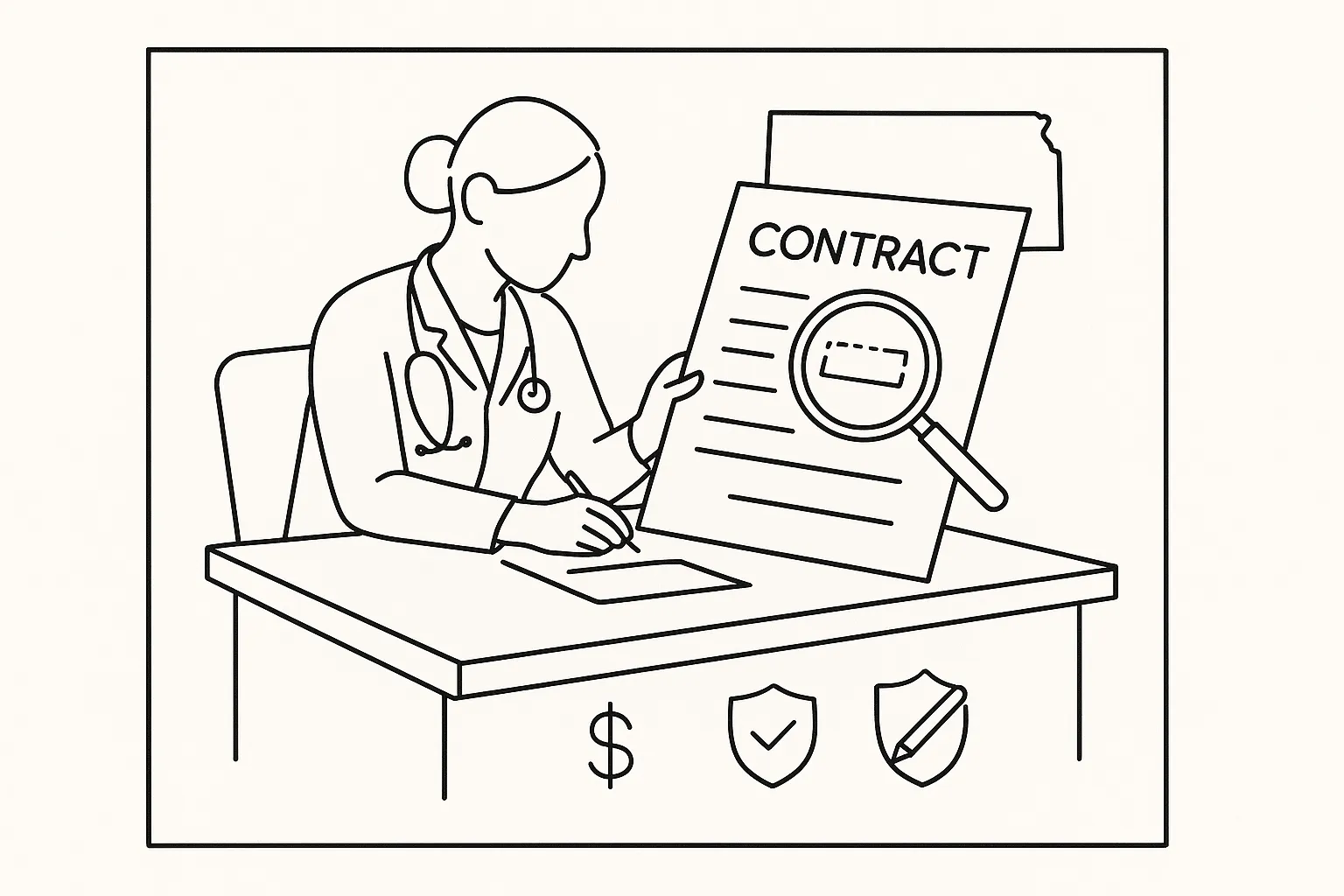
The provisions most likely to affect a Kansas nurse practitioner’s finances, liability exposure, and professional flexibility should be reviewed together rather than in isolation. A favorable salary can be undermined by an unclear productivity formula, while a manageable termination clause can become costly when combined with bonus repayment, tail coverage, or a restrictive covenant.
Compensation, Productivity, and Workload
Compensation may include a guaranteed base salary, collections-based pay, wRVU or RVU productivity incentives, and discretionary or formula-based bonuses. The agreement should define gross or net collections, write-offs, payer adjustments, overhead deductions, productivity thresholds, payment dates, and the employer’s right to revise the plan. NPs offered variable compensation can benefit from a focused review of compensation and productivity terms.
Negative accrual and reconciliation provisions deserve particular attention because they may permit an employer to offset future earnings or demand repayment when production falls below a draw or guarantee. The contract should also connect compensation to realistic scheduling, patient volume, call coverage, administrative work, and multi-site responsibilities. Open-ended requirements to provide additional coverage or work at new locations can increase the workload without corresponding pay.
Malpractice Coverage, Scope of Practice, and Credentialing
Malpractice provisions should identify whether coverage is claims-made or occurrence-based, who pays the premium, the applicable limits, and who is responsible for tail coverage after termination. Claims-made coverage generally requires protection for claims reported after the underlying policy ends, making the allocation of tail responsibility a potentially significant financial issue. A detailed malpractice and tail insurance review can clarify that exposure.
Indemnification language should also be examined for breadth and mutuality. The agreement should not leave the NP with an unclear or unlimited obligation for claims, losses, or employer conduct outside the NP’s control. Related provisions governing prescribing, supervision, collaboration, credentialing, and medical staff privileges should identify the parties’ responsibilities and address what happens if credentialing is delayed or denied.
Termination, Repayment, and Post-Employment Restrictions
Termination provisions define notice periods, grounds for immediate dismissal, compensation during notice, and the treatment of accrued but unpaid production. Broad or undefined for-cause language can give the employer substantial discretion and may trigger repayment, tail insurance, or restrictive covenant obligations. The agreement should also explain whether the NP can terminate without cause and whether the employer may remove the NP from the schedule during the notice period.
Signing bonuses, relocation assistance, training costs, and other advances often carry prorated or full repayment requirements. These provisions should be reviewed alongside the termination section so the NP can determine which events trigger repayment. A termination-focused contract review can identify the combined financial effect of notice, repayment, and post-employment clauses.
Non-compete, non-solicitation, and confidentiality provisions may limit future employment or practice opportunities. Important terms include the geographic radius, duration, restricted activities, covered locations, and whether the restriction applies after resignation, termination for cause, or termination without cause. NPs should assess these details through a dedicated non-compete review before accepting the restriction.
Common Kansas NP Contract Red Flags
Employer-drafted agreements may contain provisions that transfer financial or operational risk to the nurse practitioner without clearly explaining the consequences. Common concerns include:
- Collections-based compensation without definitions for billable events, write-offs, payer adjustments, or administrative deductions.
- Negative accrual without a cap, reset mechanism, or time-limited reconciliation period.
- Non-compete terms with a broad geographic reach, lengthy duration, or application after termination without cause.
- Tail insurance obligations that shift substantial costs to the NP without regard to the reason employment ends.
- Vague prescribing, collaboration, supervision, or compliance language that does not identify each party’s responsibilities.
- Open-ended scheduling, call, floating, or multi-location requirements without additional compensation.
- Broad indemnification, audit, recoupment, or repayment rights that permit retrospective reductions in compensation.
These terms should be evaluated collectively. For example, an NP could face a repayment demand, responsibility for tail coverage, and a post-employment restriction following the same termination event. Identifying those interactions is a central part of assessing the agreement’s overall risk.
Negotiation Priorities and Practical Tradeoffs
Negotiation priorities usually begin with provisions that most directly affect income stability, professional compliance, and future employability. Those priorities may include defining compensation and reconciliation mechanics, allocating malpractice costs, narrowing repayment triggers, clarifying practice obligations, and limiting restrictive covenants.
Every proposed change should be considered in the context of the full offer. A higher guaranteed salary may come with more demanding productivity targets, while a signing bonus may be paired with a lengthy repayment period. The objective is to understand measurable exposure—such as potential repayment, unpaid production, tail costs, or lost employment options—so the NP can decide whether the contract aligns with personal goals and risk tolerance.
Telehealth, 1099 Roles, and Ownership Opportunities
Special practice arrangements require additional contract analysis. Telehealth agreements should address where patients may be located, applicable licensing and prescribing obligations, cross-state practice expectations, payer treatment, and how remote services count toward collections or productivity. The agreement should not assume that one state’s requirements govern every patient encounter.
A 1099 label does not, by itself, resolve the practical or legal issues associated with independent contractor status. Scheduling control, supervision, the method of work, benefits, expenses, malpractice coverage, and tax responsibilities should be evaluated together. NPs considering this structure may need an independent contractor agreement review focused on the actual terms rather than the agreement’s title.
Practice ownership, partnership, or future equity offers also require precise documentation. The contract should address valuation, capital contributions, voting or management rights, distributions, exit procedures, and the effect of restrictive covenants when the ownership relationship ends. Vague promises of a future buy-in should not be treated as equivalent to documented ownership rights.
When to Obtain a Kansas NP Contract Review
An attorney review is especially useful for a first position after graduation, a contract with productivity or collections-based pay, an offer containing repayment or restrictive covenant provisions, or an independent contractor arrangement. Review should occur before signing whenever possible so the NP can evaluate the complete agreement before becoming bound by its terms.
Chelle Law’s process is designed to identify risk and explain the practical effect of the contract in plain language. The review may include secure document submission, attorney analysis, written comments or proposed revisions, and a consultation about compensation, malpractice coverage, termination, professional obligations, and post-employment restrictions.
Have a Kansas NP Contract Reviewed Before You Sign
Chelle Law can evaluate your proposed agreement and explain how its compensation, malpractice, termination, practice, and restrictive covenant terms may affect your career.
Contact Chelle LawExplore Nurse Practitioner Contract Guidance
Review related services, educational resources, and state-specific contract information for nurse practitioners.