
When a nurse practitioner accepts a position in Kentucky—whether practicing in Louisville, Lexington, Bowling Green, Frankfort, or another community—the employment or independent contractor agreement governs compensation, duties, malpractice coverage, termination rights, and post-employment restrictions. Those terms must also operate within Kentucky’s regulatory framework, including oversight by the Kentucky Board of Nursing and the provisions of KRS Chapter 314 applicable to advanced practice registered nurses.
Subtle drafting differences can materially affect productivity pay, collaborative arrangements, prescribing responsibilities, restrictive covenants, and the ability to leave a position without unexpected financial consequences. A Kentucky nurse practitioner contract review examines how the employer’s language allocates those risks and whether important operational details—such as credentialing, tail insurance, work locations, and supervision or collaboration contingencies—are clearly addressed.
At Chelle Law, the focus is a structured, attorney-led assessment of the complete agreement. We review the contract line by line to identify provisions that may affect income stability, regulatory compliance, professional liability, and future career mobility, then explain the practical consequences before the NP signs or negotiates changes.
Key Takeaways for Kentucky Nurse Practitioners
- Review collections timing, RVU calculations, bonus thresholds, and negative accrual provisions rather than relying only on the stated base salary.
- Confirm whether the relationship is W-2 employment or 1099 independent contracting and identify how that classification affects benefits, taxes, expenses, and repayment exposure.
- Require the agreement to identify the malpractice policy type and state who pays for tail coverage when claims-made coverage ends.
- Evaluate the duration, geographic reach, triggering events, and practical effect of every non-compete and non-solicitation provision.
- Address Kentucky licensure, prescribing, collaboration or supervision, credentialing, and telehealth requirements in operational contract language.
What Kentucky NP Employment and Contractor Agreements Cover

Employment and independent contractor agreements presented to Kentucky nurse practitioners often follow a similar structure while assigning risk in very different ways. Common sections address clinical duties, scheduling, call coverage, compensation, benefits, expense reimbursement, malpractice insurance, collaboration or supervision, restrictive covenants, termination, credentialing, DEA registration, and maintenance of professional licenses.
Employee and Independent Contractor Classification
The agreement should clearly identify whether the NP will be a W-2 employee or a 1099 independent contractor. Classification affects tax treatment, access to benefits, responsibility for business expenses, and exposure to reimbursement or clawback provisions. NPs considering contractor status should compare the agreement with the practical issues discussed in our guide to W-2 versus 1099 arrangements.
Private groups, health systems, urgent care organizations, and telehealth employers may also reserve broad discretion over scheduling, multi-site assignments, policies, or work locations. These provisions should be read together because the classification label alone does not explain who controls the work, bears expenses, or absorbs operational delays.
Compensation, Bonuses, and Productivity Formulas
Many agreements use a guaranteed base, collections-based compensation, RVUs, visit targets, quality measures, or a hybrid model. Effective NP compensation and productivity review requires more than identifying the rate: the contract should define the measurement period, data source, conversion factor, payment timing, exclusions, and process for challenging errors.
- Base salary plus productivity: Determine whether the base is guaranteed or treated as a recoverable draw and whether shortfalls carry forward as negative accrual.
- Collections-based pay: Define when receipts are credited to the NP and whether billing adjustments, payer chargebacks, or employer deductions reduce compensation.
- RVU compensation: Identify the applicable RVU schedule, conversion factor, coding responsibilities, administrative-time treatment, and dispute process.
- Bonus structures: Replace broad discretionary language with objective thresholds, measurement periods, quality criteria, and payment dates where possible.
For example, a contract may provide a $4,000 monthly draw reconciled quarterly against collections. If the agreement credits only $9,000 in quarterly collections against a $12,000 draw, it may create a $3,000 negative accrual recoverable through future offsets, payroll deductions, or a repayment demand. The calculation method and recovery language can therefore be as important as the advertised compensation rate.
Kentucky Scope of Practice and Regulatory Terms
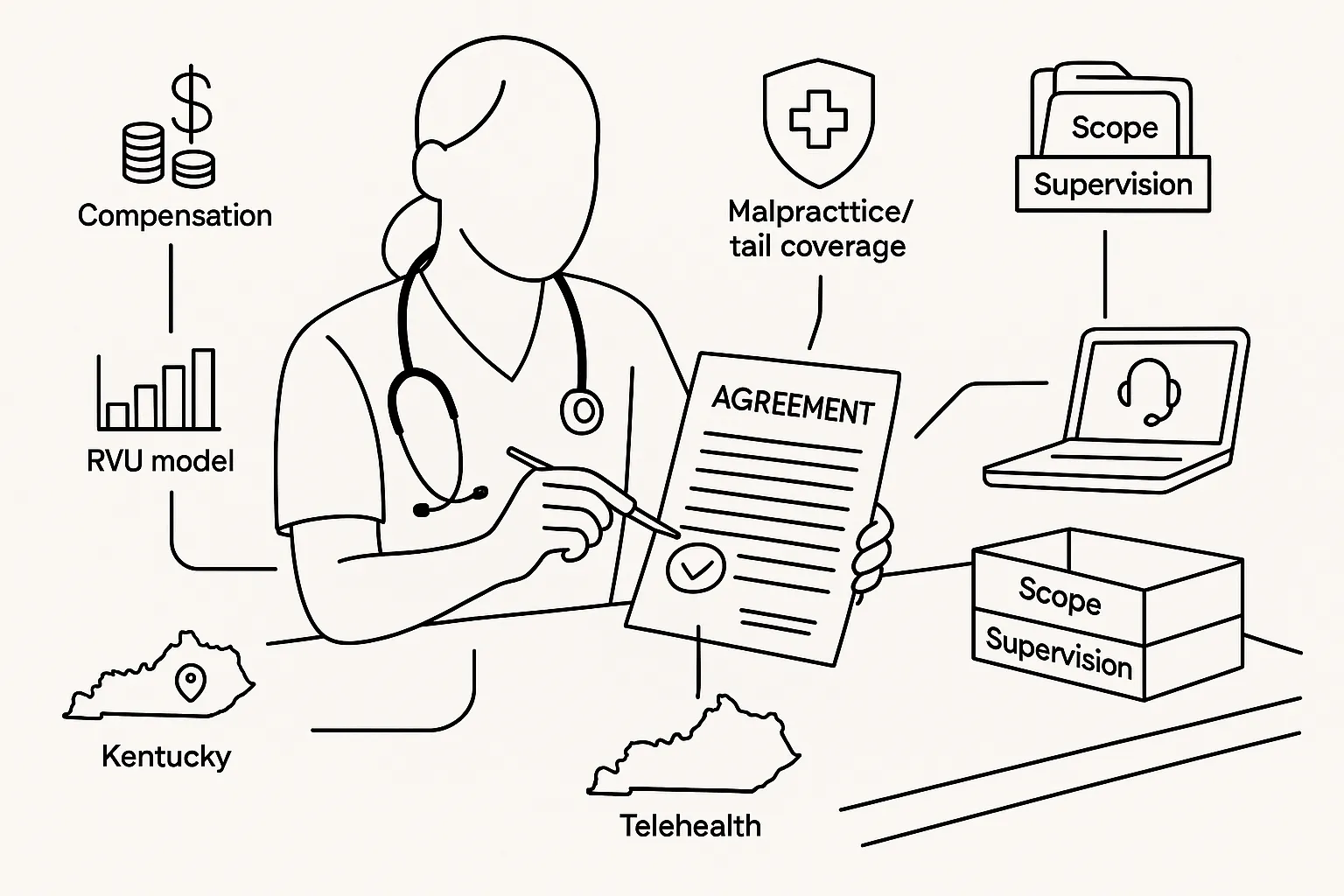
A Kentucky NP agreement should align the contractual duties with the practitioner’s education, credentials, licensure, and applicable Kentucky Board of Nursing requirements. Broad language allowing unilateral reassignment can create problems when the employer’s operational expectations do not match the NP’s training, authorized scope, or professional judgment.
Clinical Duties, Collaboration, and Prescribing
The contract should identify clinical responsibilities, call coverage, schedule expectations, patient settings, and authorized work locations. If the position depends on a collaborative or supervisory relationship, the agreement should explain who establishes and maintains that arrangement, how oversight is documented, and what happens if the participating physician leaves or becomes unavailable. A focused review of supervision and collaboration terms can identify whether the employment agreement and the operational arrangement are consistent.
Prescribing provisions should also allocate responsibility for required registrations, renewals, documentation, and access to any necessary collaborating or supervising professional. If prescribing authority or another aspect of practice depends on a named individual or separate agreement, contingency language is important because the loss of that relationship may interrupt clinical work and compensation.
Licensure, Credentialing, and Telehealth
The agreement should state who pays Kentucky licensing, controlled-substance registration, DEA, credentialing, and renewal expenses. It should also assign responsibility for initiating Medicare, Medicaid, and commercial payer enrollment and explain whether compensation changes while applications remain pending. Employer-favored recoupment language tied to credentialing delays can transfer substantial financial risk to the NP.
Telehealth terms should identify the permitted practice locations, patient locations, applicable licensure expectations, remote collaboration or supervision procedures, and how virtual encounters count toward productivity. Cross-state practice should not be assumed merely because services are delivered remotely; the contract should reflect the licenses and authority the NP actually maintains.
Malpractice Insurance and Tail Coverage
Malpractice language should specify the policy type, coverage limits, covered services, exclusions, and responsibility for premiums. An occurrence policy generally covers incidents that occur during the policy period regardless of when the claim is made. A claims-made policy generally requires continuous coverage when the claim is reported, which can make tail coverage necessary after the policy ends.
Employers sometimes provide claims-made coverage while assigning the NP responsibility for tail premiums after termination. The agreement should address whether the employer pays for tail when it ends the relationship, whether the obligation changes based on the reason for departure, and whether coverage extends to approved work outside the primary position. Our malpractice and tail insurance review evaluates these provisions together with indemnification and other liability terms.
Termination, Repayment, and Restrictive Covenants
Notice, Final Compensation, and Repayment Obligations
Termination provisions establish the notice required for without-cause termination, the events permitting immediate termination for cause, and the compensation owed when the relationship ends. The agreement should address payment for completed work, accrued bonuses, outstanding collections, unused leave if applicable, and any productivity reconciliation that occurs after departure. A detailed termination provision review can also identify clauses that make the notice period impractical or expose the NP to continuing obligations after employment ends.
Signing bonuses, relocation allowances, student loan assistance, and other recruitment benefits frequently include repayment requirements. The contract should state whether repayment is prorated, which events trigger it, whether employer-initiated termination is excluded, and how the employer may recover the amount. Negative accrual balances and post-termination compensation should also be reconciled under a defined process rather than left to unilateral employer calculations.
Non-Compete, Non-Solicitation, and Confidentiality Terms
Restrictive covenants can limit where and how an NP practices after leaving. Review the duration, geographic scope, restricted activities, covered employer locations, triggering events, and any restriction on soliciting patients, employees, referral sources, or payers. Kentucky enforceability depends on the specific language, surrounding facts, current law, and the reasonableness of the restraint, so broad restrictions should not be treated as harmless boilerplate.
The practical effect matters as much as the wording. A radius measured from every facility in a large health system may affect opportunities throughout a healthcare market, while a restriction that applies after any form of termination may remain in force even when the employer ends the relationship. Chelle Law’s nurse practitioner non-compete review evaluates these provisions in the context of the NP’s specialty, likely work locations, and future plans.
Negotiation Priorities and Contract Red Flags
The highest-priority negotiation points are usually those affecting income predictability, professional liability, regulatory compliance, and future mobility. These include compensation formulas, repayment obligations, malpractice tail responsibility, classification, termination rights, restrictive covenants, schedule control, work locations, and collaboration or prescribing contingencies. Benefits such as health coverage, retirement eligibility, paid leave, CME funding, license reimbursement, and professional development support should also be described with enough detail to be enforceable.
- Unilateral amendment clauses allowing the employer to change material terms without the NP’s agreement.
- Ambiguous productivity reconciliation, negative accrual, or repayment provisions.
- Duties defined solely by changing employer policies rather than the NP’s credentials and applicable practice requirements.
- Expansive non-compete provisions based on multiple locations or broad categories of clinical work.
- Immediate employer termination rights paired with repayment duties or continuing restrictive covenants.
- Claims-made malpractice coverage without a clear allocation of tail responsibility.
- Credentialing or payer-enrollment delays that suspend pay or create recoupment exposure.
Material recruitment promises should appear in the signed agreement or a written amendment. Schedule adjustments, additional CME funds, equipment commitments, remote-work arrangements, and special compensation terms can be difficult to rely on when they remain verbal or conflict with an integration clause stating that the written contract is the complete agreement.
What an Attorney-Led Kentucky Contract Review Covers
A targeted review examines the agreement line by line for compensation mechanics, repayment and negative accrual triggers, malpractice coverage, restrictive covenants, termination rights, classification, scope of practice, collaboration or supervision contingencies, credentialing, and unilateral employer powers. The attorney can explain how the provisions interact, identify missing terms, and suggest revisions or clarifying language where appropriate.
After the review, the NP may request a redline or amendment, seek written clarification, accept a known level of risk, or decline an offer that remains unfavorable. The purpose is to make those decisions with a clear understanding of the contract’s financial, regulatory, and career consequences rather than relying only on the headline salary or verbal assurances.
Have a Kentucky NP Contract Reviewed Before You Sign
Chelle Law can review your proposed employment or independent contractor agreement and explain provisions affecting compensation, malpractice coverage, termination, Kentucky practice requirements, and future career options.
Contact Chelle LawExplore Nurse Practitioner Contract Guidance
Review Chelle Law’s services, educational resources, and state-specific contract guidance.