
When a nurse practitioner accepts a position in Louisiana—whether practicing in New Orleans, Baton Rouge, Shreveport, or another healthcare market—the employment or independent contractor agreement becomes the governing document for compensation, duties, malpractice coverage, termination rights, and post-employment restrictions. Those terms must also operate within Louisiana’s regulatory framework, including oversight by the Louisiana State Board of Nursing and the provisions governing advanced practice registered nurses under Title 37 of the Louisiana Revised Statutes.
Subtle drafting differences can materially affect productivity pay, collaborative practice obligations, restrictive covenant exposure, and the cost of leaving a position. Louisiana’s civil law system and the statutory requirements applicable to non-compete agreements under La. R.S. 23:921 make careful review of geographic scope, duration, and restricted activities particularly important. Chelle Law’s Louisiana nurse practitioner contract review services evaluate these provisions alongside compensation formulas, malpractice allocation, notice requirements, and repayment obligations so the NP can understand the practical risks before signing.
Key Takeaways for Louisiana Nurse Practitioners
- Confirm how salary, RVUs, collections, bonuses, holdbacks, and negative accrual will be calculated and reconciled.
- Determine whether the employer or NP must pay for tail coverage when the malpractice policy is claims-made.
- Review non-compete and non-solicitation provisions for the specific parishes, municipalities, duration, and professional activities they cover.
- Understand without-cause notice, termination-for-cause definitions, severance conditions, and post-termination repayment obligations.
- Ensure the agreement’s scope-of-practice, prescribing, supervision, and collaboration language is consistent with the position and applicable Louisiana requirements.
Louisiana NP Employment and Independent Contractor Agreements
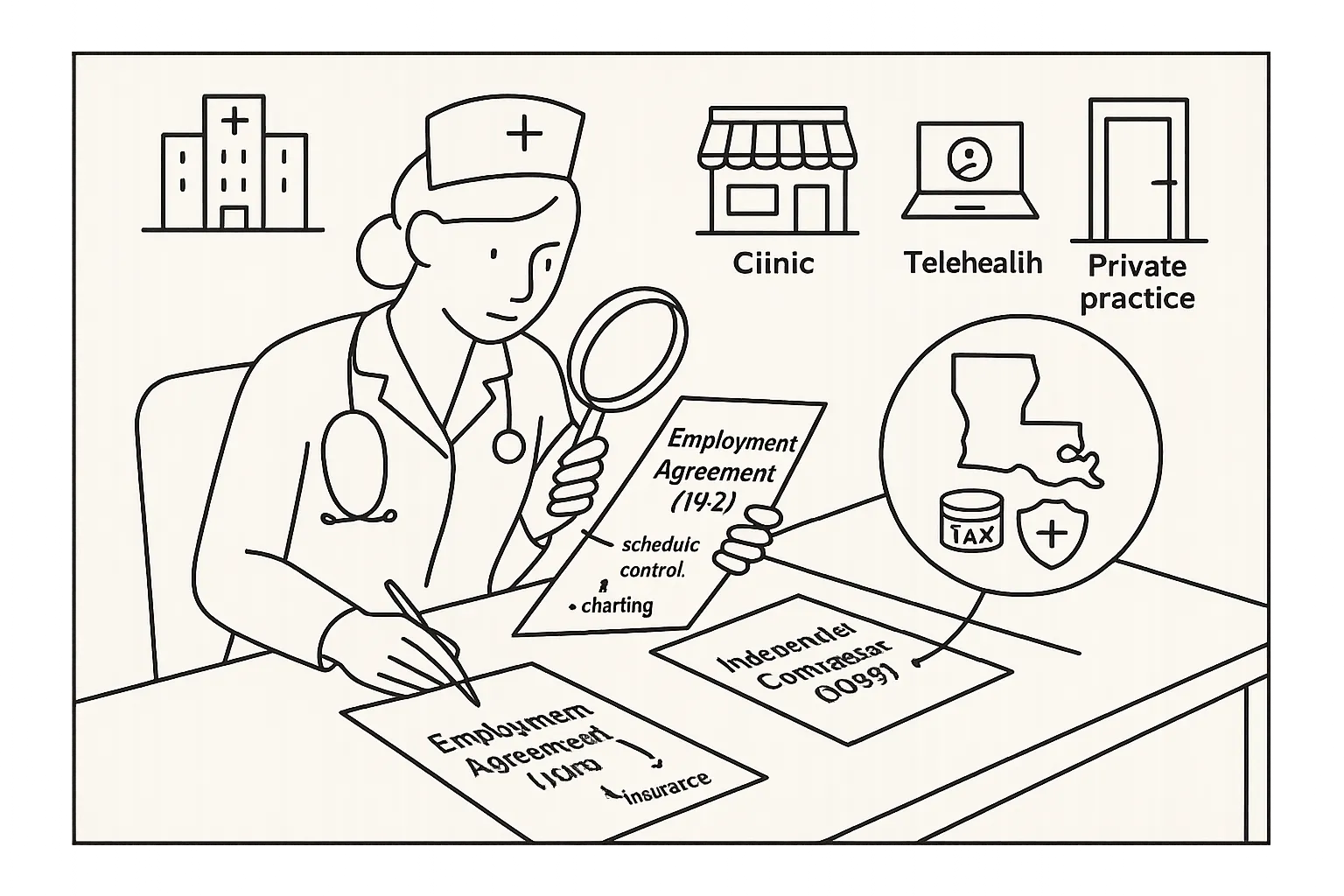
A W-2 employment agreement and a 1099 independent contractor agreement can create substantially different financial and legal obligations. Employment agreements commonly address benefits, employer-paid payroll taxes, paid leave, and termination procedures. Contractor agreements may shift malpractice premiums, taxes, insurance, business expenses, indemnification obligations, and administrative costs to the NP. The practical distinction depends on more than the contract’s label, so schedule control, required systems, workplace arrangements, and the parties’ actual responsibilities should be evaluated together. NPs considering contractor status can also review the differences between W-2 and 1099 arrangements.
The practice setting also affects contract risk. Hospital and health-system agreements frequently use departmental productivity measures and may apply restrictions across multiple facilities. Private practices and clinics may combine salary with collections-based compensation while allocating certain office costs to the provider. Telehealth agreements can add multistate licensing, technology, prescribing, and location-based practice requirements. Each agreement should clearly identify the work locations, clinical duties, scheduling expectations, administrative responsibilities, and regulatory arrangements that apply to the actual position.
Compensation, Termination, and Repayment Terms
Salary, RVUs, Collections, and Bonuses
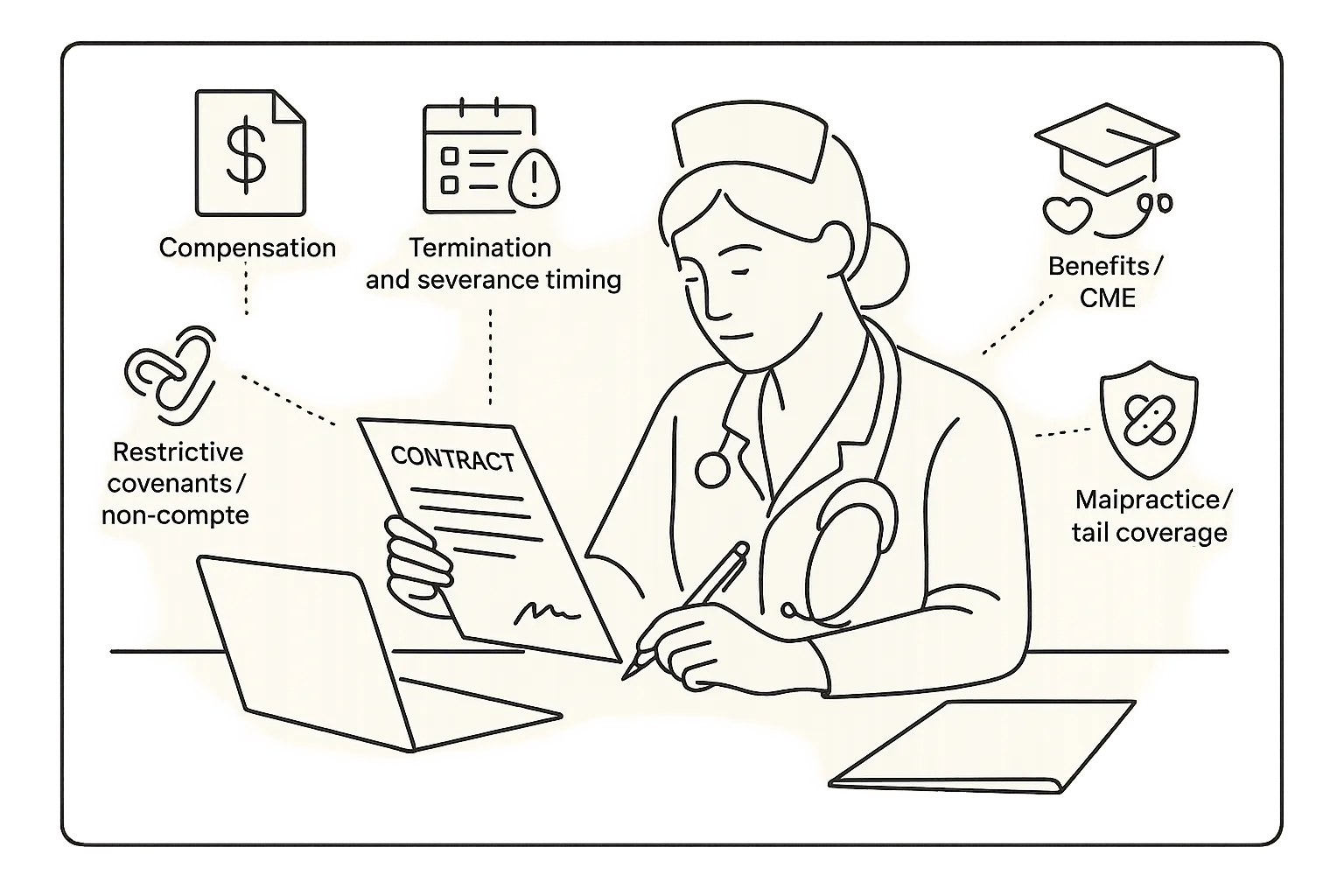
Compensation language determines not only the stated rate of pay but also when earnings become payable and whether the employer can later make adjustments. A guaranteed base salary may be straightforward, while an RVU or collections model requires clear definitions, thresholds, conversion factors, reporting periods, reconciliation procedures, and payment dates. Language addressing chargebacks, payer denials, holdbacks, negative accrual, and discretionary adjustments can materially change take-home pay even when the headline compensation appears competitive.
RVU compensation reduces some payer-collection variability but still depends on the employer’s methodology and access to accurate reports. Collections-based compensation can expose the NP to billing delays, payer mix, denials, and collection practices outside the NP’s control. A focused NP compensation and productivity review can identify whether the formula is measurable, verifiable, and internally consistent. Signing bonuses, relocation assistance, and loan repayment benefits should also be reviewed for repayment triggers, prorating, interest, and acceleration provisions.
Termination, Severance, and Clawbacks
Termination provisions establish how quickly either party can end the relationship and what financial obligations survive. The agreement should distinguish termination without cause from termination for cause, define any opportunity to cure an alleged breach, and state what happens to earned bonuses, outstanding collections, unused leave, benefits, and malpractice coverage. Short without-cause notice periods can create immediate income risk, while broad cause definitions may allow an employer to end the agreement without notice.
Repayment provisions deserve particular attention because they may create debt after employment ends. The contract should explain whether bonus, relocation, credentialing, training, or other amounts are repaid in full or prorated and whether repayment applies after resignation, termination without cause, or only specified events. A termination and exit-term review can clarify notice obligations, severance conditions, releases, continuing restrictions, and potential clawbacks before the NP signs or gives notice.
Louisiana Non-Competes, Malpractice Coverage, and Practice Requirements
Restrictive Covenants Under Louisiana Law
Louisiana nurse practitioner agreements may include non-compete, non-solicitation, confidentiality, and referral restrictions. Review should focus on the identified geographic areas, duration, restricted activities, covered facilities, and the events that trigger the restriction. A clause affecting multiple locations, broad categories of healthcare work, or telehealth services can limit career mobility beyond the NP’s primary practice site. Because Louisiana applies specific statutory requirements to non-compete agreements, the actual wording and identified territory require case-specific analysis rather than assumptions based on the clause’s heading.
Potential revisions may include narrowing the restricted activities, limiting the covered area, shortening the duration, or excluding termination without cause and employer breach. Chelle Law’s nurse practitioner non-compete review examines how the restriction may affect future employment, patient relationships, referral sources, and the ability to continue practicing in a Louisiana market.
Malpractice Insurance and Tail Responsibility
The contract should identify the malpractice policy type, coverage limits, named insured, premium responsibility, and any exclusions relevant to the NP’s duties. Claims-made coverage generally requires continued protection for later-reported claims arising from services performed during the policy period, often through tail coverage or prior-acts coverage. Occurrence coverage responds based on when the incident occurred, subject to the policy terms.
If the employer provides claims-made insurance but assigns tail responsibility to the NP, the agreement should state when that obligation applies and whether the cost is capped, shared, or waived in defined circumstances. The policy declarations and any referenced insurance provisions should be reviewed with the contract. An NP facing unclear coverage language can request a dedicated malpractice and tail insurance review.
Scope of Practice, Prescribing, Supervision, and Collaboration
Contract terms addressing clinical authority should align with the NP’s role and applicable Louisiana licensing and practice requirements. Review may include prescribing responsibilities, delegated duties, physician availability, chart review or co-signature expectations, documentation procedures, and responsibility for maintaining required practice arrangements. The agreement should also explain what happens if a collaborating or supervising professional becomes unavailable or if the employer changes the NP’s duties or location.
Ambiguous provisions can create contractual or compliance problems even when the clinical team follows a different day-to-day process. A supervision and collaboration agreement review can compare the written obligations with the proposed practice structure and identify provisions that require clarification before the start date.
Benefits, Scheduling, and Contract Red Flags
Total compensation includes more than salary. Health insurance, retirement contributions, paid leave, continuing education funds, licensing and certification fees, professional memberships, and protected CME time can materially affect the value of an offer. The contract should identify which benefits are guaranteed, which are governed by changeable employer policies, and whether eligibility begins immediately or after a waiting period.
Schedule language should address expected clinical hours, administrative time, call coverage, weekends, holidays, floating, multiple work locations, and the employer’s ability to modify assignments. If call, extra shifts, or travel affect productivity, the contract should explain how that work is credited and compensated. Verbal assurances about schedules, bonus metrics, remote work, relocation, or a future partnership opportunity should be incorporated into the agreement or a signed addendum rather than left outside the written contract.
Common warning signs include undefined productivity calculations, employer-only discretion over bonuses, open-ended repayment obligations, unilateral authority to change compensation, uncapped tail costs, broad indemnification, restrictive covenants extending beyond the actual practice area, and duties that do not match the proposed Louisiana practice arrangement. These issues do not always require rejecting an offer, but they should be understood, quantified, and addressed as part of the negotiation.
What to Expect From a Louisiana NP Contract Review
An attorney-led review translates contract language into practical consequences. The analysis can identify employer-favorable terms, explain compensation mechanics, evaluate termination and repayment exposure, review malpractice obligations, and assess ambiguity that could lead to a later dispute. Louisiana-specific provisions—including restrictive covenants and practice-related obligations—can then be considered within the structure of the complete agreement rather than in isolation.
Before requesting review, gather the complete proposed agreement, offer letter, compensation exhibits, policies incorporated by reference, productivity reports or conversion charts, malpractice declarations, job description, and any supervision or collaboration documents. Useful questions include who pays for tail coverage, how bonuses are reconciled, what triggers repayment, how much notice is required for termination without cause, and whether restrictions apply when the employer ends the relationship.
- Confirm the legal entity employing or contracting with the NP and every expected practice location.
- Request written examples of RVU, collections, or bonus calculations when the formula is complex.
- Retain malpractice policy declarations and confirm tail or prior-acts responsibility in writing.
- Document material promises concerning schedule, start date, relocation assistance, duties, and benefits.
- Review the agreement before signing, beginning work, paying expenses, or relying on verbal assurances.
Review Your Louisiana NP Contract Before You Sign
Chelle Law helps Louisiana nurse practitioners understand compensation, restrictive covenants, malpractice obligations, termination rights, and other provisions that may affect their income and professional mobility.
Contact Chelle LawExplore Nurse Practitioner Contract Guidance
Review legal services, practical contract resources, and state-specific guidance for nurse practitioners.