
When a nurse practitioner accepts a position in Michigan—whether practicing in Detroit, Grand Rapids, Ann Arbor, Lansing, or another Michigan healthcare market—the employment or independent contractor agreement becomes the governing document for compensation, scope of practice, malpractice coverage, and post-employment restrictions. These agreements operate within Michigan law and the professional framework overseen by the Michigan Board of Nursing under the Public Health Code, MCL 333.16101 et seq.
Subtle drafting differences can materially affect productivity compensation, credentialing contingencies, supervision or collaboration obligations, termination rights, and career mobility. Michigan courts may enforce reasonable non-compete agreements that protect legitimate business interests under MCL 445.774a, so the practical effect of a restriction should be evaluated before signing. A Michigan nurse practitioner contract review identifies employer-favorable provisions, explains how they operate, and helps the NP understand the financial and professional risks associated with the offer.
At Chelle Law, the review focuses on the complete agreement rather than isolated compensation figures. We examine collections formulas, negative accrual provisions, malpractice and tail insurance responsibility, repayment obligations, notice requirements, and post-employment restrictions while considering Michigan practice requirements and the NP’s long-term career plans.
Key Michigan NP Contract Review Priorities
- Review compensation mechanics, including guarantees, RVU or collections formulas, bonus thresholds, reconciliation timing, and negative accrual provisions.
- Confirm who pays for malpractice insurance and tail coverage and whether indemnification provisions shift excessive liability to the NP.
- Ensure scope-of-practice, prescribing, supervision, collaboration, credentialing, and telehealth duties are consistent with Michigan requirements and the actual position.
- Evaluate non-compete and non-solicitation restrictions for their duration, geographic reach, protected interests, and practical effect on future employment.
- Identify vague for-cause standards, inadequate without-cause termination rights, and repayment provisions that could create an unexpected balance after departure.
Essential Provisions in a Michigan Nurse Practitioner Contract
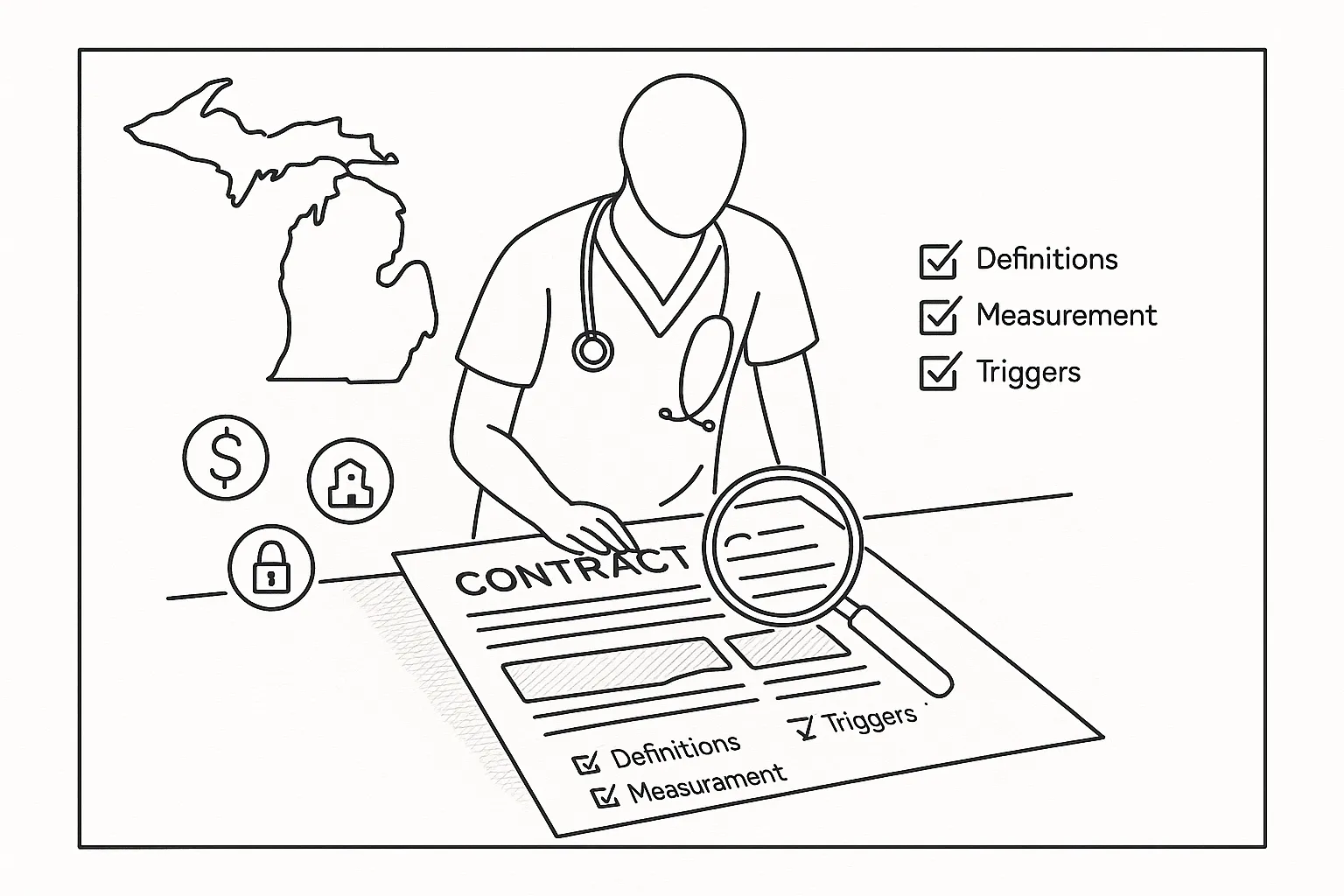
Employment agreements often contain standard-looking language with significant financial or licensing consequences. A thorough nurse practitioner contract review should address compensation mechanics, productivity reconciliation, professional duties, credentialing, malpractice coverage, restrictive covenants, termination rights, and repayment obligations as an interconnected set of terms.
Definitions are especially important. Terms such as “compensation,” “gross collected charges,” “work RVUs,” and “cause” determine how later provisions are applied. The agreement should also explain when productivity is measured, when reconciliations occur, whether a negative balance carries forward, and which events trigger payment or repayment obligations.
- Measurement and timing: Determine how often productivity is calculated, when bonuses are paid, and whether the employer can revise or delay calculations.
- Conditions precedent: Identify whether compensation depends on payer enrollment, hospital privileges, credentialing, or another condition outside the NP’s direct control.
- Professional duties: Confirm the schedule, locations, call responsibilities, administrative work, patient volume expectations, and authority to change those obligations.
- Post-employment obligations: Review restrictions, record-return requirements, notice duties, tail coverage, and repayment clauses that survive termination.
Employer-favorable default language is common. The goal of attorney review is to identify where the drafting may reduce take-home pay, impose an unexpected obligation, or expose the NP to a risk that is disproportionate to the position.
Compensation, Productivity Bonuses, and Benefits
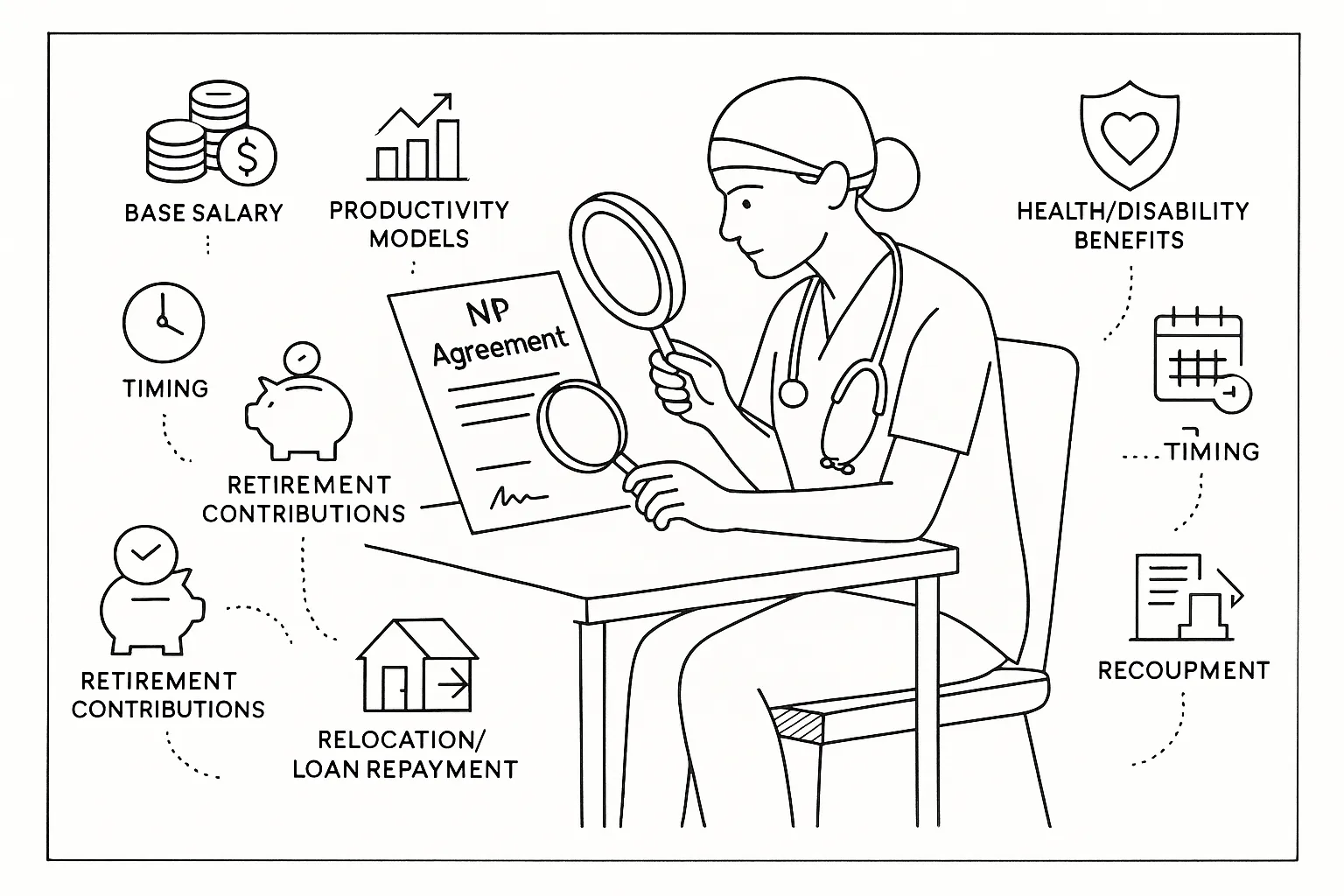
Compensation structures vary among Michigan hospitals, private practices, specialty groups, and other healthcare employers. Base salary is only one part of the analysis. The NP should understand how salary, productivity pay, collections, bonuses, benefits, and repayment obligations interact under realistic patient-volume and departure scenarios.
Base Salary, RVUs, Collections, and Reconciliation
A guaranteed salary can provide initial stability, but the agreement may later convert compensation to an RVU or collections model. Important terms include the guarantee period, conversion date, pay frequency, productivity threshold, conversion factor, and treatment of non-billable work. The contract should also state whether delayed credentialing or payer enrollment affects the start date or compensation.
In a collections-based model, compensation depends on revenue the employer actually receives. The definition of collections, attribution rules, payer denials, chargebacks, billing delays, and post-termination collections can all affect pay. An RVU model requires similar scrutiny of whether the formula uses work RVUs or another measure, which services receive credit, and whether the employer can change benchmarks. Our NP compensation and productivity review evaluates these mechanics together rather than relying only on the stated annual salary.
Negative accrual is a significant concern when an employer carries a productivity deficit into a later period or attempts to recover part of a guarantee. For example, an agreement may guarantee compensation for several months while allowing the employer to recoup a shortfall if later collections fail to reach a threshold. The calculation method, look-back period, carry-forward rules, and limits on recovery should be clear before the NP accepts the offer.
Benefits, Paid Time Off, and Bonus Repayment
Benefits can materially change the value of an offer. Review employer contributions to health, disability, and retirement plans; eligibility and vesting requirements; continuing education benefits; licensing expenses; paid time off; and whether unused PTO is treated differently at termination. Raise language should also distinguish between an automatic adjustment and a discretionary review that does not guarantee an increase.
Signing bonuses, relocation allowances, and loan repayment benefits commonly include clawbacks. The agreement should identify the repayment period, whether the amount is prorated, when payment becomes due, and whether repayment applies after resignation, termination for cause, or employer-initiated termination without cause. Accelerated lump-sum repayment can create substantial financial pressure even when the original benefit appeared favorable.
Michigan Scope of Practice, Supervision, and Credentialing
Contractual duties must be evaluated within the professional framework administered by the Michigan Board of Nursing and other applicable authorities. The agreement should accurately describe the NP’s role, prescribing responsibilities, delegated functions, practice setting, and any physician supervision or collaboration requirements. It should not impose ambiguous duties that create uncertainty about clinical authority or professional accountability.
Some agreements require a specific supervisory or collaborative relationship, physician approval for designated services, or compliance with employer protocols that are more restrictive than the baseline regulatory framework. A supervision and collaboration agreement review can determine whether those obligations are clearly defined, operationally workable, and consistent with the position presented to the NP.
- Delegation and clinical authority: Identify procedures, patient populations, or prescribing decisions that require approval and determine who is available to provide it.
- Credentialing and privileges: Clarify who completes applications, pays associated expenses, and bears the risk if hospital privileges or payer enrollment are delayed or denied.
- Licensure and DEA registration: Determine which party is responsible for fees, renewals, administrative support, and maintaining required registrations.
- Telehealth and multiple locations: Confirm where services may be provided, whether the employer can add locations, and whether remote-care duties are compatible with credentialing and applicable state requirements.
- Reporting obligations: Review notice requirements for investigations, disciplinary matters, restrictions, or other events that may affect employment or privileges.
Credentialing contingencies deserve particular attention because they can delay the start of compensation or permit termination before the NP begins practicing. The agreement should allocate responsibility for foreseeable delays and explain whether salary continues when an administrative process remains pending.
Malpractice Insurance, Tail Coverage, and Indemnification
Malpractice and indemnification provisions allocate significant financial and professional risk. The agreement should identify the policy type, coverage limits, retroactive date, named insureds, exclusions, and responsibility for post-employment coverage. A focused malpractice and tail insurance review can clarify whether the stated coverage protects the NP throughout employment and after departure.
- Occurrence coverage: Generally responds to covered incidents that occur during the policy period, regardless of when the claim is later made.
- Claims-made coverage: Generally requires the policy to remain active when the claim is made, making an extended reporting endorsement or tail policy important after employment ends.
- Tail responsibility: Determine whether the employer or NP pays, which termination events change that allocation, and whether another form of prior-acts coverage is permitted.
- Notice and cooperation: Review deadlines for reporting claims or incidents and the NP’s duty to assist with investigations or litigation after employment.
Indemnification language should also be reviewed separately from insurance. A provision that requires the NP to indemnify the employer for broad third-party claims, billing issues, or corporate compliance failures may create exposure beyond ordinary professional negligence. The contract should explain who controls the defense, who approves settlement decisions, and whether indemnity obligations are limited to conduct within the NP’s responsibility.
Michigan Non-Competes, Termination Rights, and Clawbacks
Restrictive covenants and termination provisions frequently determine whether an NP can move to another Michigan employer without interrupting income or relocating. They also affect malpractice obligations, bonus repayment, final compensation, patient transition duties, and access to post-employment collections. These provisions should be read together rather than evaluated in isolation.
Non-Compete and Non-Solicitation Restrictions
A non-compete may prohibit practice within a defined area for a specified period, while a non-solicitation clause may restrict contact with former patients, referral sources, or employees. Michigan law permits enforcement of reasonable restrictions protecting legitimate competitive business interests under MCL 445.774a, but the language and practical circumstances matter. The duration, geographic scope, prohibited activities, and locations used to measure the restriction should therefore be identified precisely.
A Michigan-focused non-compete review should also consider whether the restriction applies after every form of termination and whether appropriate exclusions are available. Potential carve-outs may address existing patients, hospital-based positions, work outside the NP’s specialty, locations where the NP did not practice, or employer-initiated termination without cause. The practical effect can differ substantially between dense markets such as Detroit or Grand Rapids and communities with fewer alternative employers.
For-Cause Termination, Without-Cause Notice, and Repayment
For-cause provisions allow termination after a defined default, while without-cause termination generally permits either party to end the relationship after notice. Vague standards based on employer satisfaction, broad policy violations, or undefined performance failures can allow immediate termination with limited opportunity to cure. The agreement should distinguish truly immediate events from defaults that can reasonably be corrected.
Without-cause language should state the notice period, whether the employer may remove the NP from duties during notice, and whether salary and benefits continue. The contract should also explain when unpaid bonuses, productivity compensation, or post-termination collections are calculated. A dedicated contract termination review can identify obligations that continue after employment and determine how notice interacts with restrictive covenants, tail coverage, and repayment clauses.
Clawbacks may require repayment of signing bonuses, relocation assistance, loan benefits, or guaranteed compensation. Particular concerns include repayment after employer-initiated termination without cause, immediate lump-sum deadlines, non-prorated balances, and negative accrual provisions that permit recovery beyond the original guarantee period. Reviewing likely departure scenarios before signing helps the NP understand the maximum potential exposure.
When to Obtain a Michigan NP Contract Review
Legal review is most useful before the agreement is signed and before the NP relies on verbal assurances that do not appear in the written contract. Review is especially important when the offer includes productivity pay, broad restrictive covenants, repayment obligations, claims-made malpractice coverage, uncertain credentialing contingencies, or supervision terms that do not match the expected practice arrangement.
A thorough attorney review provides plain-language explanations of compensation formulas, identifies provisions that shift disproportionate risk, assesses malpractice and termination exposure, and explains how restrictions may affect future opportunities. At Chelle Law, the process includes secure document submission, attorney analysis, and a consultation focused on the practical effect of the agreement on income, professional obligations, and career mobility.
Review Your Michigan NP Contract Before You Sign
Chelle Law reviews Michigan nurse practitioner employment and independent contractor agreements to explain compensation, malpractice, termination, and post-employment risks.
Contact Chelle LawExplore Nurse Practitioner Contract Guidance
Review Chelle Law’s services, educational resources, and state-specific contract information.