
When a nurse practitioner accepts a position in Mississippi—whether practicing in Jackson, Gulfport, Hattiesburg, or elsewhere in the state—the employment or independent contractor agreement becomes the governing document for compensation, scope of practice, malpractice coverage, and post-employment restrictions. These agreements operate within the framework of Mississippi law, including oversight by the Mississippi Board of Nursing and statutory authority under Title 73 of the Mississippi Code governing advanced practice registered nurses.
Subtle drafting differences can materially affect productivity-based compensation, collaborative practice arrangements, restrictive covenants, and termination rights. A Mississippi nurse practitioner contract review helps clarify how employer-drafted language interacts with state practice requirements and where financial or professional risk may be embedded. Chelle Law examines each agreement line by line, including collections formulas, negative accrual provisions, tail insurance responsibility, notice requirements, and post-employment limitations, so the NP can evaluate the offer with a clearer understanding of its practical consequences.
Key Takeaways for Mississippi Nurse Practitioners
- Compensation formulas involving base pay, collections, RVUs, bonuses, clawbacks, or negative accrual can directly affect take-home pay.
- Malpractice provisions should identify the coverage type, policy limits, and who must pay for tail coverage when the agreement ends.
- Supervision, collaboration, prescribing, credentialing, and scope-of-practice duties should be reviewed alongside Mississippi regulatory requirements.
- Restrictive covenants, non-solicitation clauses, and broad termination definitions can limit future employment or trigger repayment obligations.
- Attorney review before signing can identify financial exposure, ambiguous terms, and provisions that warrant clarification or proposed revisions.
Why a Focused Contract Review Matters in Mississippi
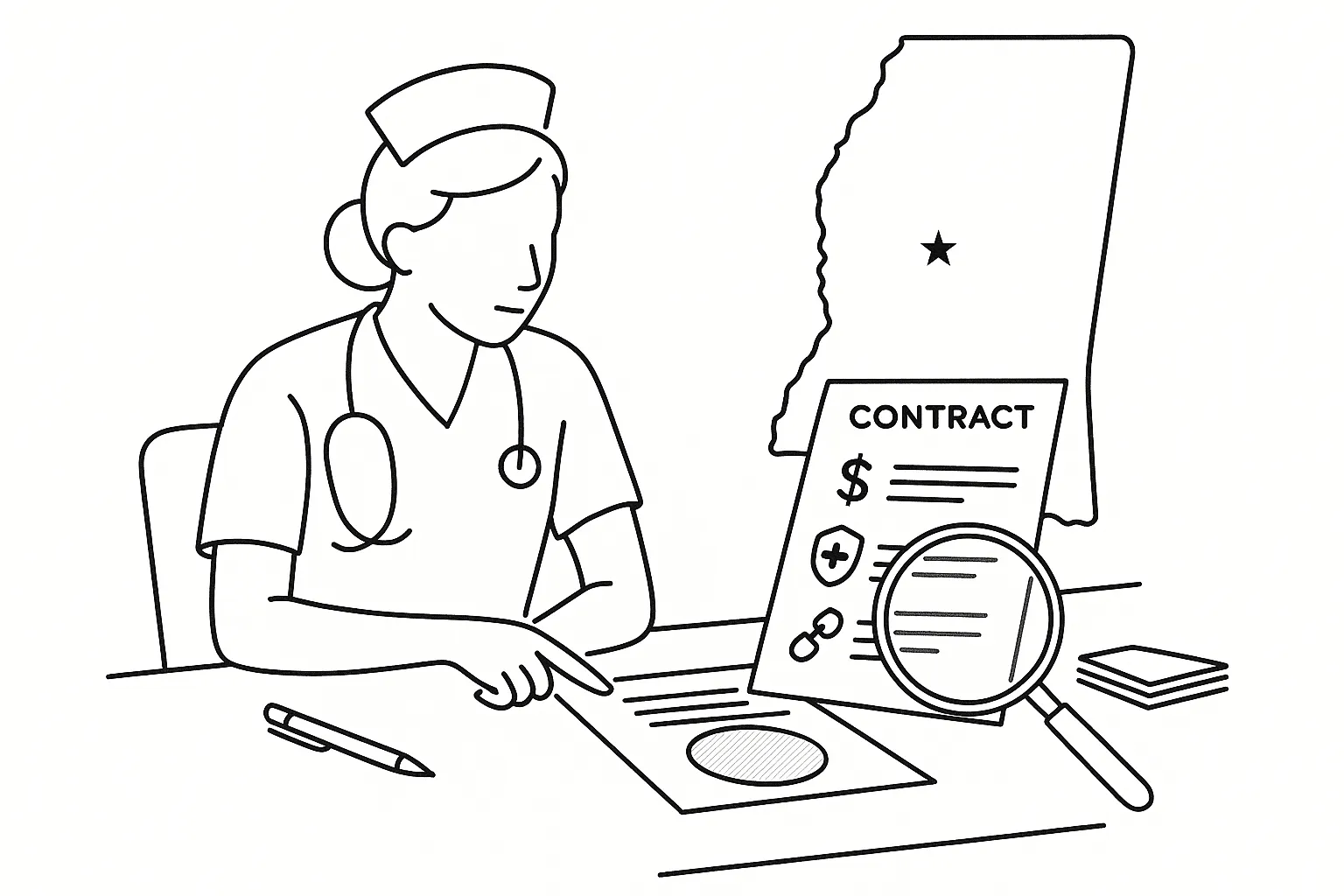
Mississippi’s regulatory and healthcare environment means contract language can have significant effects on an NP’s income and ability to practice. State requirements involving collaborative arrangements, prescriptive authority, and professional oversight may differ from those in other jurisdictions. An employer may also layer economic terms, performance standards, and post-termination restrictions onto those regulatory obligations.
A focused review considers whether the agreement accurately assigns responsibility for collaborative documentation, licensing, prescribing authority, credentialing, and required physician involvement. It also examines how compensation adjustments, malpractice obligations, and restrictive covenants may operate if the NP changes locations, loses a collaborator, experiences a credentialing delay, or leaves the employer. For agreements with detailed practice protocols, a separate review of supervision and collaboration terms may help identify contractual duties that extend beyond the parties’ basic regulatory obligations.
Mississippi NP Contract Terms That Require Careful Review

Compensation, liability coverage, practice requirements, and exit provisions are among the terms most likely to affect financial stability and career flexibility. These provisions should be read together because a favorable salary can be undermined by an unclear bonus formula, expensive tail obligation, broad non-compete, or repayment clause triggered at termination.
Compensation, Productivity, and Bonus Formulas
NP compensation models may include a guaranteed base salary, collections-based pay, RVU formulas, or a combination of salary and productivity incentives. The agreement should explain payment frequency, measurement periods, applicable thresholds, allowable deductions, reconciliation procedures, and whether compensation can be adjusted retroactively. A 40% collections split, for example, may produce a very different result if “collections” is reduced by chargebacks, payer adjustments, or expenses before the percentage is applied.
RVU provisions should identify the type of RVU being measured, the conversion factor, target-reset rules, and the treatment of shared visits or billing modifiers. Bonus language should also distinguish an enforceable formula from a discretionary plan the employer can change or withhold. Chelle Law’s NP compensation and productivity review evaluates these mechanics, including negative accrual and repayment risks.
Malpractice Insurance and Tail Responsibility
The contract should specify whether coverage is claims-made or occurrence-based, identify the policy limits, and state who pays the premiums. Claims-made coverage generally requires continued protection for claims reported after the policy ends, often through tail coverage or another extended reporting arrangement. An occurrence policy ordinarily covers an incident that occurred during the policy period even if the claim is reported later.
Employers may require the NP to purchase tail coverage or reimburse the employer after a voluntary departure. The agreement should also address whether coverage extends to outside or independent contractor activities and whether defense costs affect available limits. A targeted malpractice and tail insurance review can clarify the potential cost before the NP signs.
Scope of Practice, Collaboration, and Credentialing
Mississippi contract language may address collaborative practice arrangements, physician availability, prescribing protocols, performance standards, and the allocation of administrative responsibilities. The agreement should identify who maintains required documents, pays licensing and credentialing expenses, and manages changes involving collaborators or practice locations. It should also be reviewed for non-statutory duties or penalties that may exceed the parties’ regulatory obligations.
Credentialing and privileging terms should explain who handles applications, what happens if approval is delayed, and whether compensation begins before or after the NP is authorized to bill. The employer’s ability to modify protocols unilaterally also matters when a change could affect duties, schedule, prescribing, or compensation.
Non-Competes, Termination, and Repayment Obligations
Non-compete and non-solicitation provisions should be evaluated under the applicable law and the specific facts of the employment relationship. Duration, geographic reach, restricted activities, and the employer interests identified in the clause all matter. Even when enforceability is uncertain, broad drafting can create practical barriers to accepting another position, making an early review of the non-compete restrictions important.
Termination provisions establish notice periods, for-cause events, immediate termination rights, and entitlement to compensation after departure. They may also trigger repayment of signing bonuses, relocation assistance, education benefits, or other advances. A termination and exit-term review can identify whether ordinary performance concerns could be treated as cause, whether repayment differs by termination type, and how unpaid productivity or bonuses will be calculated.
Review Priorities by Career Stage and Practice Setting
New graduates and first-time NP employees should pay particular attention to collaboration requirements, geographic restrictions, bonus calculations, malpractice coverage, and repayment obligations tied to signing or relocation benefits. Early-career clinicians may have less experience identifying provisions that create debt after an early departure, so a new graduate contract review can focus on those transition risks.
Experienced and transitioning NPs may need closer review of RVU definitions, income recapture clauses, leadership duties, equity or buy-in language, and restrictions triggered by changes in ownership or supervisory structure. Telehealth, hospital, and specialty roles may also use patient-volume metrics, shared-visit rules, call obligations, or coverage expectations that affect productivity accounting.
Independent contractors should confirm whether the written classification aligns with the agreement’s allocation of schedule control, expenses, insurance, taxes, and benefits. The practical differences between W-2 employment and 1099 contracting can materially affect the total value and risk of an offer.
Common Red Flags in Mississippi NP Agreements
Individual terms must be evaluated in context, but the following provisions frequently warrant closer attention:
- Undefined repayment obligations for signing bonuses, relocation assistance, or loan benefits that accelerate upon resignation.
- Discretionary bonus language without objective metrics, reporting rights, or a defined payment timeline.
- Vague definitions of collections or RVUs that permit retrospective adjustments or negative accrual.
- Claims-made malpractice coverage that shifts tail responsibility to the NP without explaining the potential cost.
- Unilateral amendment clauses allowing the employer to change compensation, protocols, locations, or duties with limited notice.
- Non-compete or non-solicitation restrictions with expansive geography, unclear restricted activities, or undefined triggers.
- For-cause definitions broad enough to weaken notice rights or trigger repayment and forfeiture provisions.
Identifying a red flag does not determine the final legal result. It allows the NP and reviewing attorney to assess the likely financial and professional consequences, identify missing information, and prioritize provisions that may need clarification.
Mississippi Nurse Practitioner Contract Review Checklist
A structured review should address income, liability, regulatory obligations, and career mobility. Important steps include:
- Confirm the stated employment classification and its consequences for benefits, expenses, and taxes.
- Map the complete compensation formula, including payment timing, thresholds, reconciliation, and negative accrual.
- Review malpractice coverage type, policy limits, tail responsibility, and treatment of defense costs.
- Compare collaboration, supervision, prescribing, and scope-of-practice language with applicable Mississippi requirements.
- Analyze restrictive covenants by duration, geography, restricted activity, and triggering event.
- Identify every repayment clause and the events that activate or reduce the obligation.
- Examine termination notice, cause definitions, post-termination compensation, and continuing duties.
- Confirm benefits, leave, CME, licensing fees, credentialing costs, and expense reimbursement terms.
- Assess credentialing, privileging, start-date, and delayed-billing provisions.
- Review unilateral amendment, assignment, dispute-resolution, and governing-law clauses.
What to Expect From an Attorney-Led Contract Review
Legal review is most useful before an employment or independent contractor agreement is signed. It is particularly important when the offer includes productivity compensation, RVU targets, repayment or clawback language, claims-made malpractice coverage, or broad post-employment restrictions.
- A line-by-line analysis translating contract language into practical financial, regulatory, and career consequences.
- Identification of ambiguous or one-sided provisions affecting compensation, professional obligations, and mobility.
- Written comments and, when appropriate, proposed language or focused questions for the employer.
- A discussion of priorities and available options without promising a particular negotiation outcome.
Chelle Law provides secure document handling and written guidance tailored to the agreement, the facts of the offer, and the Mississippi practice environment. The goal is to give the NP a clear risk framework before accepting obligations that may affect income, licensure responsibilities, and future employment.
Have a Mississippi NP Contract Reviewed Before You Sign
Chelle Law can evaluate compensation, malpractice coverage, collaboration requirements, restrictive covenants, and termination terms in your proposed agreement.
Contact Chelle LawExplore Nurse Practitioner Contract Guidance
Review available legal services, educational resources, and state-specific contract information for nurse practitioners.