
When a nurse practitioner accepts a position in Ohio—whether in Columbus, Cleveland, Cincinnati, or another healthcare market—the employment or independent contractor agreement controls important financial and professional terms. It may determine compensation, productivity expectations, malpractice obligations, termination rights, and post-employment restrictions. These provisions must also be considered within Ohio’s regulatory framework, including oversight by the Ohio Board of Nursing and the statutory authority governing advanced practice registered nurses under Ohio Revised Code Chapter 4723.
An Ohio nurse practitioner contract review helps identify how employer-drafted language may affect earnings, liability, regulatory responsibilities, and future career mobility. Chelle Law evaluates the complete agreement and related exhibits, including compensation formulas, restrictive covenants, insurance provisions, repayment obligations, and supervision or collaboration terms. The goal is to clarify the practical consequences of the proposed arrangement before the NP signs or begins work.
Key Contract Review Priorities for Ohio Nurse Practitioners
- Confirm whether the relationship is structured as W-2 employment, 1099 independent contracting, or a hybrid arrangement and identify the expenses and obligations assigned to the NP.
- Review salary guarantees, collections formulas, RVU conversion factors, productivity thresholds, reporting rights, and negative accrual provisions.
- Determine whether malpractice coverage is claims-made or occurrence-based and who must purchase tail coverage after termination.
- Evaluate without-cause notice, definitions of cause, final compensation, and repayment obligations tied to bonuses, relocation, or educational support.
- Assess non-compete, non-solicitation, and geographic restrictions for their effect on future practice opportunities in Ohio.
- Confirm that scope-of-practice, prescribing, supervision, collaboration, and credentialing provisions are clear and consistent with the proposed role.
Identify the Type of NP Agreement
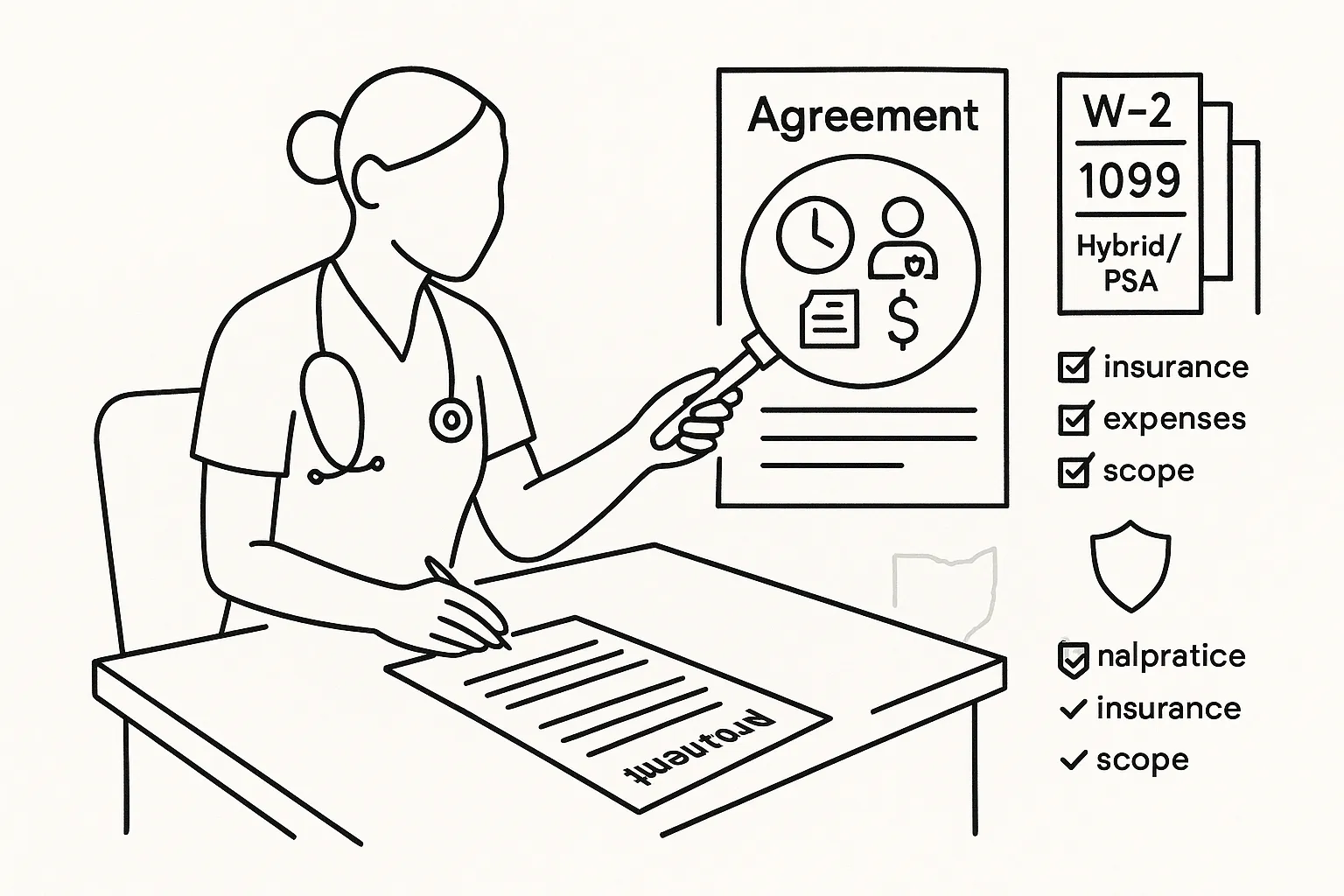
Nurse practitioner relationships commonly appear as W-2 employment agreements, 1099 independent contractor agreements, or hybrid personal-services arrangements. A W-2 agreement often gives the employer greater control over scheduling, performance standards, and workplace policies while addressing benefits and payroll withholding. A contractor agreement may shift taxes, professional expenses, insurance costs, and administrative responsibilities to the NP. The practical differences are explained further in the guide to W-2 versus 1099 status for nurse practitioners.
Classification should be evaluated based on both the contract language and the actual working relationship. Scheduling control, billing practices, supervision, required locations, performance standards, and responsibility for business expenses may all matter. A document labeled an “independent contractor agreement” can still impose extensive employer control, so NPs should understand the operational and financial effect of every provision. A focused independent contractor agreement review can identify terms that shift unexpected costs or risk to a 1099 provider.
Ohio Scope of Practice and Regulatory Terms
Ohio nurse practitioner agreements should be reviewed in light of the role described in the contract and the requirements administered by the Ohio Board of Nursing. The agreement may address scope of practice, prescribing, professional licensure, credentialing, supervision or collaboration, and responsibility for maintaining required registrations. These provisions should accurately reflect the proposed clinical setting and should not leave essential responsibilities undefined.
Particular attention should be given to clauses allowing the employer to change clinical duties, locations, schedules, or supervisory arrangements unilaterally. Vague language can create operational and regulatory risk if the parties have different expectations about the NP’s authority or support structure. Agreements should also identify who pays licensing, credentialing, and registration expenses and what happens if credentialing delays the start date. Additional context is available in the resource on supervision and collaboration agreements.
Compensation, Malpractice, and Termination Provisions

Compensation and Productivity Formulas
Common compensation structures include a guaranteed salary, base salary plus productivity, collections-based compensation, and RVU-based models. The contract should explain when compensation is earned, how productivity is measured, when reports are provided, and whether the NP can verify the employer’s calculations. If billing, coding, scheduling, or collections are controlled by the employer, those operational decisions may directly affect the NP’s compensation.
Productivity terms should identify thresholds, conversion factors, payment timing, exclusions, and the treatment of shared visits or other services. Negative accrual provisions deserve particular attention because they may allow a deficit from one period to offset future bonuses or create a repayment demand. Chelle Law’s NP compensation and productivity review evaluates these mechanics and the reporting language supporting them.
Malpractice Coverage and Tail Responsibility
The agreement should identify whether professional liability coverage is occurrence-based or claims-made, the applicable limits, and any relevant exclusions. Occurrence coverage generally addresses covered acts occurring during the policy period even when a claim is brought later. Claims-made coverage may require tail insurance when the policy ends, making responsibility for post-termination coverage a significant contract issue.
Tail responsibility may depend on whether the NP resigns, is terminated without cause, or is terminated for cause. The contract should also be reviewed for indemnification provisions, defense-cost allocation, and limitations affecting telehealth, moonlighting, or work at additional locations. A dedicated malpractice and tail insurance review can clarify these obligations before they become a post-employment dispute.
Termination Rights and Repayment Obligations
Termination provisions determine how either party can end the relationship and what obligations continue afterward. The agreement should distinguish for-cause termination from without-cause termination, define cause with sufficient clarity, and state the required notice period. It should also explain the treatment of earned salary, productivity compensation, bonuses, paid leave, and other amounts when employment ends.
Signing bonuses, relocation support, educational benefits, and other incentives may be subject to repayment if the NP leaves before a specified date. Review should focus on the triggering events, whether repayment is prorated, and whether the obligation applies after an employer-initiated termination. NPs considering departure or reviewing notice language can learn more about contract termination review.
Non-Competes, Scheduling, and Employment Benefits
Restrictive covenants may include non-compete, non-solicitation, confidentiality, and patient or employee restrictions. Ohio contracts may define the restricted area by mileage, county, facility location, or another geographic measure. The duration, covered services, triggering events, and application to future employers should all be reviewed because a broadly drafted restriction can affect opportunities in Columbus, Cleveland, Cincinnati, and surrounding markets.
The practical effect of a restriction often depends on how the contract defines the NP’s services and work locations. Multi-site language can expand the restricted territory if every facility becomes a separate reference point. A nurse practitioner non-compete review can identify overbroad terms and explain how the provision may affect future mobility.
Scheduling provisions should define regular hours, call coverage, weekend or holiday duties, telehealth expectations, and the employer’s ability to assign additional sites. The agreement should also address whether call, extra shifts, administrative work, and telehealth visits count toward productivity. Benefits provisions may cover health insurance, retirement contributions, paid time off, parental leave, CME time and reimbursement, licensing fees, credentialing assistance, and professional memberships. Any repayment condition tied to these benefits should be stated clearly in the signed agreement.
Contract Red Flags and Negotiation Priorities
Employer templates often contain provisions that transfer financial or professional risk to the NP. Important red flags include undefined compensation metrics, unilateral formula changes, limited reporting rights, negative accrual that survives termination, broad indemnification, unclear tail obligations, and repayment clauses without prorated forgiveness. Other concerns include unrestricted schedule or location changes and restrictive covenants tied to every facility where the NP provides services.
- Define “collections,” “cause,” “base salary,” productivity thresholds, and other material terms.
- Request regular compensation reports and reasonable access to information supporting bonus calculations.
- Identify who pays for tail insurance under each termination scenario.
- Limit repayment obligations through clear triggers, prorated calculations, and appropriate exceptions.
- Clarify work locations, scheduling authority, call responsibilities, and compensation for additional duties.
- Narrow restrictive covenants by duration, geography, covered services, and triggering events where appropriate.
Effective negotiation generally focuses on precise alternative language rather than broad objections. For example, an NP may request a defined collections formula tied to regular statements, a clear allocation of tail responsibility, or prorated forgiveness of a signing bonus after a portion of the service period is completed. The broader guide to nurse practitioner contract red flags explains additional provisions that deserve attention.
Ohio NP Pre-Signing Checklist
Before signing, obtain the complete agreement and every incorporated exhibit, compensation schedule, policy, or addendum. Review should account for the documents governing productivity, benefits, restrictive covenants, malpractice coverage, and supervision or collaboration. An offer letter alone may not contain the complete terms of the relationship.
- Confirm the effective date, anticipated start date, credentialing conditions, and any probationary period.
- Verify salary, payment frequency, bonus formulas, thresholds, reconciliation rules, and reporting rights.
- Identify the malpractice policy type, coverage limits, exclusions, and tail responsibility.
- Review for-cause and without-cause termination, notice requirements, and post-termination compensation.
- Calculate potential repayment obligations for signing bonuses, relocation, CME, or other support.
- Map any non-compete territory against current and potential future practice locations.
- Confirm scheduling, call, telehealth, floating, and multi-location expectations.
- Keep a dated copy of the signed agreement, exhibits, amendments, and related communications.
How an Ohio NP Contract Attorney Can Help
A healthcare contract attorney can interpret compensation mechanics, identify provisions affecting malpractice exposure or professional mobility, and explain how termination and repayment clauses operate together. Review may also address worker classification, regulatory responsibilities, and whether the written agreement accurately reflects the promised position. When changes are appropriate, counsel can prepare focused redlines or proposed language addressing the identified risk.
Review is most useful before the agreement is signed, while the NP can still seek clarification or revisions. Providing the complete contract, exhibits, offer communications, and compensation materials allows the attorney to evaluate the entire arrangement rather than isolated clauses. Chelle Law’s attorney-led review focuses on contractual clarity, financial exposure, professional obligations, and the NP’s future practice options.
Review Your Ohio Nurse Practitioner Contract Before You Sign
Chelle Law reviews Ohio NP employment and independent contractor agreements for compensation, malpractice, termination, restrictive covenant, and regulatory risks. Get clear guidance on the terms that may affect your income and career.
Contact Chelle LawExplore Nurse Practitioner Contract Guidance
Review Chelle Law’s services, educational resources, and state-specific contract guidance for nurse practitioners.