
When a nurse practitioner accepts a position in South Carolina—whether practicing in Charleston, Columbia, Greenville, or another healthcare market—the employment or independent contractor agreement governs compensation, duties, malpractice allocation, termination rights, and post-employment restrictions. These agreements operate within South Carolina law, including oversight by the South Carolina Board of Nursing and statutory authority under Title 40, Chapter 33 of the South Carolina Code governing advanced practice registered nurses.
Subtle drafting differences can materially affect productivity-based compensation, restrictive covenant obligations, and the ability to leave a position without significant financial exposure. Contract terms should also align with applicable state requirements involving nurse practitioner scope of practice, prescribing, supervision, collaboration, and professional licensure. A South Carolina nurse practitioner contract review helps identify how employer-drafted language may affect both daily practice and long-term career mobility.
At Chelle Law, we conduct a structured, attorney-led assessment of the complete agreement. The review examines collections formulas, negative accrual, repayment obligations, malpractice and tail coverage, notice requirements, collaboration provisions, and post-employment restrictions so the NP can understand the practical consequences before signing.
South Carolina NP Contract Review Priorities
- Review the agreement line by line for language that may reduce income, increase liability, or limit career mobility.
- Confirm that compensation formulas, bonus conditions, clawbacks, and negative accrual provisions clearly explain how pay is calculated and reconciled.
- Identify the malpractice policy type and determine who must purchase tail coverage when the relationship ends.
- Evaluate non-compete, non-solicitation, confidentiality, and geographic restrictions before they affect future South Carolina practice opportunities.
- Confirm that scope-of-practice, prescribing, supervision, and collaboration terms are consistent with applicable South Carolina requirements and actual workplace expectations.
- Understand termination notice, final compensation, repayment obligations, and the provisions that survive separation.
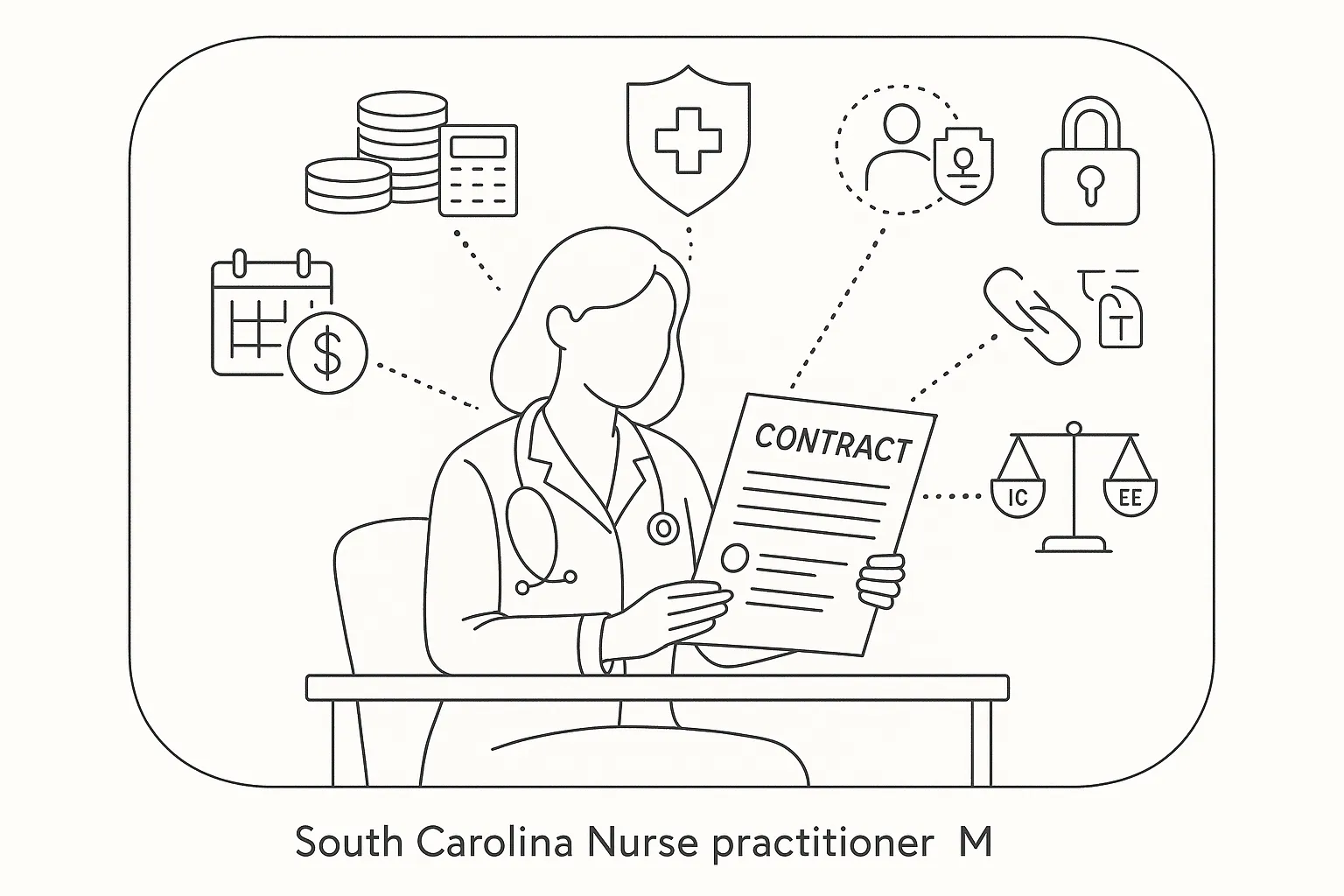
A complete nurse practitioner contract review considers these provisions together rather than treating each clause in isolation. Compensation may depend on assigned duties and locations, while termination may trigger bonus repayment, tail insurance costs, or restrictive covenants. We assess how the wording may operate within the South Carolina regulatory and employment context without promising a particular enforceability outcome.
Compensation, Bonuses, and Benefits
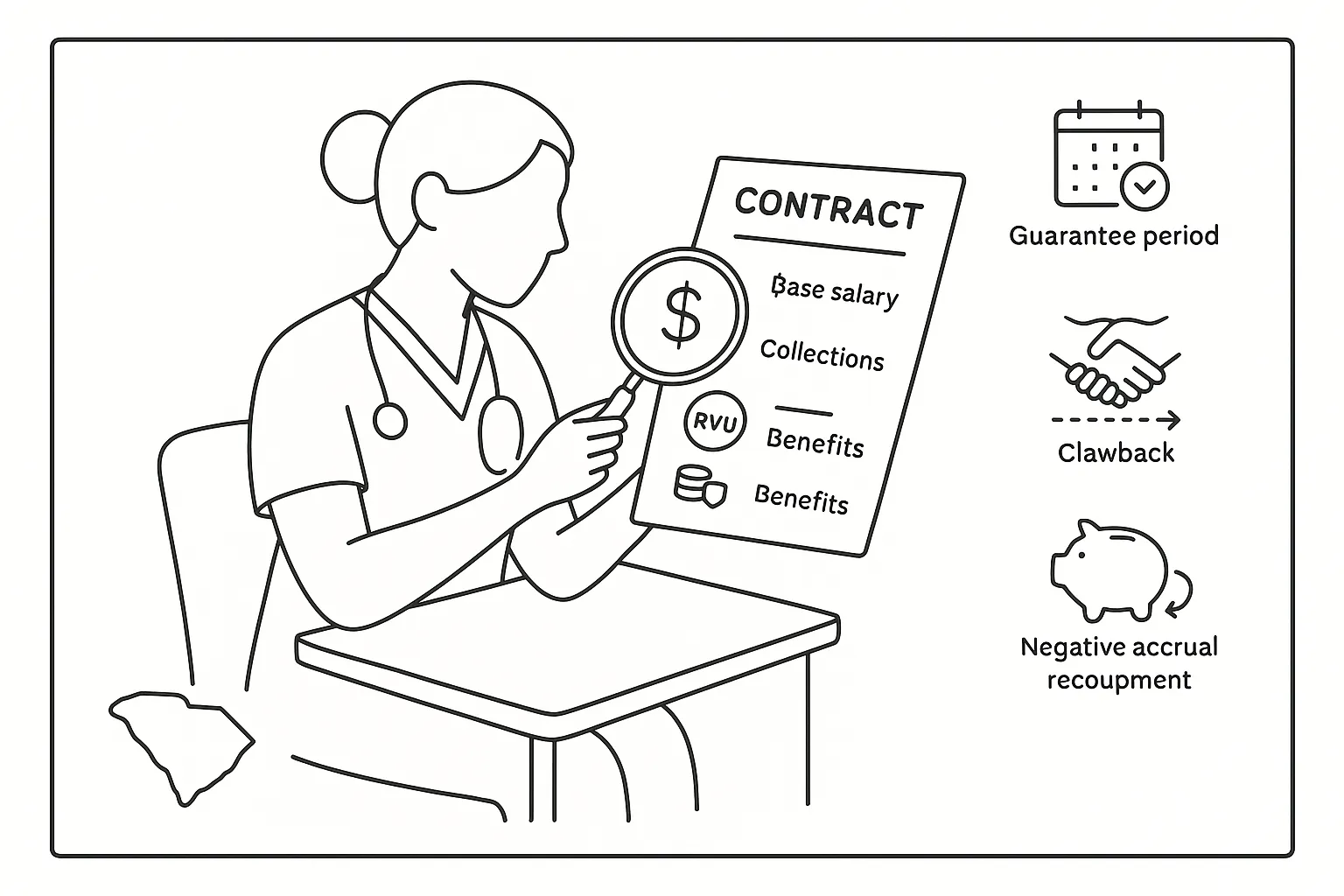
Compensation provisions are often among the most complex and consequential parts of an NP agreement. We analyze how base pay, productivity metrics, bonuses, benefits, and reconciliation terms interact so the nurse practitioner can evaluate expected cash flow and downside risk. A focused NP compensation review can be especially useful when pay depends on collections, RVUs, quality measures, or changing productivity thresholds.
Base Salary and Productivity Models
Base compensation may be stated as a guaranteed annual salary, an hourly wage, or a transitional guarantee that later converts to productivity pay. Collections-based and RVU-based models require careful review of the definitions, calculations, and reconciliation schedule used by the employer.
- The duration of any guaranteed compensation period and what happens after it expires.
- The definitions of “collections” and “net collections,” including deductions applied before compensation is calculated.
- How work RVUs are credited, which schedule and conversion factor apply, and when reconciliations occur.
- Whether negative accrual or reconciliation language permits the employer to carry a deficit forward or recoup an alleged overpayment.
For example, an agreement may guarantee a salary for 12 months and then convert compensation to a percentage of collections. If billing adjustments, refunds, or employer-controlled deductions reduce the collections attributed to the NP, actual compensation may differ substantially from the headline percentage. The review should identify those variables and explain how they may affect pay during employment and after termination.
Bonuses, Repayment Terms, and Benefits
Bonus structures may depend on collections thresholds, panel size, quality measures, productivity percentiles, or employer discretion. The agreement should explain when a bonus becomes earned, when it is paid, whether the NP must remain employed on the payment date, and how the employer calculates the result. Any signing bonus, relocation allowance, or loan repayment benefit should also identify its vesting schedule and the events that trigger repayment.
Benefits language should clarify health insurance cost-sharing, retirement contributions and vesting, CME allowances, licensure or prescribing-related fee reimbursement, and paid leave. Terms such as “eligible” or “at the employer’s discretion” may leave significant value uncertain. We flag provisions that allow important compensation or benefits to depend on unilateral decisions that are not explained in the agreement.
South Carolina Scope of Practice and Collaboration Terms
A South Carolina NP contract should align with the nurse practitioner’s authorized scope of practice and applicable requirements administered by the South Carolina Board of Nursing. It should also accurately describe clinical duties, prescribing responsibilities, collaboration expectations, credentialing conditions, and the resources the employer will provide. Contract language cannot be evaluated solely as an operational preference when it also affects professional compliance or licensure risk.
- Whether the agreement clearly defines clinical responsibilities, prescriptive authority, and decision-making duties.
- Whether required supervision or collaboration is accurately described and supported by the employer’s actual operating structure.
- Who is responsible for maintaining required agreements, approvals, credentialing, and related documentation.
- Whether the employer can unilaterally change duties, schedules, call coverage, patient volume, or work locations.
- How the contract addresses telehealth, prescribing, multi-site practice, and services outside the NP’s ordinary specialty or role.
Overly broad language can create both employment and professional risk if operational expectations change or if the agreement assigns responsibilities without defining the required support. Our supervision and collaboration agreement review evaluates whether these provisions clearly allocate responsibilities and reflect the contemplated South Carolina practice arrangement.
Malpractice Insurance, Tail Coverage, and Indemnification
Malpractice coverage is a substantial professional and financial issue. The agreement should state whether the employer provides coverage, identify the policy type and applicable limits, and explain what happens when employment ends. It should also establish whether the NP is insured under the employer’s policy and whether the employer can change coverage during the contract term.
Claims-Made and Occurrence Coverage
An occurrence policy generally covers an incident that occurs during the policy period even if the claim is asserted later. A claims-made policy generally requires the policy to remain active when the claim is made, which means extended reporting or tail coverage may be necessary after the relationship ends. The contract should clearly allocate responsibility for obtaining and paying for that coverage.
Tail obligations may depend on whether the NP resigns, is terminated for cause, or remains employed for a stated period. Because the potential expense can be significant, the allocation should not be left to an undefined policy or future employer decision. A dedicated malpractice and tail insurance review can clarify the policy mechanics and separation-related exposure.
Indemnification and Liability Allocation
Indemnification provisions may require the NP to reimburse the employer for losses, claims, legal expenses, or other costs in specified circumstances. We review whether those duties are mutual or one-sided, whether they extend beyond the NP’s conduct, and whether they conflict with the stated malpractice coverage. Broad indemnity or repayment language can create exposure that is not apparent from the insurance section alone.
Non-Competes and Other Post-Employment Restrictions
Restrictive covenants can materially affect an NP’s ability to move between employers in Charleston, Columbia, Greenville, or another South Carolina market. South Carolina courts generally scrutinize whether a non-compete is reasonable in duration and geographic scope and tied to a legitimate business interest, but the practical burden begins with the actual wording of the agreement. A careful non-compete review identifies the activities, locations, and termination events covered by the restriction.
- The duration and geographic reach of the restriction, including how distance is measured and whether multiple facilities create overlapping restricted areas.
- The definition of competing activity and whether it encompasses telehealth, administrative work, moonlighting, or practice outside the NP’s current specialty.
- Whether the restriction applies after resignation, termination without cause, nonrenewal, or an employer breach.
- Patient and employee non-solicitation provisions, confidentiality obligations, and restrictions involving referral sources.
- Liquidated damages, injunctive-relief provisions, and attorney-fee clauses that may increase the cost of a dispute.
Non-solicitation and confidentiality terms can remain important even when a non-compete is narrow. Broad patient definitions, restrictions on working with former colleagues, or limits on permissible communications may affect future employment and continuity of care. Garden leave language should likewise explain the compensation paid during the restricted period and the conditions the NP must satisfy to receive it.
Termination, Notice, and Repayment Obligations
Termination provisions determine how either party can end the relationship and frequently activate other financial obligations. The agreement should distinguish termination for cause from termination without cause, provide workable notice procedures, and explain whether an alleged breach can be cured before immediate termination occurs.
- The events permitting immediate termination, including loss or restriction of licensure, credentialing problems, exclusion, criminal conduct, or a material contract breach.
- The notice required for resignation or without-cause termination and whether the employer can remove the NP from duties during the notice period.
- Payment of accrued salary, earned bonuses, outstanding collections, unused leave, or severance after separation.
- Repayment of signing bonuses, relocation assistance, loan benefits, or other advances following specified termination events.
- The effect of termination on tail coverage, restrictive covenants, confidentiality, record access, and cooperation with later claims.
Post-termination compensation is particularly important in collections-based arrangements because revenue may arrive after the final workday. The contract should explain whether the NP receives those collections, how chargebacks are handled, and when the final accounting occurs. An attorney can also identify provisions that permit accelerated repayment or employer offsets against the final paycheck. Learn more about reviewing NP termination terms before giving notice or signing a separation-related document.
When to Request an Attorney Contract Review
Legal review is most useful after the NP receives the complete written offer and before signing, resigning from another position, relocating, or relying on promised compensation. It may also be appropriate when an employer proposes an amendment, changes the compensation model, adds a new location, or presents a termination or repayment demand. The objective is to prioritize terms that materially affect income, professional obligations, liability, and mobility rather than treating every provision as equally negotiable.
Chelle Law’s review process includes secure document submission, line-by-line attorney analysis, written comments, and a consultation explaining the practical implications. The review may identify employer-favorable provisions, estimate exposure created by reconciliation or repayment clauses, explain malpractice coverage mechanics, and suggest alternative wording for significant concerns. Outcomes cannot be guaranteed, but understanding the agreement before acceptance allows the NP to make an informed decision about the position.
Review Your South Carolina NP Contract Before Signing
Chelle Law can evaluate compensation, collaboration requirements, malpractice coverage, restrictive covenants, and termination provisions in your proposed South Carolina agreement.
Contact Chelle LawExplore Nurse Practitioner Contract Guidance
Review related services, practical contract resources, and state-specific guidance for nurse practitioners.