
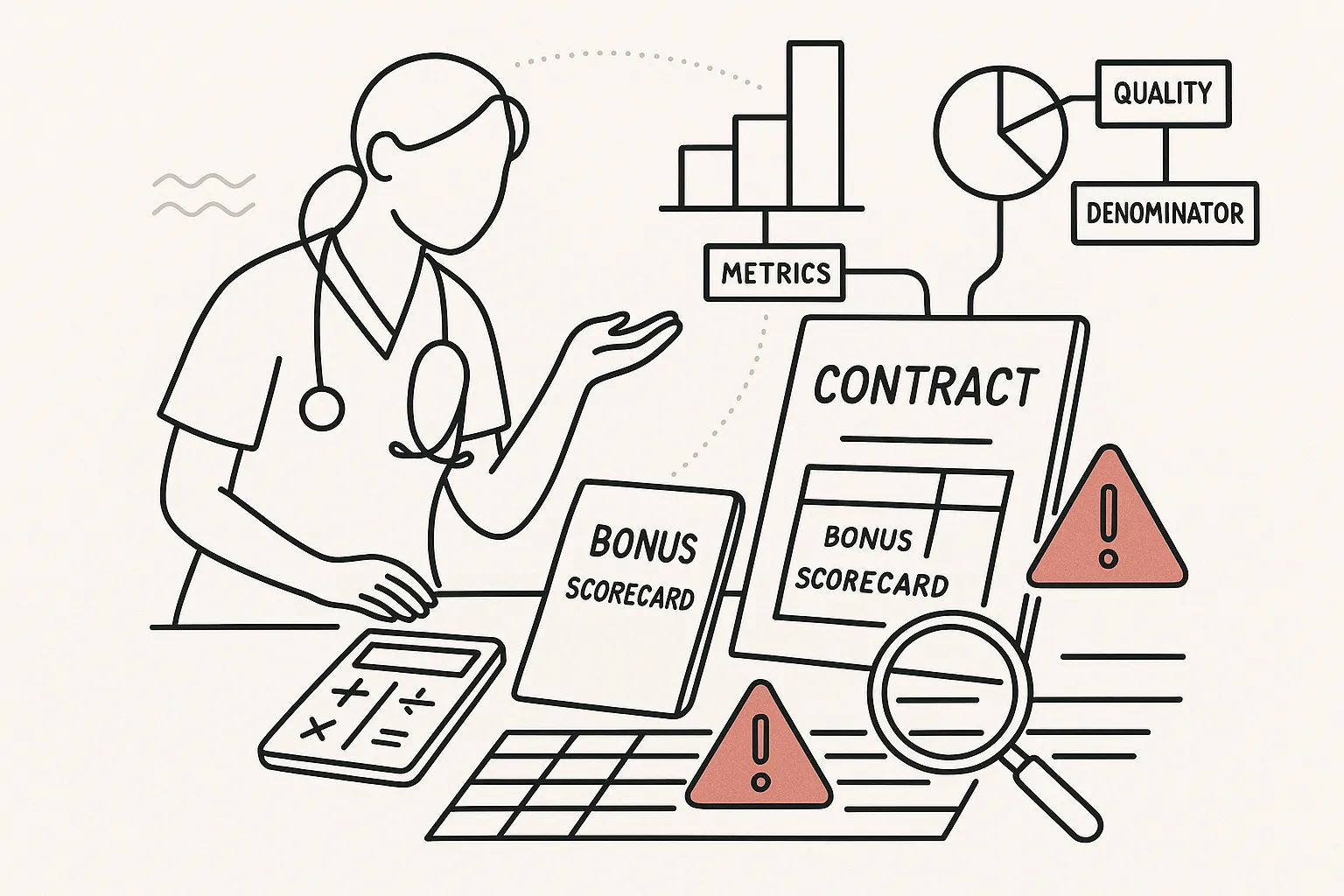
Quality bonuses are a common component of nurse practitioner compensation packages, but the provisions governing whether a bonus is earned—and how much must be paid—are often difficult to verify. A formula may combine clinical quality measures, patient experience scores, productivity targets, chart completion requirements, or other operational metrics. Each component can affect the final payment, particularly when the agreement does not clearly define the calculation method.
The financial risk is not limited to obvious arithmetic mistakes. An incorrect denominator, inconsistent weighting, changed measurement period, or mismatch between clinical and billing data can materially reduce an NP’s compensation. Broad adjustment language may also permit retroactive reconciliations, negative balances, or repayment demands long after the work was performed.
Chelle Law reviews quality bonus provisions as part of a broader evaluation of compensation, productivity, termination, and repayment terms. The goal is to identify unclear metrics before signing, determine whether the employer’s methodology can be independently verified, and improve the contractual process for addressing underpayments or calculation disputes.
Key Takeaways
- Every bonus metric should identify its numerator, denominator, data source, measurement period, weighting, threshold, and rounding method.
- Common errors include incorrect patient attribution, inconsistent weighting, improper timeframes, omitted encounters, and the use of billing data when the contract calls for clinical data.
- Nurse practitioners should retain scorecards, EHR reports, productivity logs, compensation statements, and written explanations of bonus calculations.
- Meaningful audit rights should provide timely access to the workpapers and underlying reports needed to verify a bonus.
- Legal review may be appropriate when an employer denies access, makes recurring errors, or seeks an unsupported clawback or payroll offset.
How Nurse Practitioner Quality Bonuses Are Calculated
Metrics, Thresholds, and Weighting
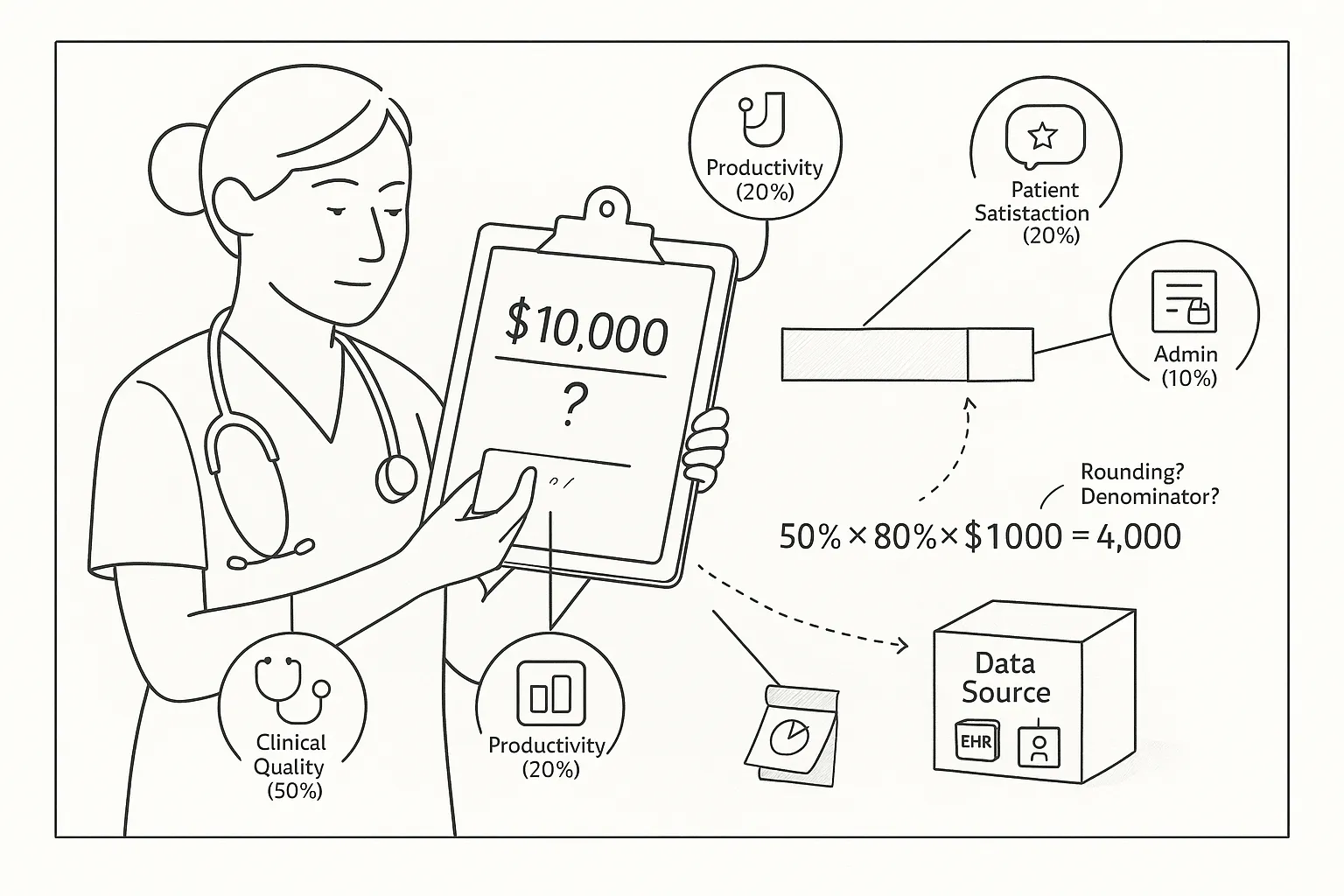
Quality bonus formulas commonly include clinical measures such as preventive screening rates, patient satisfaction results, productivity or panel-management targets, and operational measures such as chart closure or billing timeliness. The payout may be a percentage of base salary, a fixed target amount, or a tiered payment based on specified achievement levels. These terms should be reviewed alongside the agreement’s broader compensation and productivity provisions.
Many plans assign a different weight to each performance domain and then combine the results into one percentage of the target bonus. For example, if quality represents 50% of a $10,000 target and the NP earns 80% of that component, the quality portion would be $4,000. The result may change if the agreement leaves achievement thresholds, weighting, caps, or rounding rules undefined. Nurse practitioners should also determine whether a quality incentive overlaps with another type of payment described in the employer’s broader bonus structure.
Data Sources and Measurement Periods
Employers may calculate performance using the electronic health record, claims data, revenue-cycle reports, third-party quality platforms, or internal scorecards. Identically named metrics can produce different results depending on the source. A visit documented in the EHR, for example, may not appear in a billing report at the same time or may be excluded because of coding, claim-processing, or attribution rules.
The agreement should also identify whether performance is measured monthly, quarterly, annually, or through a rolling period. It should explain how delayed claims, corrected records, employment that begins or ends mid-period, and changes to assigned patients affect the calculation. These details are especially important when a bonus combines productivity and quality incentives.
Calculation Errors and Contract Terms That Reduce NP Pay
Formula, Weighting, and Dataset Errors
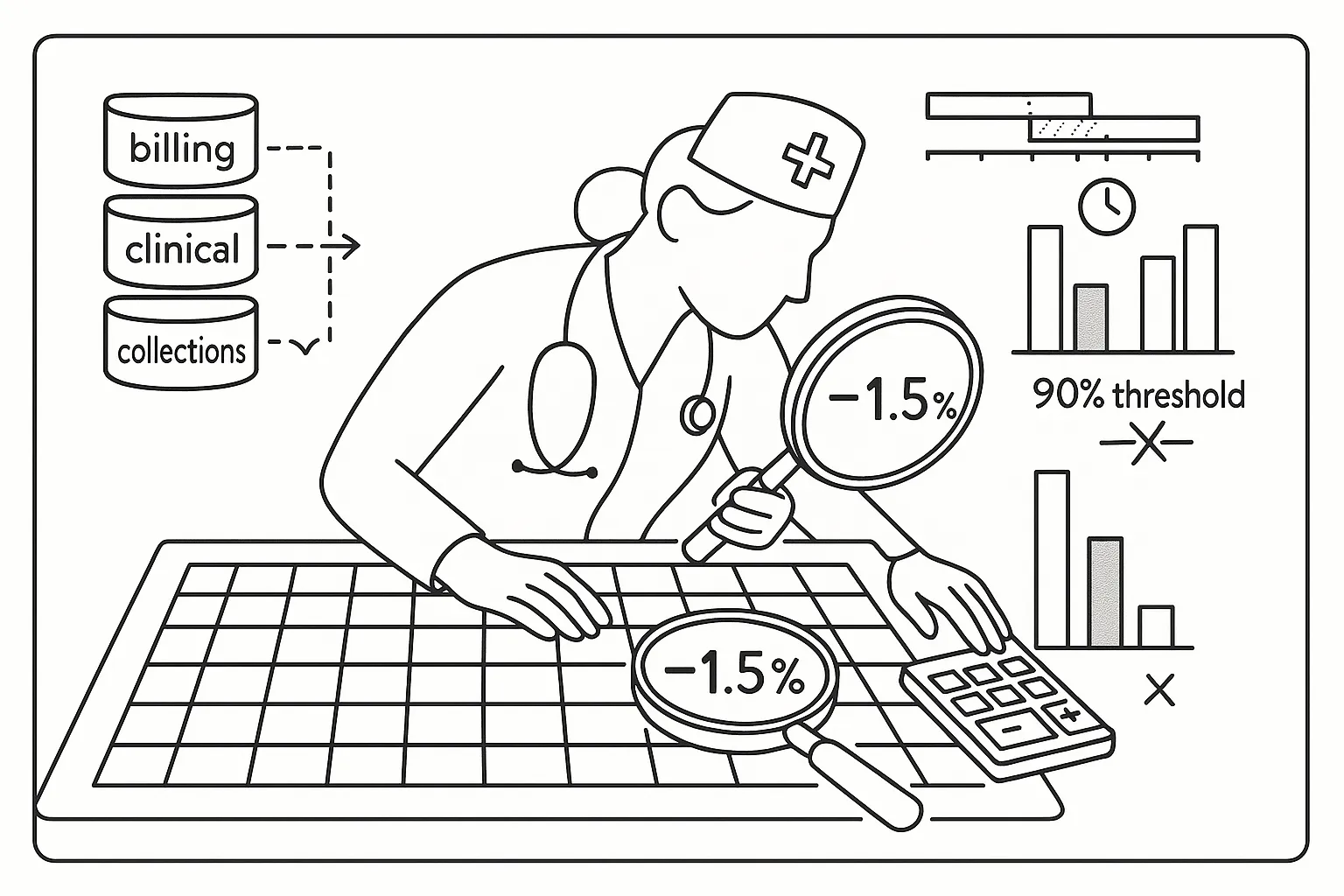
Arithmetic mistakes can occur when raw counts are converted into rates, scaling factors are applied, or separate metrics are combined. An incorrect denominator may understate the NP’s performance by including ineligible patients or omitting qualifying encounters. Repeated rounding at the subcomponent level can also produce a different result from rounding only after the final score is calculated.
Weighting and threshold errors are equally significant. An employer may calculate each metric correctly but apply a different weight from the one stated in the compensation plan, use the wrong achievement band, or impose an unstated minimum threshold. Dataset and timeframe mistakes arise when the employer uses billing activity instead of clinical documentation, applies a calendar-year period instead of a rolling period, or excludes delayed entries unrelated to the NP’s performance.
Ambiguous Definitions and Retroactive Adjustments
Terms such as “attributable patient,” “eligible visit,” and “productive hours” may sound precise but have different operational meanings. The agreement should explain whether telehealth encounters count, how shared visits are assigned, which provider must be listed in the record, and whether canceled appointments or incomplete claims affect the metric. If these terms are undefined, the employer’s internal reporting practices may effectively determine the result.
Catchall provisions allowing adjustments, corrections, or reconciliations without a deadline or notice requirement create additional risk. They may permit an employer to revise prior results because of coding changes, claim reversals, or altered attribution rules. If the revised calculation creates a balance that carries into a later period, the NP should evaluate the agreement for negative accrual provisions and any right to deduct disputed amounts from future compensation.
Documentation and Audit Rights for Bonus Verification
Nurse practitioners should retain contemporaneous records that can be compared with the employer’s final calculation. Useful documents may include EHR reports showing patient attribution, periodic scorecards, quality-vendor reports, productivity logs, compensation statements, revenue reports, and written descriptions of the methodology. Records containing patient information must be handled according to applicable privacy requirements and employer policies.
When a discrepancy appears, the NP can request the calculation workpapers in writing. A meaningful response should identify the raw numerator and denominator, the measurement dates, applicable exclusions, weighting, thresholds, rounding method, and the spreadsheet, report, or query used to generate the result. Comparing that material with the contract and the NP’s records can reveal dropped encounters, incorrect filters, inconsistent attribution, or a formula that differs from the written compensation plan.
An audit right is most useful when it establishes what information will be provided, when it must be produced, and how a dispute will be reviewed. Language that makes access entirely subject to managerial approval may offer little practical protection. The provision should also address whether the NP can receive appropriately de-identified supporting reports and how long the employer must retain the relevant calculation records.
Contract Protections for Quality Bonus Compensation
A clearer compensation provision connects each metric to a defined source and method. It should identify the qualifying encounters or patients, measurement period, numerator and denominator, weighting, target, achievement tiers, rounding convention, and payout date. If the methodology is maintained in a separate policy or compensation plan, the agreement should explain whether and how that document may be changed during the term.
Transparency provisions can require the employer to disclose the applicable methodology before the measurement period begins and provide a written calculation after it ends. The contract can also establish a deadline for raising discrepancies, a response period for the employer, and a process for correcting confirmed underpayments. These protections make the bonus easier to administer and reduce reliance on informal explanations after compensation has already been withheld.
Repayment and offset language deserves separate attention. The contract should distinguish between an employer underpayment and an alleged overpayment, require supporting documentation, and address the applicable look-back period. It should also explain whether a disputed amount may be deducted from wages or a later bonus. A comprehensive NP contract review can evaluate these provisions together rather than treating the quality bonus as an isolated exhibit.
What to Do When a Quality Bonus Appears Incorrect
Begin by preserving the compensation statement, relevant scorecards, and the version of the bonus plan that applied during the measurement period. Request the employer’s workpapers promptly and identify the specific difference between the reported result and the result supported by your records. A side-by-side comparison of the data, formula, and expected payment is generally more useful than a broad assertion that the bonus seems too low.
Keep communications professional and in writing. Ask which contractual provision, dataset, or policy supports any disputed exclusion or adjustment. Avoid agreeing to a repayment, payroll deduction, or revised calculation before understanding how the employer reached the amount and whether the proposed action is consistent with the agreement.
Legal review may be appropriate when the employer refuses reasonable access to the calculation records, the adjustment is financially significant, errors recur across multiple periods, or a unilateral clawback is threatened. Counsel can compare the employer’s methodology with the contract, assess available dispute procedures, and help document the issue for negotiation or another appropriate remedy.
Frequently Asked Questions
What should an NP quality bonus formula define?
The formula should define each metric, numerator, denominator, data source, measurement period, weighting, threshold, rounding rule, target payment, and payout date. It should also explain how exclusions, delayed data, and partial measurement periods are handled.
How can an incorrect denominator reduce a quality bonus?
An incorrect denominator can include patients or encounters that should not count or omit qualifying activity. That changes the performance rate and may move the NP into a lower achievement tier even when the underlying clinical work was completed.
Can an employer change quality bonus metrics during the measurement period?
The answer depends on the contract, incorporated compensation plan, and applicable law. A provision allowing unilateral changes creates more risk, particularly if it does not require advance notice or prohibit retroactive changes to work already performed.
What records should a nurse practitioner retain to verify a bonus?
Useful records may include compensation plans, scorecards, EHR reports, quality-vendor reports, productivity logs, compensation statements, and written explanations from the employer. Patient information should always be handled according to privacy requirements and employer policies.
What should a quality bonus audit right provide?
An audit right should provide timely access to the calculation method, underlying workpapers, relevant reports, exclusions, and final arithmetic. It should also establish deadlines for requesting review, receiving a response, and correcting a confirmed error.
When should an NP seek legal review of a bonus dispute?
Legal review may be appropriate when the employer denies access to supporting records, makes recurring or substantial adjustments, changes the methodology retroactively, or demands repayment without adequate documentation. Counsel can compare the calculation with the agreement and assess the available dispute process.
Have Questions About an NP Quality Bonus?
Chelle Law can review the bonus formula, supporting compensation documents, audit rights, and repayment provisions to identify calculation risks before or after a dispute arises.
Contact Chelle LawExplore Nurse Practitioner Contract Guidance
Review legal services, educational resources, and state-specific contract information for nurse practitioners.