
Malpractice insurance language in an employment or independent contractor agreement can create immediate and long-term financial risk for a nurse practitioner. Claims-made and occurrence policies operate differently, particularly after employment ends, so the contract should clearly identify the policy type, coverage limits, tail obligations, and responsibility for defense costs. These terms deserve careful attention during a nurse practitioner contract review.
Key Takeaways
- Claims-made policies generally require a claim to be made and reported while the policy or an extended reporting period is active.
- Occurrence policies cover incidents that happen during the policy period, even if a related claim is reported after the policy ends.
- A nurse practitioner covered under a claims-made policy may need tail insurance or valid prior-acts coverage after leaving an employer.
- The employment agreement should explain who pays for tail coverage under each termination scenario and whether repayment obligations apply.
- Policy limits, deductibles, defense control, settlement authority, and notice requirements can be as important as the policy type.
How Claims-Made and Occurrence Policies Work
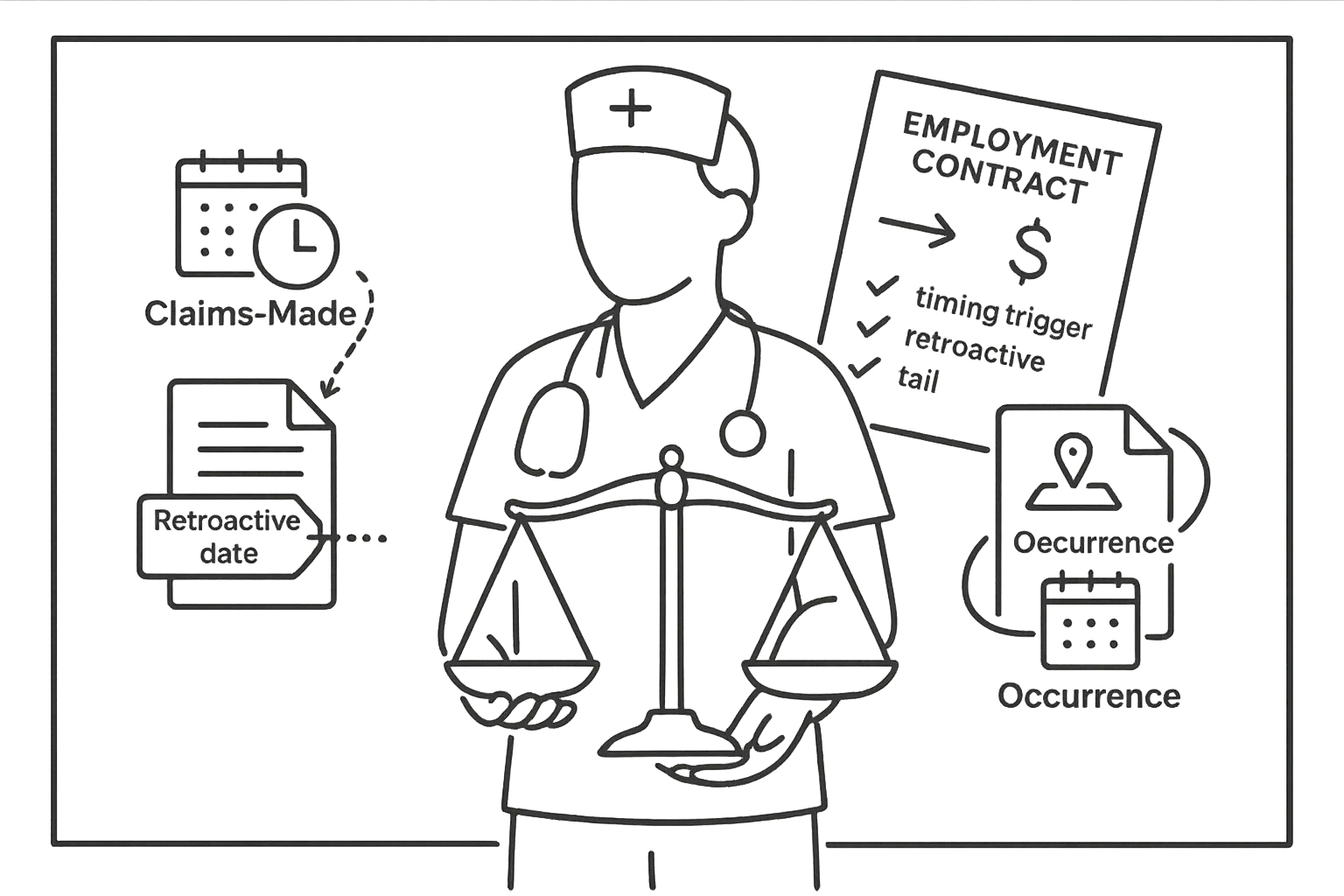
A claims-made policy generally covers a claim when the claim is made against the insured and reported to the insurer while the policy is active, subject to the policy’s specific terms. The retroactive date is important because it identifies how far back covered professional services may extend. When the policy ends, an extended reporting period—commonly called tail coverage—may be necessary for later-reported claims involving care provided during the covered period.
An occurrence policy focuses on when the alleged incident took place. If the incident occurred while the occurrence policy was active, the policy can respond even when the claim is reported after employment or the policy period ends. Tail coverage is generally not needed for incidents already protected by an occurrence policy.
- Claims-made: Coverage depends on the claim and reporting requirements stated in the policy.
- Occurrence: Coverage depends primarily on whether the incident occurred during the policy period.
- Retroactive date: A claims-made policy may exclude professional services performed before this date.
- Extended reporting period: Tail coverage allows certain claims to be reported after a claims-made policy ends.
The policy label therefore affects post-employment liability and contract drafting. An employer may pay the claims-made premium during employment while assigning the cost of tail coverage to the nurse practitioner after departure. A focused malpractice and tail insurance review can identify that allocation before the agreement is signed.
Coverage Differences That Affect Nurse Practitioners
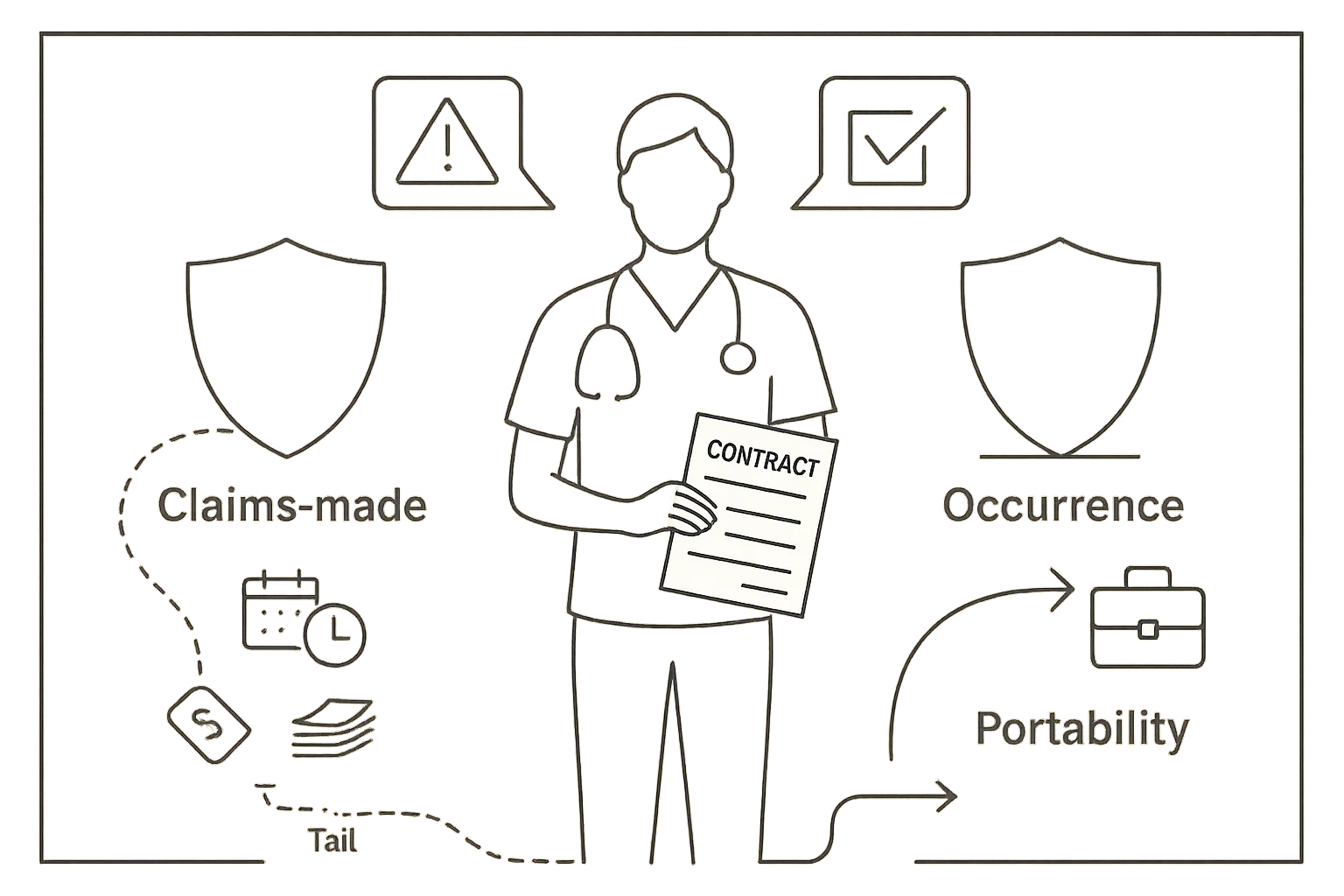
The most important differences involve post-termination protection, cost allocation, portability, and the contractual events that determine who must obtain additional coverage.
- Post-termination exposure: A claims-made policy may leave a gap if no tail or prior-acts coverage applies after employment. An occurrence policy continues to protect covered incidents that happened while the policy was active.
- Cost allocation: Claims-made premiums may be lower initially, but a later tail obligation can create a substantial expense. Occurrence coverage may have higher ongoing premiums, which an employer may consider when structuring compensation.
- Portability: A new claims-made insurer may offer prior-acts coverage for earlier services, but that protection depends on the actual endorsement and underwriting approval. Without it, the nurse practitioner may still need tail coverage from the former policy.
- Termination triggers: An agreement may assign tail costs differently for resignation, termination without cause, termination for cause, retirement, disability, or completion of an initial service period.
These issues should be reviewed alongside the agreement’s broader separation provisions. A clause requiring the nurse practitioner to purchase tail after resignation can materially affect the practical cost of leaving, making a review of the contract termination terms especially important.
Pros and Cons of Each Malpractice Policy Type
Claims-Made Coverage
Claims-made coverage can be administratively convenient while the nurse practitioner remains employed because the employer often maintains the group policy and handles renewals. Its principal drawback is the possibility of a coverage gap after the policy ends if neither an extended reporting period nor valid prior-acts coverage protects earlier services.
- Potential advantages: Lower initial premiums, centralized administration, and the possibility of transferring earlier exposure through an approved prior-acts endorsement.
- Potential disadvantages: Tail costs, dependence on the retroactive date, portability concerns, and contract provisions that shift post-employment expenses to the nurse practitioner.
Occurrence Coverage
Occurrence coverage provides longer-term certainty for incidents that happen during the policy period because protection does not ordinarily depend on keeping the policy active when the claim is later reported. It can simplify career transitions, although it may be more expensive or unavailable under an employer’s selected group program.
- Potential advantages: No tail requirement for covered incidents, more predictable post-employment protection, and fewer concerns about transferring prior exposure to a new insurer.
- Potential disadvantages: Higher ongoing premiums in some markets and limited availability through certain employers or group plans.
For example, suppose an NP works for an employer under a claims-made policy and a patient later brings a claim involving care provided during that employment. If the former policy has ended and neither tail nor prior-acts coverage applies, the NP may face a dispute over defense and indemnity. The agreement should address that risk before the employment relationship begins.
Tail Coverage, Prior Acts, and Employment Transitions
Tail coverage is an extended reporting period attached to a claims-made policy. It generally does not create coverage for new professional services performed after the original policy ends; instead, it permits the reporting of certain later claims involving services provided during the covered period. Tail terms, duration, exclusions, and reporting requirements depend on the policy and endorsement.
Prior-acts coverage, sometimes called nose coverage, works differently. A new claims-made insurer may agree to cover eligible services performed before the new policy began, usually back to an accepted retroactive date. An employer’s promise to obtain prior-acts coverage should not be treated as complete protection unless the applicable insurer actually issues the endorsement. NPs evaluating these provisions can also review this guide to tail insurance for nurse practitioners.
Employment transitions commonly create risk when an NP resigns without employer-funded tail, is terminated under language that does not clearly assign the expense, or joins a new practice whose carrier will not cover prior acts. The contract should explain responsibility for tail under each separation scenario, establish any repayment formula, and require documentation showing that the promised coverage was obtained.
Malpractice Insurance Contract Clauses to Review
Policy type is only one part of the analysis. The agreement and available insurance documents should be reviewed together so the nurse practitioner understands the actual protection and any obligations imposed outside the main malpractice clause.
- Policy type and insured parties: Confirm whether coverage is claims-made or occurrence and whether the NP is individually named or covered under a group policy.
- Coverage limits: Identify per-claim and aggregate limits and determine whether multiple clinicians share an aggregate limit.
- Tail responsibility: State who must obtain and pay for tail coverage after resignation, termination, retirement, disability, or another separation event.
- Prior-acts protection: Confirm the applicable retroactive date and whether insurer approval is required before coverage becomes effective.
- Deductibles and retentions: Determine whether the NP can be charged a deductible, self-insured retention, defense expense, or other claim-related amount.
- Defense and settlement control: Review who selects counsel, directs the defense, authorizes settlement, and reports the matter to licensing or credentialing entities when required.
- Notice and cooperation duties: Understand reporting deadlines and the consequences of failing to notify the employer or insurer promptly.
- Indemnification: Examine whether separate indemnity language shifts uninsured liabilities or legal expenses back to the nurse practitioner.
Independent contractor agreements may allocate these obligations differently from employment agreements and may require the NP to maintain an individual policy. Nurses considering that arrangement should review both the insurance provisions and the broader independent contractor agreement terms.
Evaluating Coverage Before Signing a Contract
Nurse practitioners do not always choose the policy type because the employer may already have a group program. The practical objective is to identify the available coverage, determine where gaps could arise, and negotiate clear contract language assigning responsibility for those risks.
- Obtain the policy type, coverage limits, retroactive date, and any relevant certificate or endorsement.
- Review every termination event that could affect employer-paid tail or trigger a repayment obligation.
- Confirm whether promised prior-acts coverage depends on future insurer approval.
- Clarify deductibles, defense costs, settlement authority, indemnification, and notice requirements.
- Require important insurance commitments to appear in the written agreement rather than relying on informal assurances.
Claims-made coverage is not necessarily unfavorable, and occurrence coverage does not eliminate the need to review exclusions, limits, and defense provisions. The appropriate analysis depends on the policy documents, the employment agreement, the NP’s role, and the circumstances under which the relationship may end.
Frequently Asked Questions
Does a nurse practitioner always need tail coverage with a claims-made policy?
Not always. Tail coverage may be unnecessary if the claims-made policy remains active for the relevant exposure or a new insurer provides valid prior-acts coverage. The NP should confirm the retroactive date, policy terms, and issued endorsements rather than relying only on an employer’s description.
Who usually pays for a nurse practitioner’s tail insurance?
Responsibility depends on the employment agreement and the circumstances of separation. An employer may pay in some termination scenarios while requiring the NP to pay after a voluntary resignation or termination for cause. The contract should state the allocation clearly.
Can prior-acts coverage replace tail insurance?
It can protect qualifying earlier services when a new claims-made insurer issues the appropriate endorsement with a sufficient retroactive date. Because prior-acts coverage is subject to underwriting and policy terms, the NP should verify the actual endorsement before allowing former coverage to end.
Is occurrence malpractice coverage always better for an NP?
No. Occurrence coverage offers useful post-employment protection for covered incidents, but availability, premiums, exclusions, limits, and defense provisions still matter. Claims-made coverage can also be workable when the agreement provides reliable tail or prior-acts protection.
What happens if a malpractice claim is filed after the NP leaves an employer?
Coverage depends on the policy type and applicable terms. An occurrence policy may respond if the incident happened during its policy period. A claims-made policy generally requires active reporting rights through the original policy, tail coverage, or qualifying prior-acts coverage.
What insurance documents should an NP request before signing?
The NP should request available information identifying the policy type, coverage limits, retroactive date, named or covered insureds, deductible or retention obligations, and tail or prior-acts terms. The employment agreement should be compared with those documents for inconsistencies.
Review Your Malpractice Insurance Terms Before You Sign
Chelle Law reviews claims-made and occurrence coverage provisions, tail obligations, prior-acts language, and related contract risks for nurse practitioners.
Contact Chelle Law