
When a nurse practitioner accepts a position in Alabama—whether in Birmingham, Mobile, Huntsville, Montgomery, or another community—the employment or independent contractor agreement controls important issues involving compensation, clinical authority, malpractice coverage, and post-employment restrictions. These agreements operate within Alabama law, including oversight by the Alabama Board of Nursing and provisions in Title 34 of the Code of Alabama governing nursing practice.
Even subtle drafting differences can affect productivity-based compensation, supervision arrangements, termination rights, and restrictive covenants. An Alabama nurse practitioner contract review evaluates income methodology, tail insurance responsibility, notice provisions, and post-employment limitations with attention to how the agreement may function over time in Alabama’s healthcare market.
At Chelle Law, the emphasis is on practical risk assessment and clear explanations. We review agreements line by line to identify provisions that may affect earnings stability, licensure protection, and long-term career mobility. Explore our nurse practitioner contract review services to learn more about the support available before signing an agreement.
Key Takeaways for Alabama Nurse Practitioners
- An Alabama-specific contract review considers state rules involving collaboration, scope of practice, and restrictive covenants.
- Confirm whether the agreement is for W-2 employment or 1099 independent contractor work and whether its operational terms match that classification.
- Review compensation definitions, productivity formulas, audit rights, and reconciliation procedures before relying on projected earnings.
- Identify whether malpractice coverage is claims-made or occurrence-based and who must purchase tail insurance after termination.
- Clarify repayment obligations, termination rights, collaboration requirements, and post-employment restrictions before signing.
Why an Alabama-Specific Contract Review Matters
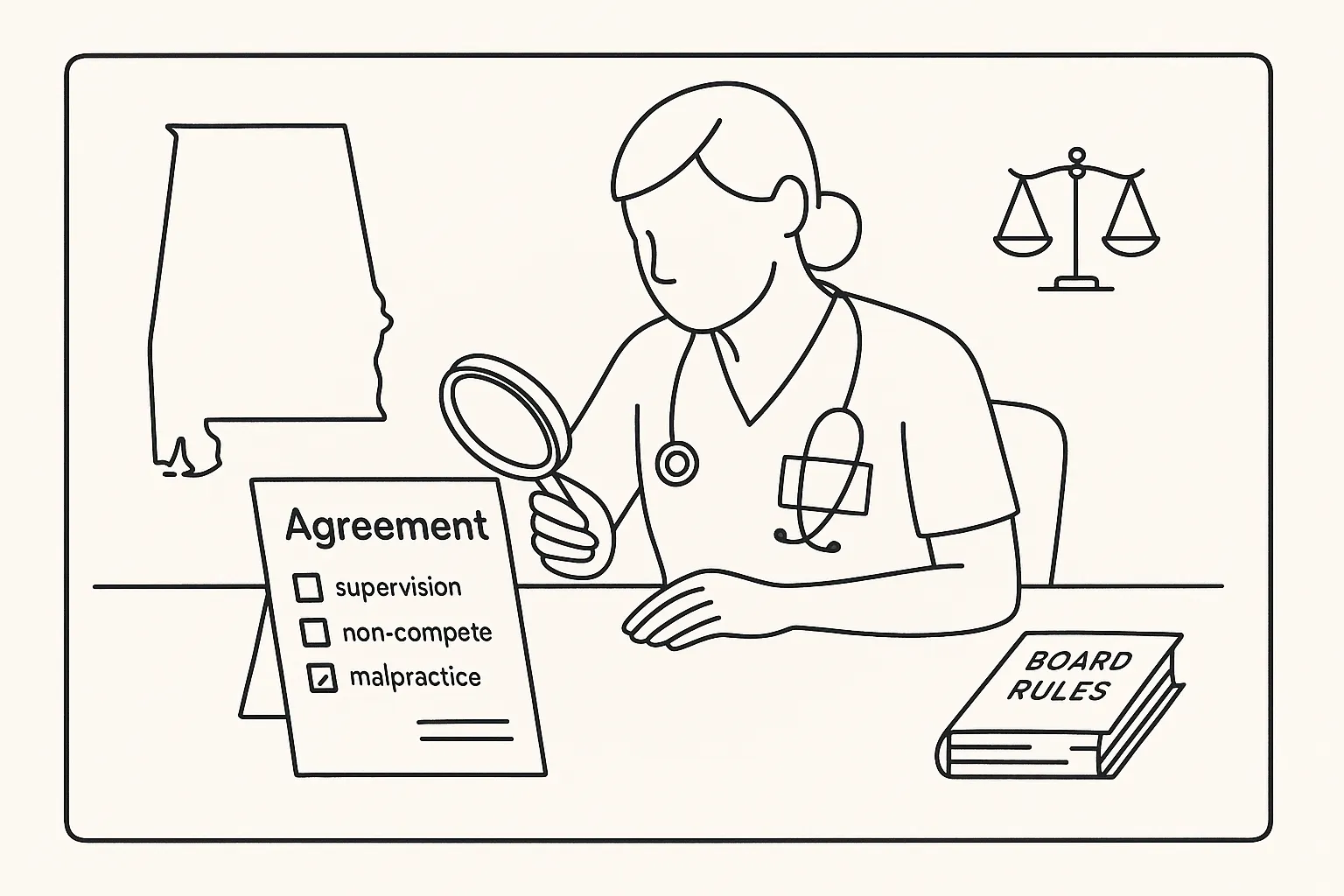
Alabama law and practice standards can influence collaboration requirements, scope-of-practice provisions, and the practical effect of restrictive covenants. Although base salaries, productivity formulas, and malpractice policies are common contract issues nationwide, their operation must be considered alongside the regulatory framework governing Alabama nurse practitioners.
For example, collaboration language should be consistent with applicable Alabama requirements rather than relying on vague employer-defined expectations. A contract may also impose obligations beyond the regulatory baseline, affecting clinical autonomy, scheduling, liability, and the ability to continue working if a collaborative relationship changes. A state-specific review identifies terms that appear routine but may create problems under Alabama practice standards.
W-2 Employment and 1099 Independent Contractor Agreements

Employment agreements, independent contractor agreements, and employer addenda carry different rights and obligations. The label on the document is not conclusive; the actual provisions governing scheduling, control, billing, supervision, equipment, and benefits also matter. Our guide to W-2 versus 1099 status for nurse practitioners explains several practical distinctions between these arrangements.
An NP labeled as a 1099 contractor may still be subject to employer direction, fixed scheduling, and operational controls that resemble employment. That mismatch can create tax, benefit, and compliance concerns while shifting expenses and administrative responsibilities to the NP. Conversely, W-2 employment commonly includes benefits but may contain more extensive employer control, repayment provisions, and post-termination restrictions.
A contract review evaluates whether the agreement’s operational terms match its stated classification and how responsibility is allocated for credentialing, billing, insurance, taxes, and business expenses. Identifying these obligations before signing helps prevent unexpected costs and disputes.
Alabama Nurse Practitioner Contract Terms to Review
The most significant provisions usually involve compensation, clinical responsibilities, liability allocation, and the circumstances under which the relationship may end. These terms should be read together because one provision can materially alter the effect of another.
Compensation, Productivity, and Benefits
Compensation may consist of a guaranteed salary, salary plus productivity, collections-based pay, an RVU formula, or a bonus structure. A focused nurse practitioner compensation and productivity review examines how the formula defines collections, work RVUs, thresholds, conversion factors, adjustments, and reconciliation periods. It should also address whether the NP has access to the records needed to verify compensation.
- Base salary: Confirm the guarantee period, payment frequency, and whether salary may be reduced or recouped.
- Collections-based pay: Determine which receipts count, what deductions apply, and when collections are credited.
- RVU compensation: Verify the applicable RVU measure, conversion factor, threshold, and treatment of split or shared services.
- Negative accrual: Identify whether a shortfall carries forward or becomes repayable after termination.
- Benefits: Review health coverage, retirement eligibility, paid leave, CME allowances, licensing expenses, and student loan benefits.
For example, a formula may promise a percentage of collections above a stated base but exclude certain payers or subtract adjustments before applying the percentage. Without clear definitions and reporting rights, actual take-home pay may differ significantly from projections.
Scope of Practice, Collaboration, and Credentialing
The agreement should define duties, patient populations, locations, schedule expectations, call coverage, telehealth responsibilities, and performance standards. These provisions should remain consistent with Alabama scope-of-practice and collaboration requirements rather than obligating the NP to perform duties beyond authorized practice or under unclear clinical protocols.
A nurse practitioner supervision and collaboration agreement review can identify who is responsible for maintaining the required relationship, addressing prescriptive authority, and responding if a collaborating professional becomes unavailable. Credentialing provisions should also explain application responsibilities, payer enrollment, privileges, costs, appeal rights, and whether compensation may be delayed while enrollment is pending.
Malpractice Coverage, Termination, and Post-Employment Restrictions
Malpractice provisions should identify policy limits, the named insured, exclusions, and whether coverage is claims-made or occurrence-based. Claims-made coverage generally requires continuous coverage or tail insurance for claims reported after the policy ends. A malpractice and tail insurance review clarifies who must obtain and pay for that protection when the relationship ends.
A contract termination review examines how much notice is required, what constitutes cause, whether compensation may be suspended, and which obligations survive separation. Repayment provisions may apply to signing bonuses, relocation allowances, training costs, or other advances. The agreement should distinguish voluntary resignation, termination without cause, and termination for cause because each event may trigger different financial consequences.
Non-compete, non-solicitation, confidentiality, and patient-related restrictions can affect future employment. Review the duration, geographic area, covered services, restricted facilities, and any connection between the restriction and the NP’s actual work. Our resource on nurse practitioner non-compete clauses discusses the contract terms that should be evaluated before accepting a restriction.
Negotiation Priorities and Contract Red Flags
Negotiation priorities commonly center on income protection, liability allocation, and career flexibility. The appropriate request depends on the complete agreement, but potentially important issues include:
- Undefined terms such as “collections,” “net revenue,” “for cause,” or “material breach.”
- Compensation formulas without sample calculations, reporting procedures, or audit rights.
- Broad indemnification language that transfers liability beyond the NP’s own conduct.
- Repayment schedules that accelerate after resignation or termination without cause.
- Tail insurance obligations that do not account for which party ends the relationship.
- Vague collaboration, schedule, call, floating, telehealth, or multi-location requirements.
- Restrictive covenants broader than the NP’s actual territory, services, or patient relationships.
Ambiguous language usually gives the party administering the contract greater discretion. A targeted review converts that ambiguity into a practical assessment of possible financial, licensing, and career consequences.
Pre-Signing Checklist for Alabama Nurse Practitioners
Gathering the agreement and all referenced documents allows counsel to evaluate the complete arrangement rather than reviewing an isolated offer letter. Before requesting a review:
- Identify whether the relationship is classified as W-2 employment or 1099 independent contractor work.
- Request the compensation formula, sample calculations, productivity thresholds, and reconciliation rules.
- Locate the malpractice provisions and determine whether coverage is claims-made or occurrence-based.
- Highlight non-compete, non-solicitation, confidentiality, and patient restriction provisions.
- Confirm clinical duties, locations, schedule, call, collaboration expectations, and prescriptive authority terms.
- Review termination notice, for-cause events, final compensation, and repayment triggers.
- Check benefits, leave, CME, licensing costs, and credentialing responsibilities.
- Collect incorporated documents such as handbooks, policies, addenda, bonus plans, and billing manuals.
When to Consult a Nurse Practitioner Contract Attorney
Legal review is especially important when compensation depends on productivity or collections, the agreement includes a non-compete, the NP may owe tail insurance, or the employer can demand repayment of bonuses and other benefits. Review is also useful when an independent contractor agreement gives the organization extensive control over scheduling, billing, or clinical operations.
An attorney-led review translates the agreement into practical risks involving compensation, termination, liability, and future employment. At Chelle Law, the review focuses on explaining how the provisions work together and identifying terms that may warrant clarification or revision before the agreement is signed.
Have an Alabama NP Contract Reviewed Before You Sign
Chelle Law can evaluate compensation, collaboration requirements, malpractice coverage, termination provisions, and post-employment restrictions in your proposed agreement.
Contact Chelle Law