
When a nurse practitioner accepts a position in Arkansas—whether practicing in Little Rock, Fayetteville, Fort Smith, or the broader Central Arkansas region—the employment or independent contractor agreement becomes the governing document for compensation, clinical authority, malpractice allocation, and post-employment restrictions. These agreements operate within Arkansas law, including oversight by the Arkansas State Board of Nursing and statutory provisions under Title 17 of the Arkansas Code governing nursing practice. An Arkansas nurse practitioner contract review helps clarify how employer-drafted language interacts with state regulatory requirements and where financial or professional risk may be embedded. Seemingly minor drafting differences can materially affect productivity calculations, restrictive covenants, supervision arrangements, and termination rights.
At Chelle Law, the analysis centers on structured, attorney-led risk assessment. We review each provision line by line, including compensation structures, negative accrual provisions, tail insurance responsibility, notice periods, and post-employment limitations, to identify terms that may affect earnings stability, licensure protection, and long-term career mobility. A comprehensive nurse practitioner contract review can help an NP understand these provisions before signing or negotiating an agreement.
Key Contract Review Takeaways for Arkansas Nurse Practitioners
- Obtain an attorney-led, line-by-line review before signing so contract language can be translated into practical income, liability, and mobility consequences.
- Confirm worker classification because W-2 or 1099 status affects taxes, benefits, malpractice responsibility, and employment protections.
- Scrutinize compensation mechanics because reconciliations, chargebacks, RVU rules, and clawbacks can cause retroactive pay reductions or unexpected liabilities.
- Require clear malpractice and tail coverage terms, especially when the employer provides a claims-made policy.
- Identify restrictive covenants, repayment triggers, and termination-for-cause language early enough to evaluate negotiation options.
Arkansas NP Employment and Independent Contractor Agreements
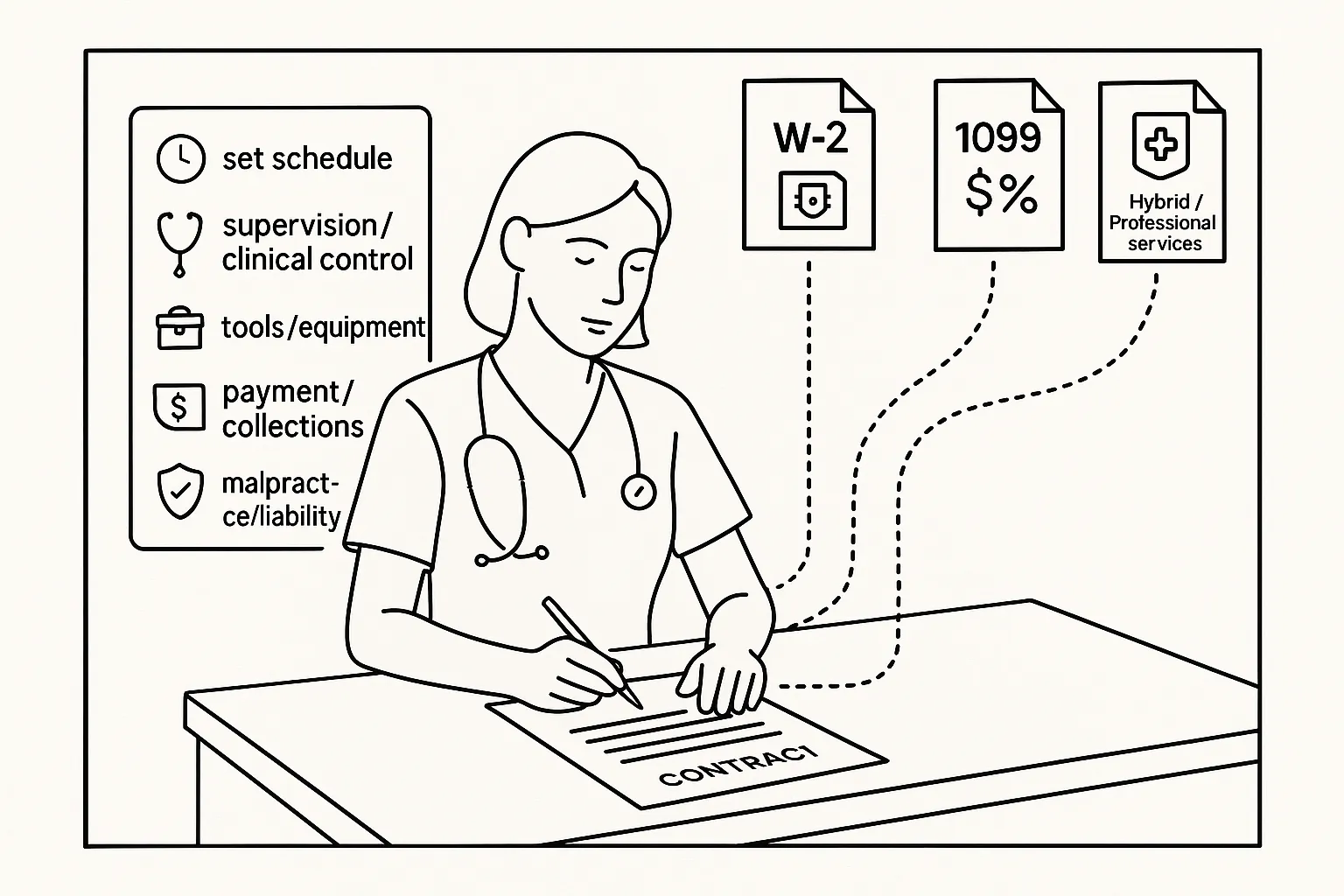
Agreements for nurse practitioners in Arkansas commonly take one of three forms: W-2 employment agreements with salary and benefits, 1099 independent contractor agreements tied to collections or productivity, and hybrid professional services agreements used by telehealth companies and staffing groups. Each form carries different legal and practical consequences.
Employee agreements typically include employer-controlled benefits, tax withholding, and defined termination provisions. Independent contractor agreements shift tax and benefit responsibility to the NP and may contain broader indemnification or liability language, while hybrid agreements can obscure classification and leave the NP with fewer protections. Our review considers schedule control, supervision clauses, clinical decision-making authority, equipment, payment structure, and other classification indicators. NPs evaluating a 1099 arrangement can also review the differences between W-2 and 1099 status for nurse practitioners.
NP Compensation, Productivity, and Employee Benefits

Salary, productivity, bonus, and benefits provisions determine both immediate income and long-term financial outcomes. Contract language that appears routine can create negative accrual, retroactive reconciliation, or payroll deduction risks that materially reduce compensation. A focused nurse practitioner compensation and productivity review examines how the written formula will translate into actual pay.
Salary, Collections, RVUs, and Bonuses
Common compensation models include base salary guarantees, collections-based pay, productivity or relative value unit models, and discretionary or formula-based bonuses. Each model allocates financial risk differently:
- Base salary: Confirm pay frequency, prorated calculations for partial periods, and whether the salary is subject to clawbacks or offsets.
- Collections-based pay: Determine whether compensation uses gross charges or net collections after adjustments, when payments are calculated, and whether denials or refunds can generate later chargebacks.
- RVU productivity: Review the per-RVU rate, productivity threshold, reconciliation method, treatment of administrative time, coding responsibility, and audit rights. For example, an agreement may promise $45 per wRVU with an annual target of 5,000 wRVUs and a year-end true-up.
- Bonuses: Determine whether the bonus is discretionary or guaranteed and whether patient satisfaction, quality, payer mix, or other metrics are objectively defined. Timing and clawback triggers should also be clear.
Phrases such as “subject to reconciliation” or “company may offset” often signal employer-favorable mechanisms. The review should translate those phrases into potential dollar outcomes rather than treating them as routine boilerplate.
Benefits provisions may address health insurance, disability coverage, continuing medical education allowances, licensure and DEA fee reimbursement, and retirement contributions. Important details include employer contribution percentages, retirement vesting schedules, eligibility waiting periods, and when benefits end after termination. Paid leave language should define accrual, carryover, and payout on separation. Sign-on bonuses, relocation allowances, and loan benefits should be reviewed for repayment triggers, prorated forgiveness, and the consequences of early separation.
Malpractice Insurance, Indemnity, and Tail Coverage
Malpractice coverage and liability allocation are central to protecting an NP’s license and personal assets. Contracts may assign responsibility for policy premiums, coverage limits, deductibles, defense costs, and tail coverage in ways that create risk after employment ends. A malpractice and tail insurance review for nurse practitioners can clarify which party bears each obligation.
Occurrence policies generally cover incidents that occur during the policy period regardless of when the claim is filed. Claims-made policies generally require the claim to be made and reported while coverage is active, so tail coverage or another form of continuing protection may be needed for later-reported claims arising from prior services. Employer-favorable language may limit the organization’s obligation to active policy premiums while making the NP responsible for tail coverage after departure. Broad indemnification clauses can also shift defense costs or liability exposure to the NP, making it important to review policy limits, primary or excess status, prior-acts protection, claim-notification duties, and responsibility for post-termination coverage.
Arkansas Scope of Practice, Collaboration, and Scheduling
Contract language defining duties and scheduling affects day-to-day autonomy and regulatory compliance. Clauses addressing permitted procedures, patient populations, multi-site assignments, and administrative duties can create operational or licensure risk if they conflict with applicable Arkansas requirements, professional standards, or medical staff policies. Agreements may reference physician supervision, collaboration, or delegation, but the practical obligations depend on the exact language. The contract should make clear whether it requires chart co-signatures, on-site supervision, an available collaborator, or other procedures.
Arkansas statutes and regulations establish applicable requirements, while an employer may impose additional contractual conditions. A supervision and collaboration agreement review can identify ambiguous terms that unnecessarily restrict clinical autonomy or place responsibility on the NP for matters outside the NP’s control. Nurse practitioners should also compare the proposed duties with applicable scope-of-practice contract issues.
Workload provisions may establish patient volume, visit times, administrative duties, call coverage, floating obligations, and assignments at multiple locations. Telehealth clauses require attention to patient location, state licensing, documentation, and out-of-state practice obligations. The contract should also explain call pay, scheduling flexibility, and whether failure to meet productivity standards can trigger discipline or termination.
Arkansas Non-Competes and Post-Employment Restrictions
Restrictive covenants can have a lasting effect on an NP’s career. Even when enforceability is uncertain, a broad restriction may discourage future employers, delay a job transition, or create litigation risk. A dedicated nurse practitioner non-compete review evaluates the language before those limitations become binding.
Non-compete clauses may restrict practice within a stated radius for a defined period, while non-solicitation provisions may limit contact with former patients, employees, referral sources, or colleagues. The review should examine duration, geography, covered activities, and how the employer’s market is defined because a seemingly modest radius can become much broader when paired with multiple worksites or an expansive service-area definition. Arkansas enforceability questions depend on the governing law and the specific wording and circumstances. From a practical perspective, an overbroad covenant may limit the NP’s ability to accept another role, join a nearby health system, or continue telehealth work.
Termination, Repayment, and Dispute Terms
Termination, repayment, and dispute resolution provisions determine short-term income security and the obligations that survive separation. These sections should be read together because a termination event may trigger repayment, loss of a bonus, tail insurance responsibility, or enforcement of a restrictive covenant. For-cause provisions may permit immediate termination and the forfeiture of compensation or benefits, while without-cause provisions should specify the required notice period and any severance obligations. The review should identify vague cause definitions, missing notice or cure rights, accelerated repayments, treatment of earned bonuses, and when benefits cease. NPs planning an exit can also consult the guide to terminating a nurse practitioner contract.
Clawback provisions may require repayment of signing bonuses, relocation expenses, loan benefits, or other incentives if employment ends before a minimum service period. Important terms include the repayment timeline, prorated forgiveness, offsets from final pay, and whether repayment applies when the employer ends the agreement without cause. Arbitration, choice-of-law, and venue provisions affect where and how disputes proceed. The review should address whether arbitration is mandatory, which claims are covered, how fees are allocated, what law applies, and where proceedings must occur because these terms can materially affect the cost and convenience of pursuing or defending a claim.
How to Prepare for an Arkansas Contract Review
A systematic review converts dense legal language into a practical inventory of financial, liability, and career risks. Before meeting with counsel, identify ambiguities and estimate potential exposure, such as the maximum bonus repayment, possible tail obligation, compensation affected by a reconciliation, or the geographic reach of a restrictive covenant. High-risk terms to flag include:
- W-2 or 1099 worker classification
- Compensation reconciliations, negative accrual, offsets, and chargebacks
- Claims-made or occurrence malpractice coverage and tail responsibility
- Non-compete duration, geographic scope, and non-solicitation language
- For-cause definitions, without-cause notice, and severance terms
- Signing bonus, relocation, and loan repayment obligations
- Indemnification and insurance requirements
- Scope, supervision, scheduling, call, telehealth, and location requirements
Prepare a prioritized question list for counsel, placing issues that affect immediate cash flow, professional liability, licensure, or long-term mobility first. Chelle Law provides attorney-led contract reviews with written comments and remote consultations designed to help Arkansas nurse practitioners understand material terms before making a decision.
Review Your Arkansas Nurse Practitioner Contract Before Signing
Chelle Law can evaluate compensation, malpractice coverage, collaboration terms, restrictive covenants, termination rights, and repayment obligations so you can make an informed decision.
Contact Chelle LawExplore Nurse Practitioner Contract Guidance
Review attorney-led services, practical contract resources, and state-specific guidance from Chelle Law.