
When a nurse practitioner accepts a position in California—whether practicing in Los Angeles, San Diego, San Francisco, or Sacramento—the employment or independent contractor agreement becomes the governing document for compensation, scope of practice, malpractice allocation, and post-employment restrictions. These agreements operate within the framework of California law, including oversight by the California Board of Registered Nursing and provisions in the California Business and Professions Code. A California nurse practitioner contract review helps clarify how employer-drafted language interacts with state regulatory requirements and California’s practice authority standards.
Seemingly minor drafting differences can materially affect productivity-based compensation, termination rights, and restrictive covenants. Because California generally prohibits non-compete agreements under Business and Professions Code §16600, contract language should be examined for alternative restrictions that may affect future employment. A California nurse practitioner contract attorney also evaluates compensation formulas, tail insurance responsibility, notice requirements, and post-employment provisions within the state’s distinct legal framework.
At Chelle Law, the focus is on structured, attorney-led risk assessment tailored to the California healthcare market. Our nurse practitioner contract review service examines each agreement line by line to identify provisions that may affect income stability, regulatory compliance, professional liability, and long-term career mobility.
California NP Contract Review Priorities
- Treat contract review as risk management because contract language can convert pay and duties into long-term income, liability, and mobility constraints.
- Verify whether base pay is genuinely guaranteed, how productivity, collections, or RVU conversions are defined, and whether negative accrual or clawback provisions can create repayment obligations.
- Confirm whether malpractice coverage is occurrence or claims-made and who must pay for tail coverage when the relationship ends.
- Scrutinize supervision, restrictive covenants, and termination language for unnecessary clinical dependence, overbroad restrictions, and vague for-cause triggers.
- Use a line-by-line legal review to translate contract terms into practical financial outcomes and identify employer-favorable defaults before signing.
California NP Agreement Types and Worker Classification
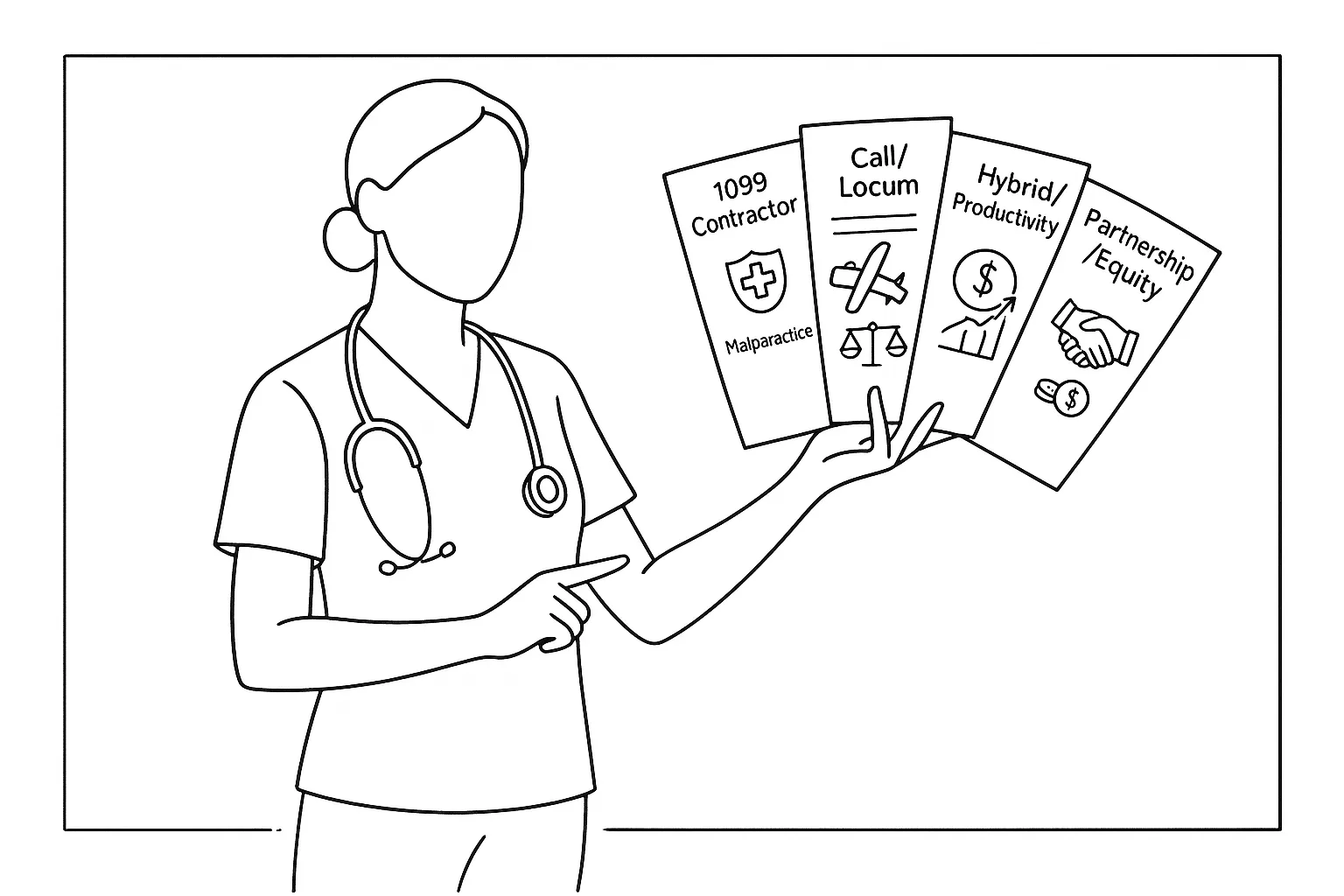
California nurse practitioners commonly encounter several contract forms, each with different legal and financial implications. Identifying the type of agreement is the first step because classification affects compensation, malpractice coverage, termination protections, restrictive provisions, taxes, and repayment obligations.
- Employment agreements (W-2): These documents establish base salary, benefits, termination rights, and employer-directed supervision or collaboration arrangements. Employers may also include performance metrics and procedures for corrective action or termination.
- Independent contractor agreements (1099): These agreements treat the NP as an independent business entity and frequently allocate more financial and operational risk to the NP. Because the contract label alone does not determine worker status, an independent contractor agreement review should consider control, integration, economic dependence, invoicing, collections, and tax-related provisions.
- Call, locum tenens, or per-diem agreements: Short-term assignments often emphasize hourly or per-shift compensation, coverage obligations, documentation expectations, malpractice requirements, and possible repayment provisions for travel or relocation incentives.
- Hybrid or productivity-based agreements: These arrangements combine a guaranteed base with collections, RVUs, or bonuses. The definition of production, reconciliation timing, and negative accrual language are frequent sources of disagreement.
- Partnership, buy-in, or equity agreements: These less common agreements may use vague language about future ownership, vesting, valuation, or buy-in calculations. Ambiguous terms can create unattractive or unexpected financial commitments.
California NP Compensation, Productivity, and Benefits
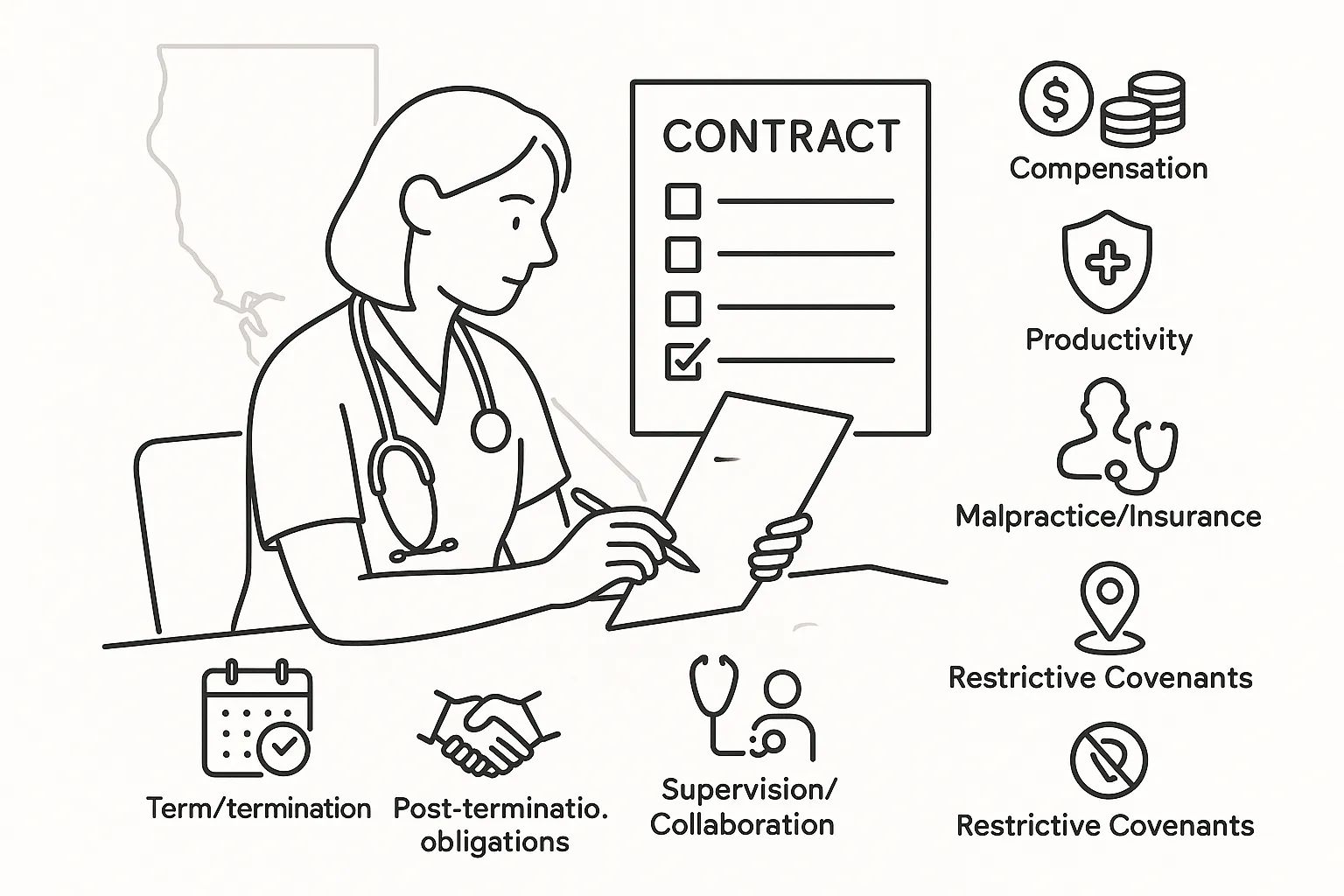
Compensation architecture is often the largest income driver and one of the most complex sources of contract disputes. A focused nurse practitioner compensation and productivity review should test whether the written formula supports the earnings represented during recruitment.
- Base salary: Confirm whether the base is guaranteed, when it is paid, and whether it can be reduced or withheld because of productivity shortfalls. A stated guarantee paired with a reconciliation clause may function as an advance against future production.
- Collections-based pay: Determine who controls billing and coding, how collections are defined, when payments are calculated, and how refunds, denials, write-offs, or chargebacks affect compensation. A percentage based only on funds deposited by the employer can produce a materially different result from a gross-revenue formula.
- RVU compensation: Review the RVU schedule, conversion factor, productivity threshold, specialty or geographic modifiers, and the employer’s ability to change the formula. Misaligned baselines or shifting conversion factors can obscure actual earning potential.
- Bonuses and incentives: Clarify objective metrics, measurement periods, payout timing, and whether bonuses are guaranteed or discretionary. Vague conditions such as “meeting productivity goals” leave substantial room for employer interpretation.
- Negative accrual and repayment obligations: Some contracts permit the employer to carry productivity deficits forward, withhold future compensation, or require repayment after reconciliation. These provisions can create immediate cash-flow risk.
- Benefits and expense reimbursement: Verify health and retirement benefits, CME allowances, licensing and DEA expenses, credentialing costs, relocation assistance, reimbursement deadlines, and any right to offset expenses against future compensation.
Malpractice Coverage, Practice Authority, and Restrictive Terms
Contract provisions addressing professional liability, clinical authority, and post-employment conduct can affect both current practice and the ability to move to another employer. California scope-of-practice issues in NP contracts should be considered alongside insurance obligations, supervision terms, and restrictions rather than treated as isolated boilerplate.
- Malpractice insurance: Distinguish occurrence coverage from claims-made coverage. Claims-made policies may require tail coverage after the policy ends, so the agreement should identify who pays for that coverage and whether the employer’s policy applies to every service the NP is expected to perform. A malpractice and tail insurance review can identify gaps and unresolved post-employment costs.
- Supervision and collaboration: Contracts may impose physician supervision, collaboration, delegation, or chart-review requirements that exceed what is otherwise required for the position. A supervision and collaboration agreement review should identify unnecessary restrictions, dependence on a named physician, and the absence of a transition plan if that relationship ends.
- Restrictive covenants and non-solicitation provisions: Although California generally restricts non-compete agreements, confidentiality, non-solicitation, trade secret, and related clauses may still create practical risk. A nurse practitioner non-compete review evaluates the activities covered, triggering events, duration, and potential effect on future employment without promising a particular enforceability outcome.
- Post-employment obligations: Patient notification, property-return, confidentiality, record-access, and non-solicitation provisions may continue after departure. The agreement should clearly distinguish legitimate ongoing duties from language that unnecessarily interferes with professional mobility.
Termination Rights and Post-Employment Compensation
Termination language determines how quickly either party can end the relationship and what financial obligations survive. A nurse practitioner contract termination review should examine the initial term, automatic renewal, without-cause notice, for-cause definitions, cure rights, repayment obligations, and duties that continue after departure.
Immediate termination triggers involving fraud, licensure, credentialing, exclusions, or patient safety should be clearly and narrowly drafted. Vague performance or documentation standards can give an employer broad discretion to characterize a separation as for cause, potentially affecting notice, bonus eligibility, repayment obligations, or other contractual rights.
Post-termination compensation is also frequently overlooked. The contract should explain whether final pay includes accrued salary, earned bonuses, completed shifts, previously generated collections, or accounts receivable received after departure. It should also address chargebacks, reconciliation timing, access to supporting records, and whether the NP remains entitled to compensation for services already performed.
California Contract Negotiation Priorities and Red Flags
Contract negotiation should focus on employer-favorable defaults and open-ended obligations that can materially change the offer. Common concerns include undefined production targets, subjective bonus criteria, broad repayment provisions, unclear insurance obligations, and termination language that gives the employer disproportionate control.
- Vague production definitions: Undefined productivity targets or poorly defined collections can permit unexpected compensation reductions.
- Broad repayment or clawback provisions: Repayment language without a clear amount, lookback period, proration method, or dispute process creates avoidable financial exposure.
- Ambiguous bonus criteria: A discretionary bonus without objective metrics, measurement dates, and payment deadlines may never become an enforceable payment obligation.
- Employer control in a contractor agreement: Extensive control over scheduling, billing, documentation, equipment, or outside work may conflict with the practical expectations of an independent contractor relationship.
- Unresolved tail insurance responsibility: Silence about tail coverage can leave a departing NP facing a substantial and unexpected expense.
- Overbroad restrictive language: Even when a traditional non-compete is prohibited, expansive non-solicitation, confidentiality, or trade secret language can create conflict during a job transition.
- Broad for-cause termination: Vague performance or documentation triggers may make immediate termination easier and eliminate rights that otherwise apply to a without-cause separation.
An attorney-led review translates these provisions into practical consequences, including projected income under the stated formula, potential tail insurance expense, post-termination collection disputes, repayment exposure, and limits on professional mobility. The goal is to clarify obligations and identify reasonable drafting alternatives before the agreement is signed.
Get Your California NP Contract Reviewed
Before signing or terminating a California nurse practitioner agreement, have Chelle Law identify compensation risks, insurance obligations, restrictive terms, and provisions that may affect your professional mobility.
Contact Chelle Law