
When a nurse practitioner accepts a position in Connecticut—whether practicing in Hartford, New Haven, Stamford, or along the Fairfield County corridor—the employment or independent contractor agreement governs compensation, professional duties, malpractice allocation, and post-employment restrictions. These agreements operate within the framework of Connecticut law, including oversight by the Connecticut Board of Examiners for Nursing and statutory authority under Title 20 of the Connecticut General Statutes. A Connecticut nurse practitioner contract review helps clarify how employer-drafted provisions interact with state regulatory requirements and the practitioner’s level of authority.
Seemingly minor drafting differences can materially affect productivity-based compensation, restrictive covenants, supervision or collaboration structures, and termination rights. A nurse practitioner contract attorney can evaluate collections formulas, bonus thresholds, tail insurance responsibility, notice provisions, and post-employment limitations with attention to how the agreement is likely to function in Connecticut’s healthcare market.
At Chelle Law, the approach centers on structured, attorney-led risk assessment. We review each agreement line by line to identify clauses that may affect earnings stability, regulatory compliance, and long-term career mobility. Nurse practitioners entering practice for the first time can also learn about our new graduate nurse practitioner contract review service.
Key Connecticut NP Contract Takeaways
- Treat contract review as a risk-management exercise designed to identify employer-favorable language that may affect compensation, licensure, and career mobility.
- Determine whether the agreement accurately reflects W-2 employment, a 1099 independent contractor relationship, or locum or telehealth work because each structure assigns financial and professional risk differently.
- Inspect malpractice and tail coverage provisions. If the employer uses claims-made coverage, the agreement should clearly assign responsibility for any required tail policy.
- Review salary, RVUs, collections, bonuses, billing control, clawbacks, and negative accrual language to understand how compensation will actually be calculated.
- Gather the offer letter, complete contract, compensation exhibits, job description, and malpractice policy information before requesting attorney review.
Types of Nurse Practitioner Agreements in Connecticut
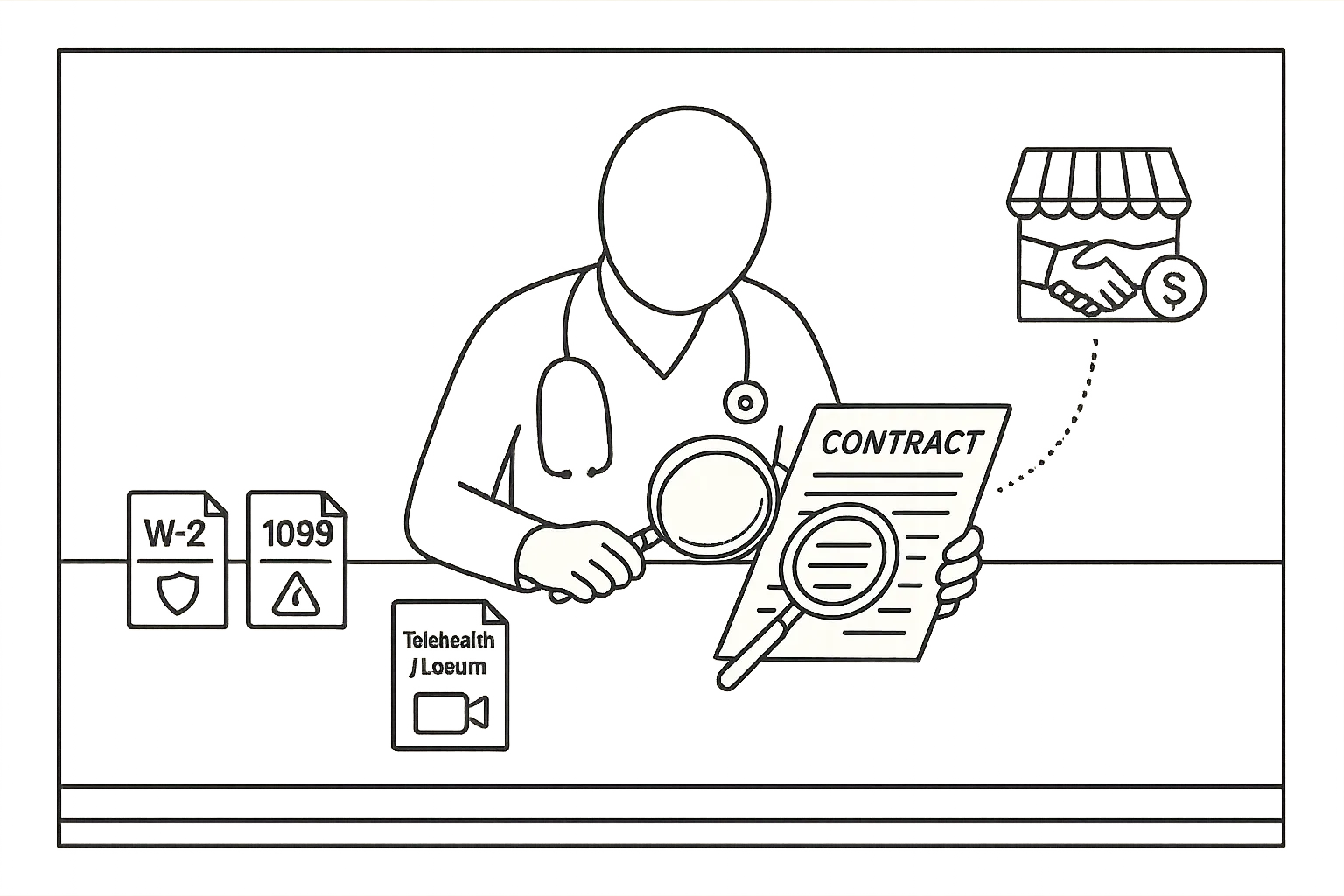
Employment, Independent Contractor, Telehealth, and Locum Agreements
Connecticut NPs commonly encounter W-2 employment agreements, 1099 independent contractor agreements, and short-term locum tenens or telehealth contracts. Employment agreements typically include payroll withholding, benefits, employer control over billing, productivity measures, performance standards, and restrictive covenants. By contrast, an independent contractor agreement may offer higher gross compensation while shifting taxes, benefits, insurance, and other expenses to the NP. Our guide to W-2 versus 1099 status for nurse practitioners explains several practical distinctions.
Telehealth and locum tenens contracts are often time-limited but may contain broad non-solicitation language, immediate termination rights, cross-state licensure requirements, and complex indemnification provisions. The complete agreement must be reviewed to understand the relationship because the title assigned to the arrangement does not necessarily resolve every classification or control issue.
Practice Ownership, Partnership, and Buy-In Terms
Offers that include partnership, profit sharing, or a future buy-in require careful scrutiny. A general promise of partnership without a defined valuation method, timeline, governance structure, or exit process can create long-term uncertainty. Important provisions include equity valuation, vesting schedules, capital contributions, distribution rights, voting authority, clawbacks triggered by termination, and responsibility for practice debts or claims after departure.
Connecticut Scope of Practice and Malpractice Terms

Scope of Practice, Collaboration, and Contract Duties
Connecticut statutes and regulatory guidance define an NP’s scope of practice and any applicable collaboration or oversight requirements. Contracts frequently incorporate regulatory language by reference, so the agreement should be checked for duties that exceed the NP’s permitted scope or create unclear supervisory mechanisms. A detailed supervision and collaboration agreement review can identify terms that do not align with the intended clinical relationship.
The review should consider whether the contract requires documentation or delegation that may be inconsistent with applicable rules, makes duties contingent on physician presence or approval, or establishes reporting and disciplinary procedures that differ from standard licensing processes. Clinical responsibilities, prescribing expectations, patient volume, work locations, and administrative duties should also be clearly stated.
Malpractice Insurance and Tail Coverage
Malpractice language requires close attention because claims-made and occurrence policies create different post-termination exposure. Claims-made insurance generally responds when a claim is reported while the policy is active, which may make tail coverage necessary after employment ends. Occurrence coverage generally applies to incidents occurring during the policy period regardless of when a claim is later filed.
A contract should identify the policy type, coverage limits, premium responsibility, consent-to-settle terms, and who must purchase tail coverage. Provisions that make the NP responsible for an undefined tail expense or condition employer-paid tail on a narrow termination scenario deserve careful review. Learn more about tail insurance for nurse practitioners and the issues that should be addressed before signing.
Compensation and Restrictive Covenant Clauses
Salary, RVUs, Collections, Bonuses, and Repayment Obligations
NP compensation may combine a base salary with RVUs, collections, quality measures, patient satisfaction targets, or other bonus criteria. A formula such as “base salary plus RVUs above a threshold multiplied by a conversion factor” may appear straightforward, but its value depends on how RVUs are credited, who controls coding, when reports are issued, and whether the employer can change the threshold or conversion factor.
Collections-based arrangements require equally careful definitions because billed charges, adjusted production, and actual collections are not interchangeable. The contract should address reconciliation timing, access to supporting reports, chargebacks, repayment demands, and negative accrual. A nurse practitioner compensation and productivity review can help translate these formulas into their likely financial effect. Signing bonuses, relocation assistance, and loan repayment benefits should also be reviewed for prorated or full repayment obligations after early termination.
Non-Compete and Non-Solicitation Restrictions
Restrictive covenants can limit where and how an NP practices after leaving a position. Connecticut agreements may include non-compete provisions with geographic and time limits, non-solicitation restrictions covering patients or employees, confidentiality requirements, and restrictions involving referral sources. Enforceability depends on the language, circumstances, applicable law, and legal developments rather than the heading assigned to the clause.
Broad geographic areas, lengthy restriction periods, vague definitions, and restrictions tied to every employer location may create substantial career risk. These provisions should be evaluated before the NP becomes dependent on the position or relocates. Our nurse practitioner non-compete review focuses on the practical effect of the proposed restrictions and potential revisions.
Termination Terms and Common Contract Red Flags
Notice, For-Cause Termination, Clawbacks, and Disputes
Termination provisions determine the required notice period, grounds for immediate termination, available cure periods, and whether either party can end the agreement without cause. They should also explain how final salary, earned bonuses, unused leave, collections, and other compensation will be calculated and paid. Clawback language may require repayment of signing bonuses, relocation payments, or loan benefits, while arbitration, forum-selection, and attorney-fee provisions can affect the cost and location of a dispute.
A nurse practitioner contract termination review can identify obligations that continue after departure, including repayment requirements, patient or employee non-solicitation, record-return duties, confidentiality, and indemnification.
Duties, Scheduling, Credentialing, and Billing Control
Ambiguous duties, work hours, call requirements, floating obligations, and location assignments can give an employer significant unilateral flexibility. Credentialing provisions also deserve attention when they allow termination for delayed or lost privileges without defining the parties’ responsibilities, a reasonable remediation process, or compensation during the delay.
Performance metrics should use defined calculation periods and objective data that the NP can review. Red flags include retroactive metric changes, employer control over coding and denial appeals without reporting access, vague performance standards, and negative accrual that carries an earlier shortfall into a later compensation period.
How to Prepare for a Connecticut Contract Review
Before requesting review, gather the complete offer letter, proposed agreement, amendments and exhibits, job description, compensation plan, available productivity reports, malpractice policy summary, and relevant correspondence about the offer. Reviewing the entire document package helps identify inconsistencies between the offer, compensation exhibits, and binding contract language.
- Confirm the employment or contractor classification and the expenses assigned to each party.
- Calculate compensation under realistic productivity and collections scenarios.
- Identify malpractice coverage, tail responsibility, and indemnification obligations.
- Review non-compete, non-solicitation, confidentiality, and outside-activity restrictions.
- Evaluate termination notice, cure rights, repayment provisions, and final compensation.
After signing, retain the executed agreement, amendments, compensation reports, performance reviews, and correspondence concerning discipline or pay. Keep records of malpractice coverage, licensure renewals, continuing education, and credentialing. If a transition or dispute appears likely, reviewing post-employment obligations early may preserve options and reduce avoidable professional or financial exposure.
Get Your Connecticut NP Contract Reviewed
Before signing or ending a Connecticut nurse practitioner agreement, Chelle Law can review the terms, explain the practical risks, and identify provisions that may affect your compensation and career mobility.
Contact Chelle LawExplore Nurse Practitioner Contract Guidance
Review Chelle Law’s services, educational resources, and state-specific contract information.