
When a nurse practitioner accepts a position in Georgia—whether practicing in Atlanta, Savannah, Augusta, or another Georgia healthcare market—the employment or independent contractor agreement controls critical issues such as compensation, clinical duties, malpractice coverage, termination rights, and post-employment restrictions. Those terms must also operate within Georgia’s professional and regulatory framework, including oversight by the Georgia Board of Nursing and applicable provisions of Title 43 of the Official Code of Georgia Annotated.
Subtle drafting differences can materially affect productivity calculations, collaboration requirements, restrictive covenant exposure, and the financial consequences of leaving a position. Georgia generally evaluates restrictive covenants under O.C.G.A. § 13-8-50 et seq., while an NP’s clinical responsibilities must remain consistent with applicable licensure, prescribing, scope-of-practice, and collaborative practice requirements.
Chelle Law provides attorney-led review focused on the practical effect of employer-drafted provisions. We examine the agreement line by line to identify terms that may affect earnings stability, regulatory compliance, liability, and career mobility. The review can address W-2 and 1099 classification, compensation formulas, supervision or collaboration language, malpractice and tail insurance, termination provisions, repayment obligations, and restrictive covenants before an NP signs or renews an agreement.
Key Georgia NP Contract Review Priorities
- Confirm whether the agreement accurately describes a W-2 employment or 1099 independent contractor relationship and allocates the associated taxes, benefits, expenses, and insurance obligations.
- Require objective definitions for productivity metrics, bonus calculations, reconciliation procedures, and access to the data used to calculate compensation.
- Compare clinical duties, prescribing authority, collaboration provisions, and practice locations with Georgia licensing and practice requirements.
- Identify who provides malpractice coverage and who must pay for tail insurance after the relationship ends.
- Review termination, repayment, non-compete, and non-solicitation provisions together because their combined effect can determine the real cost of leaving a position.
Employment, Contractor, and Georgia Practice Terms

An employment agreement typically provides W-2 wages, tax withholding, employer-sponsored benefits, and workplace policies. A 1099 agreement usually places more responsibility on the NP for taxes, benefits, professional expenses, and insurance while describing greater control over how services are performed. Misclassification concerns may arise when a contract labels the NP an independent contractor but the organization controls schedules, equipment, billing, policies, or other important aspects of the working relationship. NPs offered a contractor role should consider a focused independent contractor agreement review.
Locum tenens, telehealth, and ownership agreements introduce additional issues. Locum contracts often emphasize scheduling, travel, cancellation rights, and malpractice coverage. Telehealth terms may address technology, patient location, cross-state practice, and prescribing responsibilities. Owner or partner agreements can include governance rights, equity contributions, buyouts, and exit provisions that differ substantially from ordinary employment terms.
Georgia agreements should also describe duties in a way that is consistent with the NP’s license and authorized practice. Collaboration, supervision, prescribing, and delegated responsibilities should not be left to vague employer policies that can change without clear contractual limits. A dedicated review of supervision and collaboration terms can help identify inconsistencies between the contract, the clinical arrangement, and applicable Georgia requirements.
Clinical Duties, Scheduling, and Termination Rights
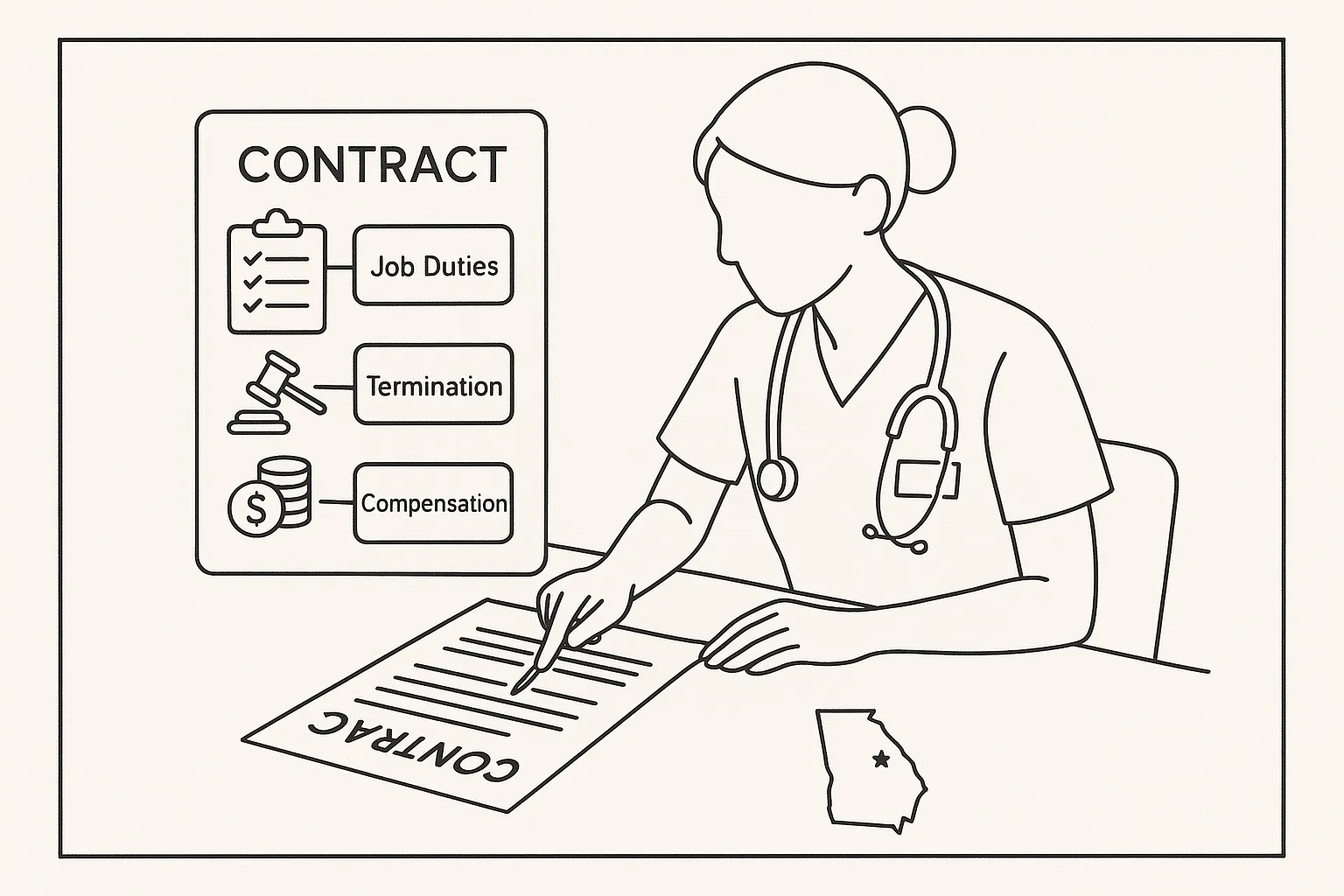
Broad job descriptions can allow an employer to change workload or expectations after signing. The agreement should define clinical services, patient volume expectations, administrative responsibilities, call coverage, schedules, remote work, and assignments to multiple sites. If the employer can modify these matters unilaterally, the NP may have limited protection against increased workload or travel that was not reflected in the original offer.
Termination provisions determine how much notice each party must provide and when immediate termination is permitted. A well-defined for-cause provision should explain the events that permit immediate action and whether the NP receives notice or an opportunity to cure a correctable issue. Without-cause termination rights, notice periods, compensation through the final day, benefit continuation, and the handling of accrued paid time off should be read alongside repayment and restrictive covenant provisions.
Termination can also affect bonuses, outstanding collections, tail insurance, credentialing, and the enforceability of post-employment restrictions. A contract termination review can clarify these connected obligations before an NP resigns, responds to a notice, or agrees to separation terms.
Compensation, Productivity, and Repayment Provisions
NP compensation may consist of guaranteed salary, collections, relative value units, percentage splits, quality incentives, or a combination of these models. Collections-based compensation depends on billing, coding, payer mix, collection timing, and employer-controlled processes. RVU compensation requires a defined conversion rate, an explanation of which services generate credit, and rules for shared visits, bundled services, and adjustments. A thorough NP compensation review should test the formula against sample calculations rather than relying on the stated percentage or rate alone.
For example, a percentage of collections may appear attractive but produce less compensation if collection rates are low or certain services are excluded. The agreement should identify whether the formula uses gross charges, allowed amounts, or money actually collected, when calculations occur, and whether the NP can review supporting reports. Reconciliation and negative accrual provisions also require attention because they may allow alleged overpayments to be deducted from future compensation.
Benefits are part of total compensation and should be evaluated with the same care as salary. Relevant terms include paid time off, continuing education allowances, licensing and professional fee reimbursement, retirement contributions, health benefits, and eligibility or vesting requirements. Signing bonuses, relocation assistance, and loan repayment benefits often include repayment obligations if the NP leaves before a specified date. The contract should explain whether repayment is prorated and whether it applies when the employer terminates the agreement without cause.
Malpractice Coverage, Tail Insurance, and Indemnification
Malpractice provisions determine the type and limits of coverage, who pays the premium, and whether the policy protects the NP for all contracted services and locations. Occurrence coverage generally responds to covered events that occurred during the policy period, even if the claim is filed later. Claims-made coverage generally requires the policy to remain active when the claim is made, which can create a need for tail coverage after employment ends.
The agreement should expressly allocate responsibility for tail insurance rather than leaving the issue to employer policy. Relevant questions include whether the employer pays when it terminates without cause, whether the NP pays after resignation or for-cause termination, and whether another form of prior-acts coverage will satisfy the obligation. Our malpractice and tail insurance review examines these provisions together with termination language and continuing post-employment duties.
Indemnification and hold-harmless clauses can create additional exposure if they require the NP to reimburse the organization for billing errors, regulatory penalties, or conduct outside the NP’s control. These clauses should be reviewed for scope, reciprocity, exclusions, and consistency with the parties’ respective responsibilities. Language that transfers employer-level operational risk to an individual practitioner warrants particular scrutiny.
Georgia Non-Competes and Post-Employment Restrictions
Non-compete clauses may restrict practice within a defined area for a stated period after employment ends, while non-solicitation provisions may limit contact with patients, referral sources, or employees. Georgia generally evaluates restrictive covenants under O.C.G.A. § 13-8-50 et seq., but enforceability depends on the language and circumstances. The practical concern is not limited to litigation: a broad restriction can affect an NP’s ability to accept another position in Atlanta, Savannah, Augusta, or another nearby healthcare market.
A non-compete review should examine duration, geographic scope, restricted activities, covered locations, and the events that trigger enforcement. The contract should also address patient records, transition responsibilities, professional announcements, and whether restrictions apply when the employer terminates the NP without cause. Narrowing ambiguous or excessive language before signing can reduce uncertainty and preserve future practice options.
How to Review a Georgia NP Contract Before Signing
A structured review should begin with the economic terms but also test how different provisions interact. For example, an attractive signing bonus may become a substantial liability when paired with a short without-cause notice period and broad repayment language. Similarly, a productivity formula may be difficult to evaluate if the employer controls all underlying data and the agreement provides no audit or dispute process.
- Confirm the compensation formula, payment timing, reconciliation rules, and access to supporting data.
- Identify all repayment obligations, including signing bonuses, relocation assistance, alleged overpayments, and training expenses.
- Compare duties, schedules, call coverage, practice locations, and collaboration terms with the offer and expected Georgia practice arrangement.
- Determine who pays for malpractice coverage and any required tail insurance after termination.
- Review without-cause notice, for-cause definitions, cure rights, final compensation, and post-employment restrictions together.
Red flags include undefined clawbacks, employer-only discretion over productivity calculations, ambiguous tail responsibility, broad indemnification, one-sided termination rights, misclassification indicators, and restrictions that cover more locations or services than necessary. An attorney review before signing can translate these provisions into their practical financial, licensing, and career consequences and identify focused revisions for the employer to consider.
Have a Georgia NP Contract Reviewed Before You Sign
Chelle Law reviews Georgia nurse practitioner employment and independent contractor agreements for compensation risks, collaboration terms, malpractice obligations, termination rights, and post-employment restrictions.
Contact Chelle LawExplore Nurse Practitioner Contract Guidance
Review Chelle Law’s NP contract services, practical resources, and state-specific guidance.