
When a nurse practitioner accepts a position in Hawaii—whether practicing in Honolulu, Hilo, Kailua, or elsewhere on Oahu, Maui, or the Big Island—the employment or independent contractor agreement becomes the governing document for compensation, professional duties, malpractice allocation, and post-employment restrictions. These agreements operate within the framework of Hawaii law, including oversight by the Hawaii Board of Nursing and statutory authority under Chapter 457 of the Hawaii Revised Statutes. A focused nurse practitioner contract review can clarify how employer-drafted language interacts with those requirements and where financial or professional risk may be embedded.
Subtle drafting differences can materially affect productivity-based compensation, restrictive covenants, malpractice obligations, and termination rights. An attorney can evaluate collections formulas, negative accrual provisions, tail insurance responsibility, notice requirements, and post-employment limitations with attention to how the agreement may function in Hawaii’s healthcare environment. The analysis should address not only what the contract says, but also how its terms may affect day-to-day practice, income stability, regulatory compliance, and future career options.
At Chelle Law, the focus is on structured, attorney-led risk assessment tailored to real-world practice conditions. Each agreement is examined line by line to identify clauses that may affect earnings, professional obligations, liability, and mobility before the nurse practitioner signs or makes a career transition.
Key Takeaways
- A Hawaii nurse practitioner contract should be reviewed before signing to identify income risk from collections-based pay, chargebacks, or negative accrual.
- Compensation terms should clearly define calculations, payment timing, productivity thresholds, and reconciliation procedures.
- Clinical duties, prescribing responsibilities, telehealth work, and any supervision or collaboration provisions should align with Hawaii practice and licensing requirements.
- A claims-made malpractice policy should include clear language identifying who pays for tail coverage after employment ends.
- Restrictive covenants, repayment obligations, termination notice, and final compensation terms can directly affect future mobility and income.
Why Contract Review Matters for Hawaii Nurse Practitioners
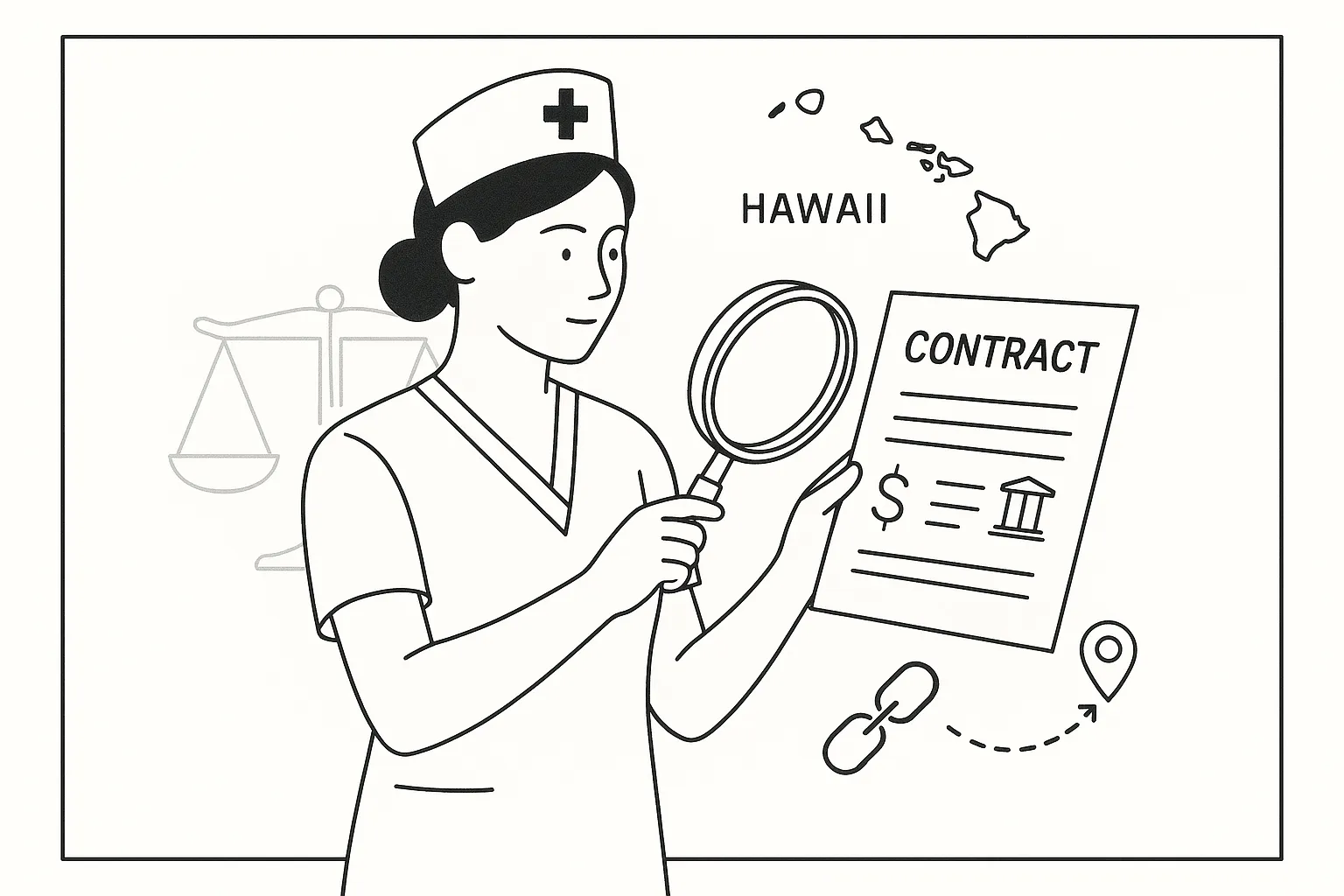
Employment and independent contractor agreements translate workplace arrangements into enforceable rights and obligations. For Hawaii nurse practitioners, those terms must be considered alongside state scope-of-practice, licensure, prescribing, and other professional requirements administered by the Hawaii Board of Nursing. Contract review helps quantify income risk, identify potential licensing or compliance concerns, and assess restrictions that could limit future work in Hawaii’s island-based healthcare markets.
Employer templates may shift revenue risk to the NP through collections-based pay, negative accrual, or chargebacks. They may also contain broad termination rights, unclear clinical expectations, or restrictive covenants that affect the ability to move between practices. Review does not guarantee a particular negotiation result; it identifies the practical consequences of signing and the provisions that may warrant clarification, revision, or additional safeguards.
Hawaii NP Contract Terms That Require Close Review
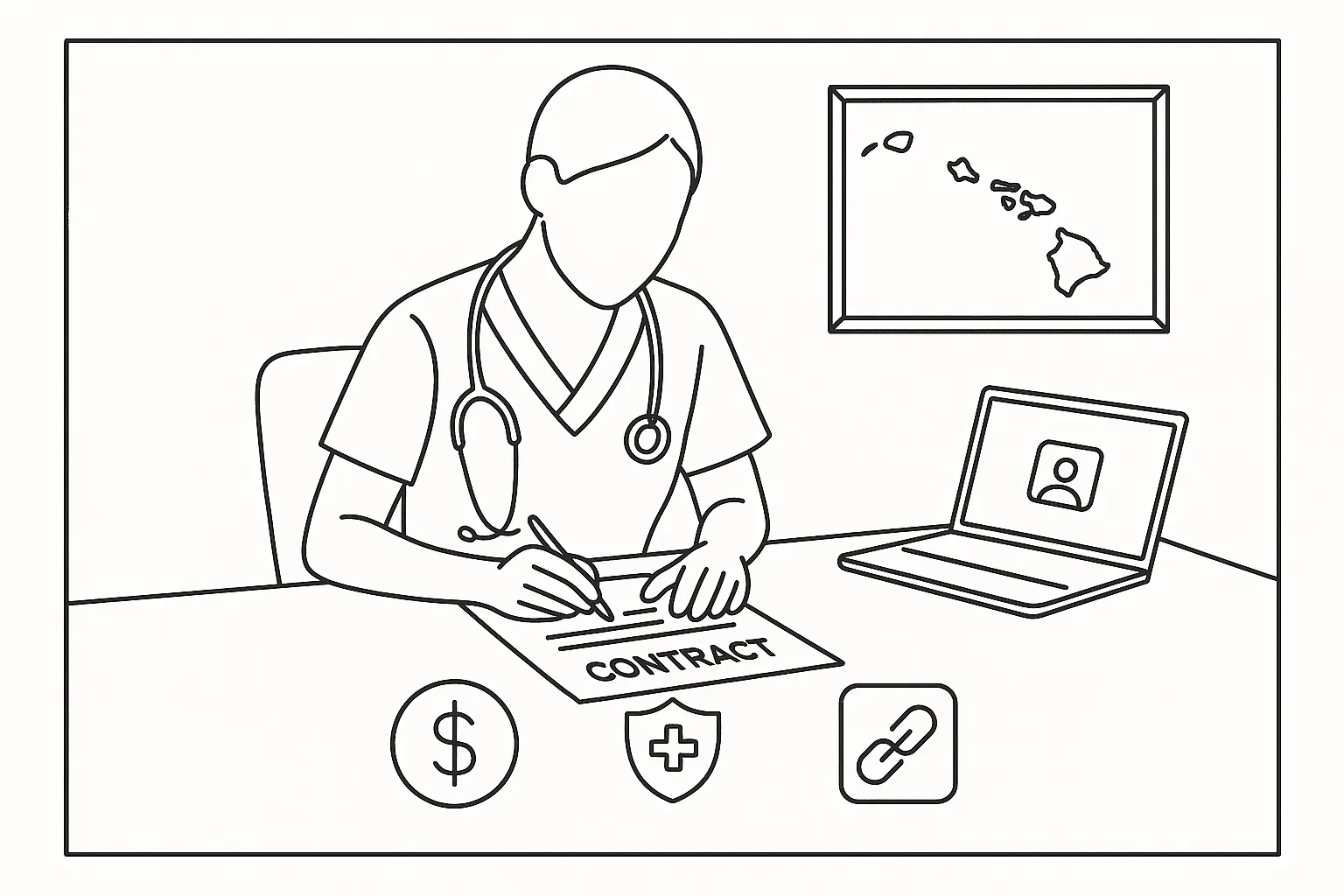
A thorough review should connect each clause to its likely financial, clinical, or professional effect. The following groups of terms commonly require particular attention in Hawaii nurse practitioner agreements.
Compensation, Duties, and State Practice Requirements
Compensation may consist of a guaranteed salary, base pay plus productivity, collections-based compensation, relative value unit production, or a separate bonus formula. Important mechanics include whether calculations use gross charges or net collections, when compensation is paid, whether productivity is capped, and whether a shortfall can carry forward through negative accrual. Patient no-shows, payer denials, delayed collections, and employer-controlled billing adjustments can all affect actual earnings. A dedicated NP compensation and productivity review can help test how these formulas work under realistic conditions.
The agreement should also describe duties and workload in measurable terms, including patient volume, visit length, schedules, call coverage, administrative work, and practice locations. Vague workload provisions may permit substantial changes without a corresponding adjustment to compensation. Clinical duties should remain consistent with Hawaii nurse practitioner scope of practice, licensure, and prescribing requirements rather than relying solely on a broad employer job description.
Any provisions addressing supervision, collaboration, chart review, signatures, or physician availability should be compared with applicable Hawaii requirements and the actual practice arrangement. Contract-created obligations may affect autonomy, workflow, and liability even when they are imposed by the employer rather than directly required by law. Nurse practitioners evaluating these provisions may benefit from a focused review of supervision and collaboration agreement terms.
Malpractice Coverage and Post-Employment Restrictions
Malpractice provisions should identify the carrier, policy type, coverage limits, and responsibility for premiums. Occurrence coverage generally protects incidents that happen during the policy period regardless of when the claim is made. Claims-made coverage generally requires the policy to remain active when the claim is made, which can create a need for tail coverage after the relationship ends. A contract that assigns an undefined tail obligation to the NP may create significant post-employment expense, so a malpractice and tail insurance review should also examine indemnification, defense control, and reimbursement obligations.
Non-compete and non-solicitation provisions may restrict future practice by geography, duration, type of service, patient relationships, or contact with staff. Their practical impact can be especially important in an island market where a geographic restriction may eliminate a meaningful portion of available opportunities. A review of NP non-compete terms can assess the scope of the restriction, the circumstances that trigger it, and whether narrower language would better protect future mobility.
Termination, Repayment, Benefits, and Location Terms
Termination language controls notice periods, for-cause grounds, immediate termination events, and the treatment of final compensation. Vague misconduct standards or broad employer discretion may reduce income protection, while resignation can trigger repayment of a signing bonus, relocation assistance, training stipend, or other benefit. A contract termination review can clarify notice requirements, repayment triggers, final pay, accrued benefits, and obligations that continue after departure.
Health insurance, retirement contributions, paid leave, continuing education allowances, licensing reimbursements, and professional development support contribute to total compensation. The agreement should state eligibility, vesting, reimbursement limits, and the employer’s ability to change a benefit plan. If the NP will work through telehealth or at multiple locations, the contract should also address technology, travel, scheduling, cross-jurisdictional practice, and the way remote encounters are credited for compensation or productivity.
Common Contract Red Flags and Their Practical Impact
Certain provisions commonly increase employer leverage or shift unexpected costs to the nurse practitioner. Red flags can include:
- Collections-based compensation that gives the employer unilateral control over billing, write-offs, and adjustments.
- Negative accrual or chargeback clauses that permit recoupment without a clear reconciliation process.
- A broad definition of for-cause termination that allows immediate dismissal and loss of compensation or benefits.
- Employer-provided claims-made malpractice coverage without a clear allocation of tail insurance responsibility.
- Restrictive covenants or non-solicitation provisions that materially limit practice opportunities in Hawaii.
- Signing bonus or relocation repayment provisions that are not prorated or that apply regardless of why employment ends.
Each red flag should be evaluated by its measurable effect: reduced take-home pay, increased out-of-pocket liability, expanded licensing exposure, or curtailed career mobility. The purpose of legal review is to translate the drafting into likely practical consequences so the NP can make an informed decision.
Negotiation Priorities for a Hawaii NP Agreement
Negotiation should focus first on provisions that create the greatest financial, professional, or regulatory risk. Common priorities include clarifying compensation calculations and payment timing, limiting unilateral billing adjustments, defining repayment triggers and prorated schedules, allocating tail coverage responsibility, narrowing restrictive covenants, and establishing workable termination notice. Duties and practice expectations should also be written clearly enough to distinguish employer preferences from requirements imposed by Hawaii law or the applicable licensing authority.
The appropriate priorities depend on the specific offer and the NP’s circumstances. A productivity formula may be the central concern in one agreement, while malpractice coverage, practice location, telehealth duties, or a post-employment restriction may carry greater risk in another. Attorney review helps identify the limited group of terms that most warrant attention rather than treating every provision as equally important.
What an Attorney Reviews Before You Sign
An attorney experienced in healthcare employment agreements can provide legal analysis and a practical assessment of how the contract operates. The review process may include:
- Line-by-line identification of employer-favorable provisions and potential financial exposure.
- Analysis of compensation, productivity, bonus, and repayment mechanics.
- Assessment of malpractice coverage, tail obligations, indemnification, and liability allocation.
- Evaluation of restrictive covenants and their practical effect on future employment.
- Comparison of clinical duties and contract requirements with applicable Hawaii practice and licensing considerations.
- Plain-language explanations, written comments or redlines, and a consultation about possible next steps.
Review is most useful before the agreement is signed, while there is still time to clarify terms or request revisions. If an agreement has already been executed, an attorney can still assess termination exposure, repayment obligations, restrictive covenants, and other risks, although the available options may be more limited. Chelle Law uses a flat-fee review approach to provide predictable cost and focused analysis without making unsupported promises about a particular negotiation outcome.
Pre-Signing Checklist for Hawaii Nurse Practitioners
Gathering the complete set of documents helps ensure that the review addresses the material terms rather than only the primary agreement. Before signing, consider providing counsel with:
- The complete offer, employment agreement, or independent contractor agreement.
- Any incorporated handbook, billing policy, productivity plan, bonus schedule, or benefits document.
- Sample productivity reports and available information about payer mix or collection timing.
- Malpractice policy details, including the carrier, policy type, limits, and proposed tail arrangement.
- Descriptions of expected schedules, call coverage, telehealth duties, supervision or collaboration arrangements, and practice locations.
- Any prior restrictive covenant or repayment obligation that could overlap with the new agreement.
Submit the documents and schedule the review as early as possible after receiving the offer. Allowing time for analysis helps identify immediate financial triggers, post-employment restrictions, malpractice obligations, and state-specific practice concerns before acceptance creates binding obligations.
Review Your Hawaii Nurse Practitioner Contract Before Signing
Chelle Law reviews Hawaii NP employment and independent contractor agreements for compensation risk, malpractice obligations, termination terms, restrictive covenants, and state-specific practice concerns.
Contact Chelle LawExplore Nurse Practitioner Contract Guidance
Review legal services, practical contract resources, and state-specific guidance for nurse practitioners.