
When a nurse practitioner accepts a position in Maryland—whether practicing in Baltimore, Annapolis, Rockville, Montgomery County, or another healthcare market—the employment or independent contractor agreement governs compensation, duties, malpractice obligations, and post-employment restrictions. These agreements operate within Maryland law and the professional framework overseen by the Maryland Board of Nursing, including rules affecting advanced practice nursing, prescribing, licensure, and scope of practice.
Subtle drafting differences can materially affect productivity pay, bonus eligibility, restrictive covenants, and termination rights. Maryland has also enacted statutory limitations on non-compete agreements for certain healthcare professionals under Md. Code, Labor and Employment § 3-716. A Maryland nurse practitioner contract review helps identify how employer-drafted provisions may affect earnings, regulatory compliance, liability exposure, and future career mobility before the agreement is signed.
At Chelle Law, the focus is a structured, attorney-led assessment of the complete agreement. The review can address collections formulas, negative accrual provisions, malpractice and tail insurance, repayment obligations, notice requirements, and post-employment restrictions. NPs with production-based pay can also learn more about our compensation and productivity review.
Key Contract Review Considerations for Maryland NPs
- Confirm whether the working relationship is accurately classified as W-2 employment or independent contracting.
- Calculate how base compensation, collections, RVUs, bonuses, and negative accrual provisions operate in practice.
- Compare duties, prescribing expectations, and operational requirements with Maryland’s scope-of-practice framework.
- Identify the malpractice policy type, available limits, defense obligations, and responsibility for tail coverage.
- Review non-compete, non-solicitation, repayment, termination, arbitration, and forum-selection provisions before signing.
Why a Maryland-Focused NP Contract Review Matters
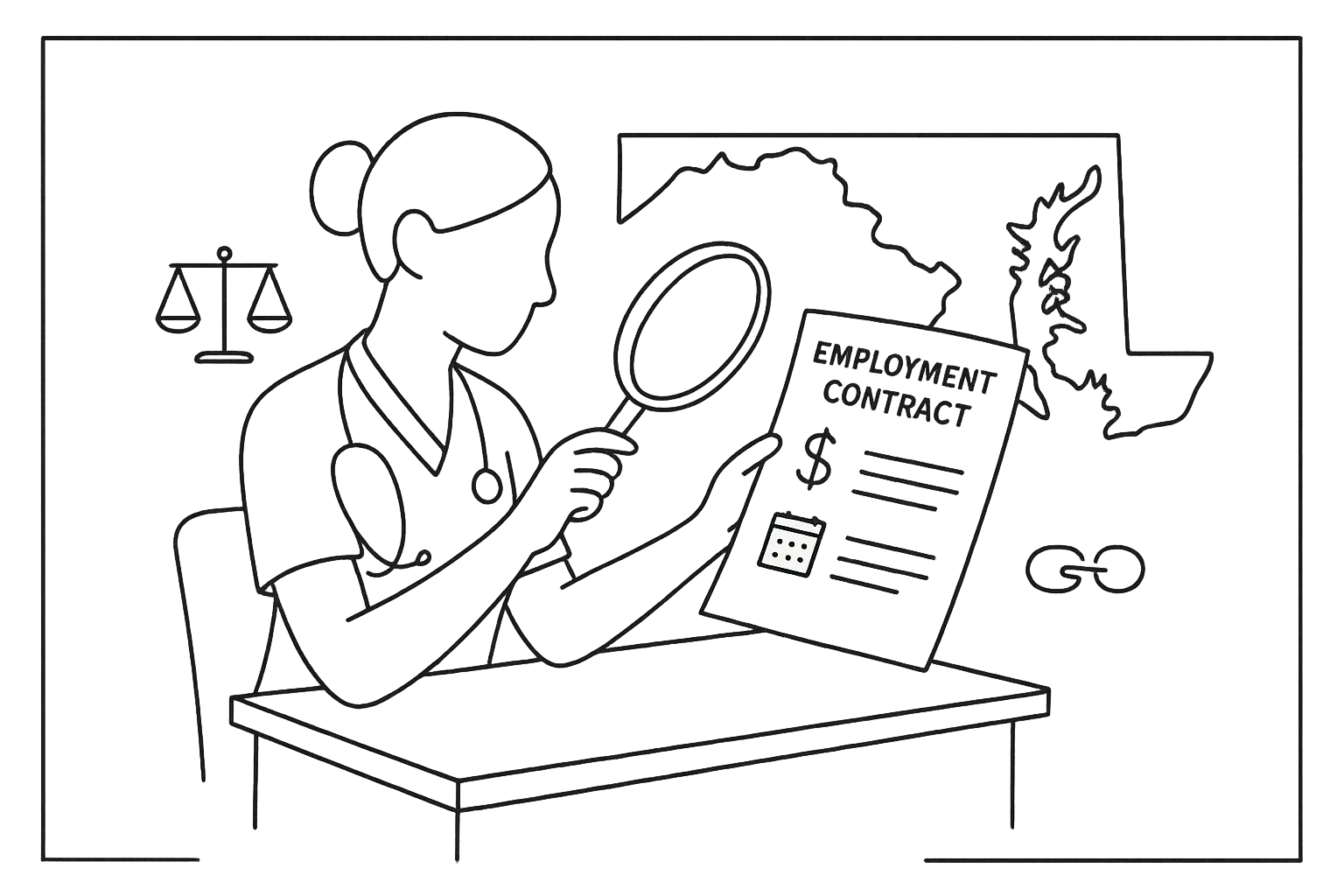
Nurse practitioner agreements routinely contain dense provisions that appear standard but can create significant financial and professional consequences. Compensation formulas may shift collection risk to the clinician, restrictive covenants may limit future practice, and insurance or indemnification language may expose an NP to obligations that continue after departure. A focused review explains how each provision works in the context of the entire agreement rather than evaluating clauses in isolation.
Maryland-specific review is also important when contract language addresses prescribing, supervision, collaboration, telehealth, credentialing, or multi-site practice. The agreement should be evaluated alongside the professional requirements administered by the Maryland Board of Nursing. The purpose is to identify ambiguity, quantify reasonably foreseeable risks, and develop practical questions or proposed revisions—not to guarantee a particular employment or legal outcome.
Employee and Independent Contractor Classification
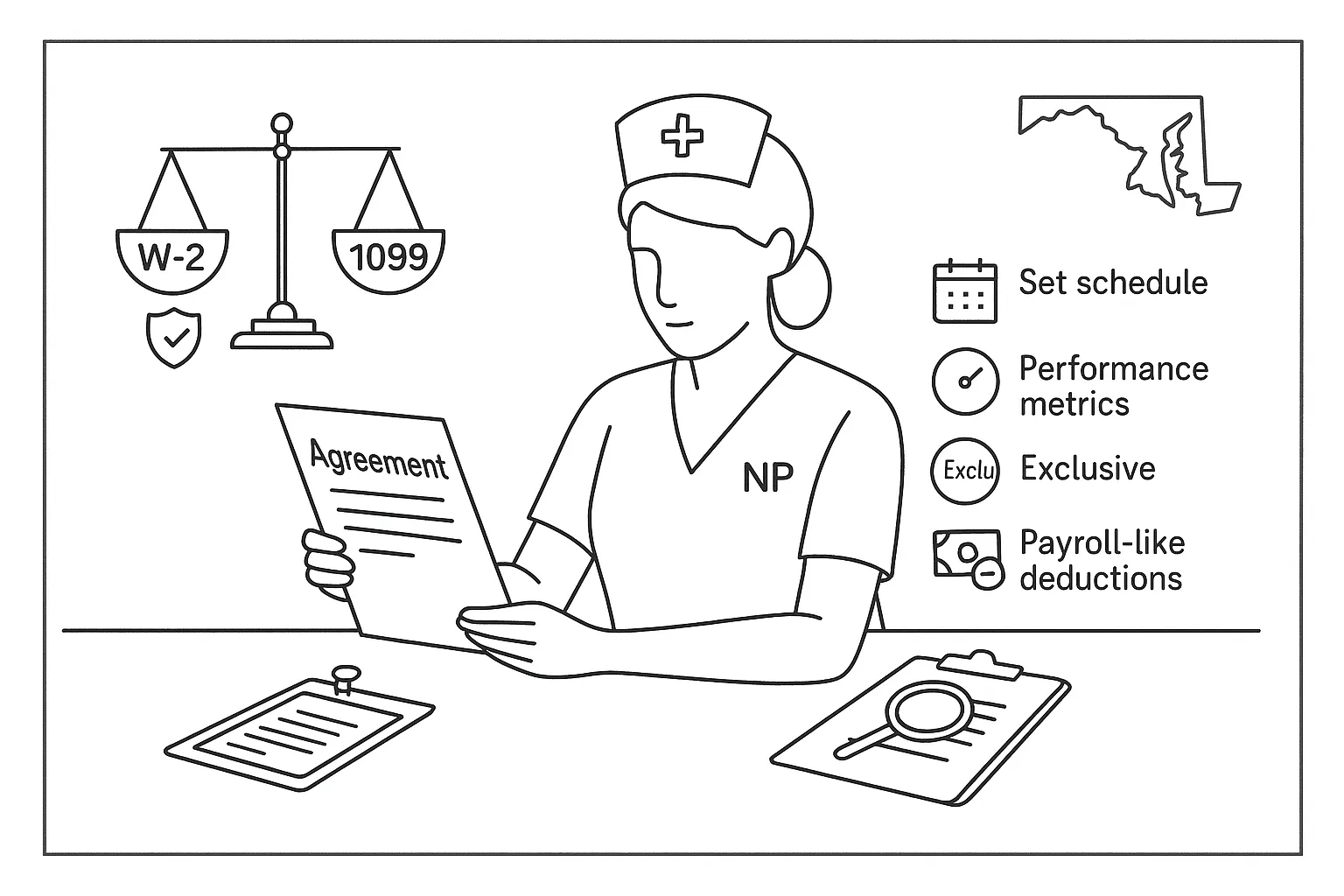
Classification affects taxation, benefits, worker protections, expense responsibility, and the practical allocation of business risk. A W-2 employee typically receives payroll withholding and may receive employer-sponsored benefits, while a 1099 independent contractor generally assumes greater responsibility for taxes, benefits, and operating expenses. The contract label alone does not explain how the relationship will function.
A review should examine scheduling control, exclusivity, performance standards, billing arrangements, reimbursement terms, equipment, support staff, and the ability to provide services elsewhere. When an agreement is structured as a contractor relationship, an independent contractor agreement review can identify provisions that allocate unexpected costs or impose controls more commonly associated with employment. An attorney can explain the contractual implications without providing tax advice.
Compensation, Productivity, and Benefits Terms
Common compensation models include a fixed salary, salary plus productivity, collections-based pay, and relative value unit systems. The agreement should define the guarantee period, productivity threshold, conversion factor, payment schedule, reconciliation method, and treatment of shortfalls. It should also explain whether compensation is calculated from billed charges, allowed amounts, or money actually collected and whether refunds, denials, or chargebacks reduce the NP’s credit.
For example, a percentage of collections above a stated threshold may appear favorable until the contract’s deductions, collection period, or negative accrual method is considered. A detailed guide to RVU compensation for nurse practitioners can help clarify productivity terminology, while the contract review determines how the specific formula applies to the proposed position.
Benefits should be reviewed with the same care as salary. Important terms include health and retirement eligibility, paid time off, continuing education, professional dues, licensure and DEA reimbursement, relocation assistance, student loan benefits, and signing bonuses. Any benefit tied to a service commitment should state the repayment period, whether the obligation is prorated, and which termination events trigger a clawback.
Scope of Practice, Scheduling, and Clinical Duties
The agreement should clearly describe clinical duties, patient populations, practice locations, scheduling expectations, call coverage, administrative work, and performance standards. Although a contract does not replace Maryland’s statutory and regulatory framework, it can impose operational requirements that are narrower than an NP’s legal authority. Vague or conflicting language may create problems involving workflow, reimbursement, credentialing, or professional accountability.
Review is especially important when the contract references physician supervision, collaboration, delegated duties, prescriptive authority, telehealth, or practice across state lines. Chelle Law’s supervision and collaboration agreement review addresses how these provisions fit within the proposed practice arrangement. Multi-location assignments should also identify travel obligations, mileage or expense reimbursement, credentialing responsibility, and whether the employer may add locations without the NP’s consent.
Malpractice Insurance, Tail Coverage, and Indemnification
Malpractice provisions should identify whether coverage is claims-made or occurrence based. Claims-made coverage generally requires the policy to remain active when a claim is reported, which may create a need for extended reporting—or tail—coverage after employment ends. Occurrence coverage generally applies based on when the incident occurred, subject to the policy’s terms and limits.
The contract should state who purchases the policy, whether the NP is individually named, the applicable coverage limits, and who pays for tail coverage after termination. A malpractice and tail insurance review can also address defense costs, settlement control, exclusions, and whether coverage extends to telehealth, outside work, or services performed at multiple facilities.
Indemnification language requires separate attention because it may obligate the NP to reimburse the employer for losses, claims, or legal expenses. Broad indemnity provisions can create exposure beyond the malpractice policy. The review should compare those obligations with the insurance language and identify whether the employer is attempting to transfer business or billing risks to the clinician.
Non-Competes and Other Post-Employment Restrictions
Restrictive covenants may include non-compete, non-solicitation, confidentiality, and patient-relationship provisions. Their effect depends on the wording of the agreement and applicable Maryland law, including statutory limitations affecting certain healthcare professionals. Important details include the restricted period, geographic area, definition of a competitor, covered practice locations, and whether telehealth or employment with an affiliated entity is restricted.
A nurse practitioner non-compete review should also examine when the restriction applies. A provision that operates after every form of termination may be more consequential than one limited to a voluntary departure. Non-solicitation and confidentiality terms should clearly distinguish protected business information from an NP’s general skills, professional relationships, and lawful future practice.
Termination, Repayment, and Dispute Terms
Termination provisions determine how the relationship can end and what obligations survive. The agreement should distinguish termination for cause from termination without cause, define any opportunity to cure an alleged breach, and state the required notice period. Immediate termination triggers may include loss or restriction of a license, credentialing problems, exclusion from government programs, or failure to maintain required insurance.
A contract termination review can evaluate severance, accrued compensation, bonus eligibility, patient-transition duties, and continuing restrictions. Repayment provisions may cover signing bonuses, relocation assistance, educational benefits, or productivity advances. The agreement should explain whether repayment is prorated and whether employer-initiated termination also triggers the obligation.
Governing-law, forum-selection, and arbitration clauses determine where and how disputes will be resolved. These terms may limit access to court, require a particular venue, allocate arbitration costs, or waive certain procedures. They should be reviewed before signing rather than after a compensation or termination dispute develops.
What to Prepare for a Maryland NP Contract Review
A complete review requires more than the signature page. Provide the proposed agreement, amendments, compensation exhibits, referenced policies, benefits summaries, restrictive covenant documents, malpractice information, and relevant written communications. Historical productivity reports or sample calculations can also help when the offer includes collections, RVUs, bonuses, or reconciliation provisions.
- Confirm the base salary, guarantee period, bonus formula, payment timing, and treatment of negative accruals.
- Identify every work location, scheduling requirement, call obligation, telehealth expectation, and credentialing duty.
- Verify malpractice policy type, coverage limits, tail responsibility, defense costs, and indemnification obligations.
- Measure the duration and geographic reach of non-compete and non-solicitation provisions.
- Calculate repayment obligations and review termination notice, severance, dispute resolution, and surviving duties.
Chelle Law’s review process includes document intake, line-by-line analysis, identification of income and liability risks, and an attorney-led discussion of the agreement’s practical tradeoffs. The goal is to provide clear information about the proposed terms so the NP can make a well-informed decision and prioritize appropriate revisions or clarifying questions.
Review Your Maryland NP Contract Before Signing
Chelle Law can evaluate the compensation, malpractice, restrictive covenant, scope-of-practice, and termination provisions in your proposed Maryland nurse practitioner agreement.
Contact Chelle Law