
When a nurse practitioner accepts a position in Minnesota—whether in Minneapolis, St. Paul, Rochester, or another healthcare market—the employment or independent contractor agreement defines critical financial and professional obligations. Compensation formulas, malpractice coverage, termination rights, work locations, and post-employment restrictions can all affect an NP’s income, liability exposure, and career mobility.
These agreements also operate within Minnesota’s professional regulatory framework. Contract language concerning clinical duties, prescribing, credentialing, and practice expectations should be consistent with applicable Minnesota law, Minnesota Statutes Chapter 148, and the requirements administered by the Minnesota Board of Nursing. Employer policies should not obscure the distinction between contractual expectations and legal practice requirements.
Chelle Law provides attorney-led Minnesota nurse practitioner contract review focused on the practical consequences of employer-drafted terms. The review examines classification, compensation, malpractice insurance, scope of practice provisions, restrictive covenants, repayment obligations, and termination rights before the NP signs or renegotiates an agreement.
Key Contract Review Priorities for Minnesota NPs
- Confirm whether the agreement creates a W-2 employment relationship or a 1099 independent contractor arrangement and whether its allocation of control, expenses, taxes, and benefits fits that classification.
- Evaluate base salary, collections, RVU conversion factors, bonus measurements, reconciliation provisions, and potential negative accrual.
- Identify who pays malpractice premiums and whether the policy is claims-made or occurrence-based, including responsibility for tail coverage.
- Compare scope of practice, prescribing, credentialing, location, schedule, and call provisions with Minnesota regulatory requirements and the parties’ actual expectations.
- Review termination notice, repayment triggers, post-employment restrictions, dispute resolution, and compensation owed after departure.
Employment and Independent Contractor Agreements
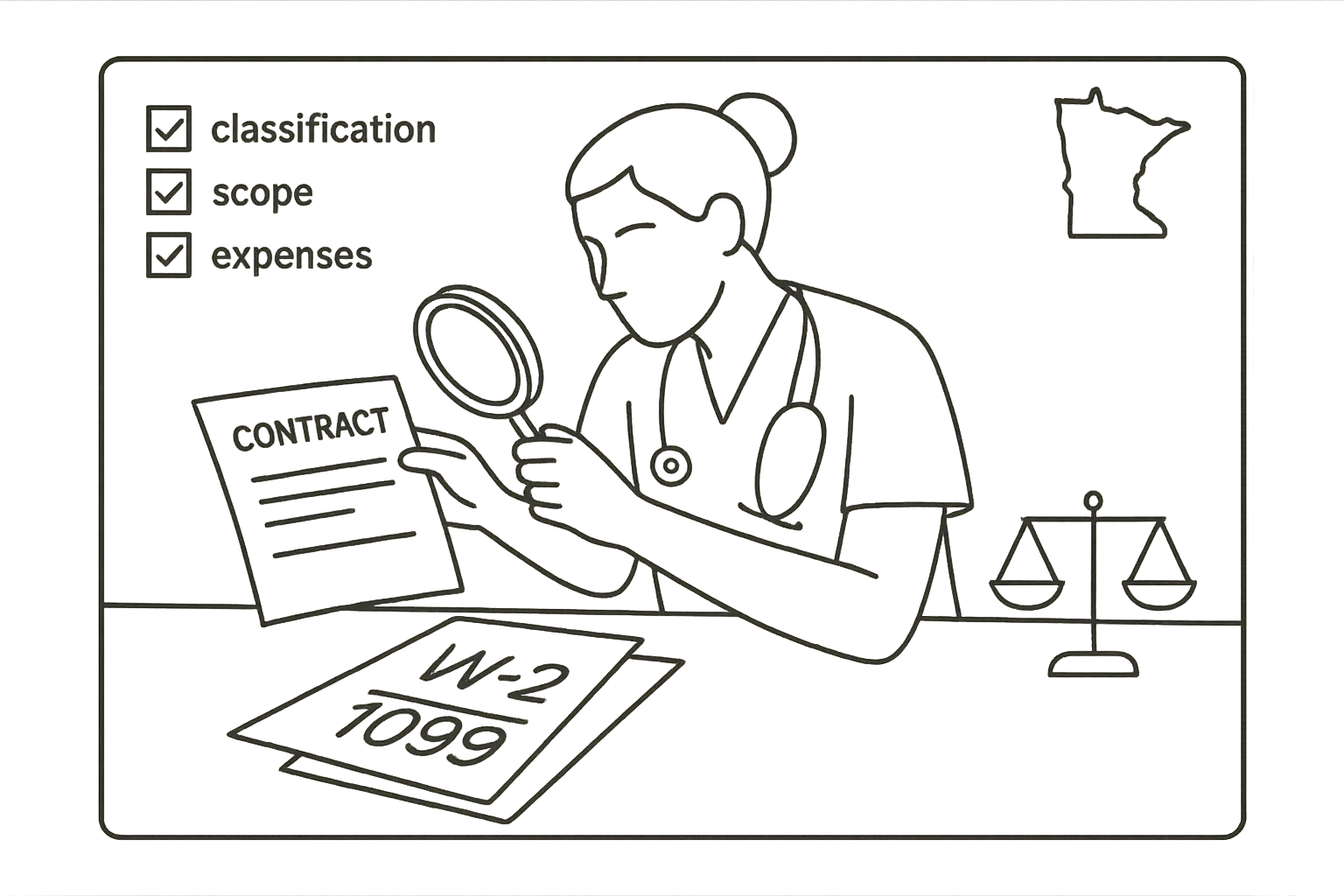
Employment agreements and independent contractor agreements allocate taxes, benefits, expenses, control, and professional risk differently. A W-2 agreement commonly includes employer-sponsored benefits and greater employer control over duties and scheduling. A 1099 agreement may provide more operational flexibility, but it can also shift tax obligations, business expenses, insurance costs, and other risks to the NP. The practical relationship matters in addition to the label used in the contract.
A review should identify who controls the schedule, supplies equipment, sets clinical protocols, pays licensing and credentialing expenses, and provides malpractice insurance. NPs comparing these arrangements can review the broader implications of W-2 versus 1099 status. A dedicated independent contractor agreement review is particularly useful when the proposed arrangement shifts substantial operating costs or liability to the practitioner.
Compensation, Productivity, and Benefits

Compensation provisions should explain not only the stated salary or rate but also how earnings are calculated, measured, adjusted, and paid. A guaranteed base should identify the pay period, part-time treatment, and any draw or reconciliation mechanism. Collections-based provisions should define which receipts count, when collections are measured, and how denials, refunds, and write-offs affect compensation.
- RVU compensation: Review the productivity target, conversion factor, measurement period, and treatment of professional and facility work.
- Bonuses: Determine whether the bonus is discretionary or based on objective metrics and whether the NP must remain employed on the payment date.
- Negative accrual: Identify whether a shortfall carries into a later period or creates a repayment obligation.
- Deductions and expenses: Confirm whether administrative, credentialing, electronic health record, licensing, or insurance expenses may be deducted from compensation.
- Benefits: Document PTO, continuing education, retirement, health coverage, licensing fees, relocation assistance, and any conditions attached to those benefits.
An attorney can model how these provisions operate under expected and unfavorable scenarios. A focused NP compensation and productivity review can identify unclear formulas, unfavorable reconciliation language, and bonus terms that may not match the initial offer.
Malpractice Insurance and Tail Coverage
Malpractice provisions determine who obtains coverage, who pays the premium, what limits apply, and whether protection continues after the relationship ends. An occurrence policy generally covers incidents occurring during the policy period even if a claim is made later. A claims-made policy generally requires coverage to be active when the claim is made, which can create a need for prior-acts protection or tail coverage after termination.
The agreement should expressly allocate responsibility for tail coverage rather than simply state that the employer provides malpractice insurance. It should also address policy limits, defense costs, reporting duties, cooperation obligations, and coverage at every required work location. Because tail exposure can be substantial, a malpractice and tail insurance review should occur before the NP accepts responsibility for post-employment coverage.
Minnesota Scope of Practice and Work Requirements
Clinical-duty provisions should be reviewed against Minnesota’s nurse practitioner practice framework and the requirements of the Minnesota Board of Nursing. The contract should accurately describe the NP’s role without confusing employer-imposed policies with legal supervision, collaboration, prescribing, delegation, or documentation requirements. It should also explain what happens if credentialing, privileges, or another condition necessary to practice is delayed, suspended, or lost.
- Define clinical duties, patient populations, prescribing expectations, protocols, and administrative responsibilities.
- Identify each worksite and the employer’s authority to add locations, including travel time, mileage, scheduling notice, and differential pay.
- Specify call coverage, weekends, holidays, floating obligations, and how additional coverage is compensated.
- Allocate responsibility for Minnesota licensure, prescribing credentials, payer enrollment, hospital privileges, and renewal expenses.
Ambiguous practice provisions can create operational and regulatory problems even when the compensation terms appear favorable. A review of supervision and collaboration language can clarify whether the document accurately reflects Minnesota requirements and the intended practice structure.
Non-Competes and Other Post-Employment Restrictions
Minnesota contracts may contain non-compete, non-solicitation, confidentiality, patient-contact, and proprietary-information provisions. These clauses should not be treated as interchangeable. Their practical effect and enforceability can depend on the type of restriction, the agreement’s execution date, the circumstances of departure, and current Minnesota law.
Review should address the restricted activities, geographic area, duration, covered patients or referral sources, and events that trigger the restriction. A clause affecting work throughout Minneapolis–St. Paul or another Minnesota market may materially limit future employment even when it appears narrow on paper. Confidentiality and non-solicitation terms also require careful drafting so the NP understands which communications and professional relationships are restricted. A Minnesota-focused non-compete and restrictive covenant review can evaluate the clause under the law applicable to the specific agreement.
Termination, Repayment, and Dispute Resolution
Termination language determines how either party may end the relationship and what financial obligations survive. The agreement should distinguish termination for cause from termination without cause, define any opportunity to cure an alleged breach, and state the notice required from both the employer and the NP. Broad cause definitions can allow immediate termination and may also affect bonuses, repayment obligations, tail coverage, or restrictive covenants.
- Review the initial term, automatic renewal, amendment procedure, and deadlines for providing nonrenewal notice.
- Determine whether the NP must continue working during the notice period and whether the employer may remove the NP from the schedule without continuing compensation.
- Identify when earned bonuses, collections, PTO, or other compensation will be calculated and paid after departure.
- Calculate potential repayment of signing bonuses, relocation assistance, training expenses, or other advances and determine whether repayment is prorated.
- Examine choice-of-law, venue, mediation, arbitration, fee-shifting, and other dispute-resolution provisions.
A contract termination review can clarify notice obligations, repayment exposure, post-employment compensation, and restrictions before an NP resigns or responds to an employer’s termination notice.
Minnesota NP Contract Review Checklist
Before signing, compare the written agreement with the offer, compensation presentation, benefits summary, job description, and any recruiting promises. Material terms should appear in the contract or an incorporated document rather than depend on an informal assurance that may be difficult to enforce later.
- Confirm classification, term, renewal, schedule, locations, call coverage, duties, and outside-work restrictions.
- Recalculate base pay, productivity compensation, bonuses, deductions, and repayment obligations using realistic assumptions.
- Verify malpractice policy type, limits, premium responsibility, and tail coverage.
- Compare clinical and credentialing language with Minnesota Board of Nursing requirements and the actual practice arrangement.
- Review non-compete, non-solicitation, confidentiality, termination, and dispute provisions together because one clause may trigger another.
- Request revisions or clarification before signing rather than relying on a later policy change or verbal explanation.
Have a Minnesota NP Contract Reviewed Before You Sign
Chelle Law can evaluate compensation, malpractice coverage, practice requirements, restrictive covenants, repayment obligations, and termination terms so you can make an informed decision.
Contact Chelle Law