
When a nurse practitioner accepts a position in Montana—whether practicing in Billings, Missoula, Bozeman, Helena, or a rural community—the employment or independent contractor agreement governs compensation, professional duties, malpractice responsibility, termination rights, and post-employment restrictions. These provisions must also operate within Montana’s regulatory framework, including oversight by the Montana Board of Nursing and applicable requirements for advanced practice registered nurses.
Subtle drafting differences can materially affect productivity pay, repayment obligations, professional liability, and the ability to move to another practice. Montana law, including the Montana Wrongful Discharge from Employment Act, may also be relevant to termination analysis, but the agreement’s notice, cause, and repayment provisions remain important. A Montana nurse practitioner contract review translates those terms into practical financial and career consequences before the NP signs.
Chelle Law provides attorney-led, line-by-line review of Montana NP agreements. The review identifies provisions that may affect earnings stability, regulatory compliance, liability exposure, and long-term mobility, including compensation formulas, restrictive covenants, malpractice coverage, scope-of-practice language, and termination obligations.
Key Contract Review Priorities for Montana Nurse Practitioners
- Calculate how base salary, collections, RVUs, bonuses, negative accruals, and reconciliation provisions will affect actual compensation.
- Confirm whether malpractice coverage is occurrence-based or claims-made and identify who must pay for tail coverage.
- Compare scope-of-practice, prescribing, supervision, and collaboration terms with applicable Montana Board of Nursing requirements.
- Review termination notice, for-cause definitions, final compensation, and repayment obligations before accepting the position.
- Assess non-compete, non-solicitation, confidentiality, and other post-employment restrictions for their practical effect on future Montana practice opportunities.
- Make sure offer letters, exhibits, bonus promises, location commitments, and other referenced documents are included in the review.
Why Montana NP Agreements Require Careful Review

Employment and independent contractor agreements are the primary means by which a practice allocates income, liability, and professional control. Ambiguous language can lead to reduced pay, delayed bonus reconciliation, unexpected insurance costs, or restrictions that make it difficult to accept another position. An attorney review should therefore examine the entire agreement rather than focusing only on salary.
Employer-favorable provisions may include broad definitions of for-cause termination, collections-based compensation with delayed reconciliation, extensive repayment requirements, or unclear clinical-control language. A careful NP contract review converts these terms into practical exposure estimates, such as potential negative accrual balances, tail insurance responsibility, or income that may remain unpaid after departure.
The purpose is not merely to identify unfavorable wording. It is to explain how the agreement could affect the NP’s compensation, licensing responsibilities, daily practice, and career options so the NP can make an informed decision before signing.
Compensation, Malpractice Coverage, and Clinical Duties
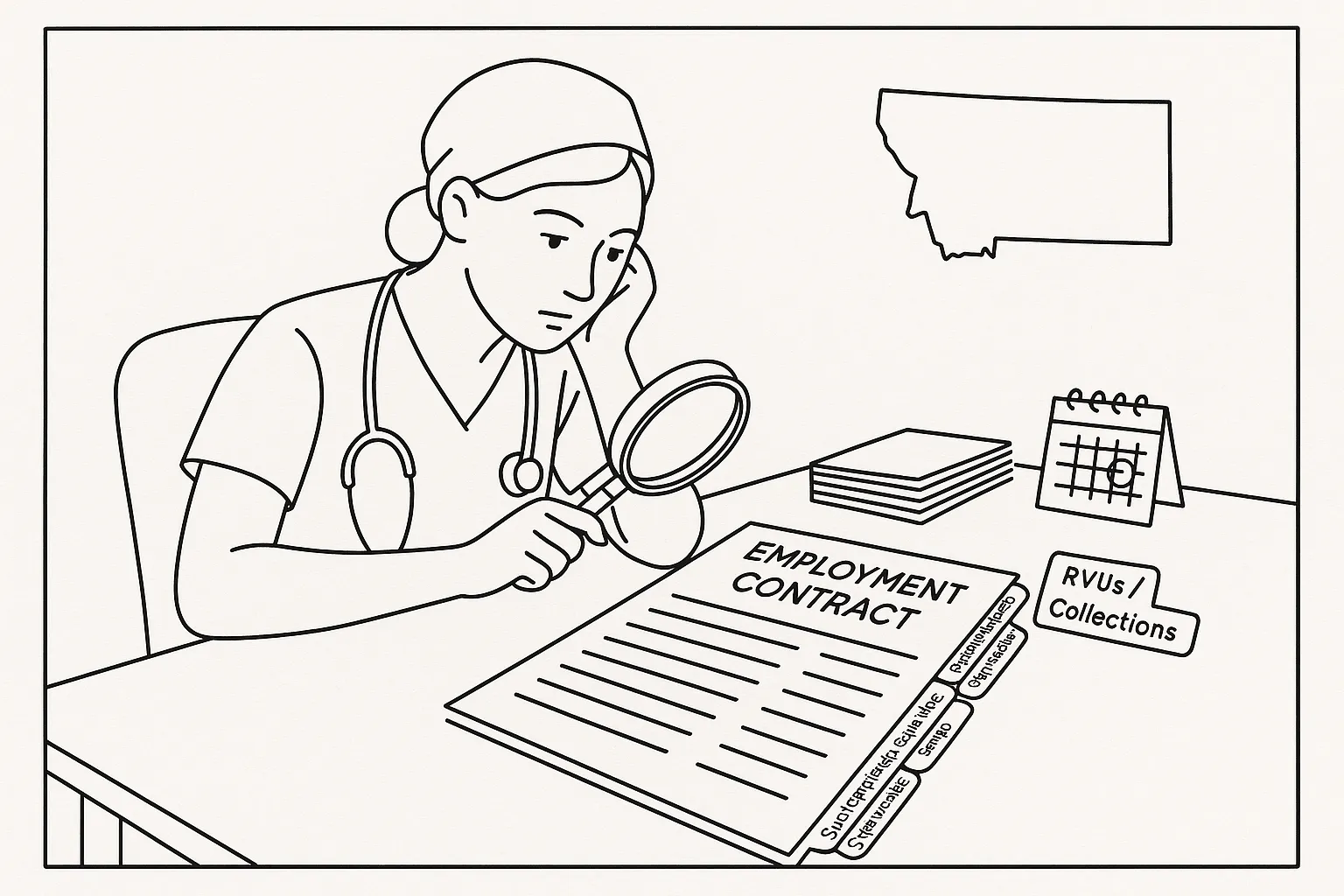
Compensation and Productivity Formulas
Compensation may consist of a guaranteed salary, collections percentage, RVU formula, encounter-based payment, or a combination of base pay and incentives. The agreement should state the payment schedule, productivity threshold, conversion factor, reconciliation period, and treatment of refunds, denials, chargebacks, and work performed before termination. A detailed review of NP compensation and productivity terms can reveal whether an attractive headline number depends on assumptions the employer controls.
- Base salary: Confirm the payment frequency, prorated calculations, and any circumstances allowing the employer to reduce guaranteed compensation.
- Collections: Determine when collections are credited, how payer denials and refunds are handled, and whether the NP can verify the employer’s accounting.
- RVUs: Identify the credited RVU measure, threshold, conversion factor, exclusions, and timing of productivity reports.
- Negative accrual: Determine whether a shortfall carries forward, reduces future bonuses, or becomes immediately repayable when employment ends.
Malpractice Insurance and Tail Responsibility
The agreement should identify the type of professional liability coverage, applicable policy limits, premium responsibility, and any exclusions. Claims-made coverage generally creates a separate tail-coverage issue when the relationship ends, while occurrence coverage operates differently. The contract should clearly allocate responsibility instead of leaving the NP to discover the obligation at departure.
A focused malpractice and tail insurance review should also examine whether the employer can require reimbursement, whether tail responsibility changes based on the reason for termination, and whether the promised coverage is described consistently throughout the agreement.
Scope of Practice, Scheduling, and Work Locations
Clinical duties, prescribing responsibilities, supervision or collaboration language, chart-review requirements, and employer protocols should be compared with applicable Montana requirements. Contract language may create operational burdens even when those obligations are not clearly explained in the offer. A review of supervision and collaboration terms can identify provisions that unnecessarily limit clinical work or create uncertainty about responsibility.
The agreement should also define the primary location, multi-site assignments, call frequency, schedule-change authority, and telehealth expectations. If compensation depends on productivity, it should explain whether telehealth encounters, administrative work, call coverage, and work at additional locations count toward the applicable target.
Termination, Repayment, and Restrictive Covenants
Ending the Agreement and Calculating Final Obligations
Termination provisions should address without-cause notice, for-cause events, cure opportunities, final compensation, pending bonuses, and the treatment of patient collections received after departure. The review should also identify whether termination accelerates repayment of a signing bonus, relocation allowance, draw, training expense, or other benefit. These provisions should be evaluated together because a seemingly reasonable notice clause may still expose the NP to a substantial repayment demand.
Montana’s employment-law framework may be relevant to the analysis, but the written terms still determine important contractual rights and obligations. A dedicated contract termination review can clarify the notice process, financial consequences, and obligations that continue after the relationship ends.
Non-Competes and Other Post-Employment Restrictions
Restrictive covenants may limit where an NP can work, the services the NP can provide, or contact with patients and staff after departure. The practical effect depends on the restricted activities, geographic area, duration, triggering events, and available remedies. In Montana, a restriction covering multiple facilities or a broad service area can have a particularly significant impact when alternative employers are separated by substantial distances.
An attorney conducting a nurse practitioner non-compete review should evaluate the clause alongside confidentiality, non-solicitation, patient-transition, and repayment provisions. Even when enforceability is uncertain, broad wording can create immediate career risk and potential legal expense.
Montana Regulatory and Practice Considerations
Montana NP agreements should be evaluated against the requirements administered by the Montana Board of Nursing and other applicable licensing or regulatory authorities. Scope-of-practice, prescribing, documentation, and professional-responsibility provisions should accurately reflect the position and should not leave essential compliance duties undefined. Employer policies may supplement legal requirements, but the agreement should make clear which duties are contractual and who bears the cost of satisfying them.
Responsibility for professional licensing, DEA registration, credentialing, required training, and related fees should be stated in writing. The contract should also address what happens if credentialing delays the start date or prevents the NP from meeting an initial productivity target. For remote or cross-state work, the agreement should not assume that a Montana license alone authorizes every contemplated patient encounter.
Montana’s mix of urban and rural healthcare markets also makes location language important. An assignment clause that appears manageable in Billings, Missoula, Bozeman, or Helena may operate differently when it permits reassignment to distant clinics. Telehealth expectations, travel reimbursement, rural incentive obligations, and service commitments should be documented so they do not conflict with compensation or repayment provisions.
Pre-Signing Checklist for Montana NPs
- Obtain the complete agreement and every referenced exhibit, policy, compensation plan, and addendum.
- Confirm the base salary, productivity metric, conversion factor, reconciliation schedule, bonus rules, and negative accrual terms.
- Identify whether the relationship is W-2 employment or independent contractor work and compare the written obligations with that classification.
- Verify malpractice coverage type, policy limits, premium responsibility, and any tail or repayment obligation.
- Compare scope-of-practice, prescribing, supervision, collaboration, and documentation terms with applicable Montana requirements.
- Review without-cause notice, for-cause language, cure rights, final compensation, and every repayment trigger.
- Measure the practical impact of non-compete, non-solicitation, confidentiality, and patient-transition provisions.
- Put verbal promises about schedule, location, call coverage, bonuses, start dates, and remote work into the agreement or a signed addendum.
- Provide the complete package to an experienced contract attorney before signing or beginning work.
If the position is structured as a 1099 relationship, the analysis should also address control, expenses, insurance, termination, and payment timing. Chelle Law offers a separate independent contractor agreement review for NPs evaluating those arrangements.
Get Your Montana NP Contract Reviewed Before You Sign
Chelle Law reviews nurse practitioner employment and independent contractor agreements remotely. Receive an attorney-led assessment of compensation, termination, malpractice, restrictive covenant, and Montana practice-related provisions.
Contact Chelle LawExplore Nurse Practitioner Contract Guidance
Review related services, educational resources, and state-specific contract information from Chelle Law.