
When a nurse practitioner accepts a position in New Mexico—whether practicing in Albuquerque, Santa Fe, Las Cruces, or another healthcare market—the employment or independent contractor agreement governs compensation, professional duties, malpractice coverage, termination rights, and post-employment restrictions. These provisions must also operate within New Mexico’s professional framework, including oversight by the New Mexico Board of Nursing and the New Mexico Nursing Practice Act, NMSA 1978, § 61-3-1 et seq.
A New Mexico nurse practitioner contract review can clarify how employer-drafted terms interact with applicable regulatory requirements and identify financial or professional risks before the agreement is signed. Chelle Law evaluates compensation formulas, repayment obligations, malpractice and tail coverage, restrictive covenants, termination provisions, and language affecting scope of practice or professional autonomy. The goal is a practical, attorney-led assessment of how the contract may affect earnings, compliance, and long-term career mobility.
Key Contract Review Takeaways for New Mexico Nurse Practitioners
- Employer-favorable clauses involving clawbacks, negative accrual, or broad post-employment restrictions can materially reduce compensation or limit future practice options.
- Compensation formulas should clearly define collections, RVUs, bonus thresholds, reconciliation periods, and any audit or reporting rights.
- The agreement should identify the malpractice policy type and specify who is responsible for tail coverage when employment ends.
- Scope-of-practice, prescribing, collaboration, and other professional terms should be consistent with New Mexico law and the requirements of the New Mexico Board of Nursing.
- Termination language should explain notice requirements, repayment triggers, final compensation, and the treatment of unpaid bonuses or collections.
Why Contract Review Matters for Nurse Practitioners in New Mexico

Nurse practitioner agreements often contain provisions that are easy to overlook without a careful legal and financial review. An ambiguous repayment clause, broad restrictive covenant, negative accrual mechanism, or unexpected tail-insurance obligation can reduce take-home pay or affect where and how an NP practices after leaving the employer. Reviewing common nurse practitioner contract red flags can help identify which provisions deserve closer attention.
Three recurring areas of exposure are income risk, professional compliance risk, and career mobility risk. Income risk can arise from unclear compensation formulas, clawbacks, chargebacks, or subjective performance metrics. Compliance concerns may appear when contractual duties, prescribing expectations, or professional arrangements do not match the NP’s actual practice or applicable requirements. Career mobility can be affected by non-compete, non-solicitation, repayment, and notice provisions that continue to operate after termination.
A focused review identifies these issues, explains how the clauses work together, and evaluates potential financial exposure. It can also reveal conflicts between different sections of the agreement, such as a bonus provision that appears favorable but is undermined by termination language allowing the employer to withhold unpaid incentives.
Employment and Independent Contractor Agreements
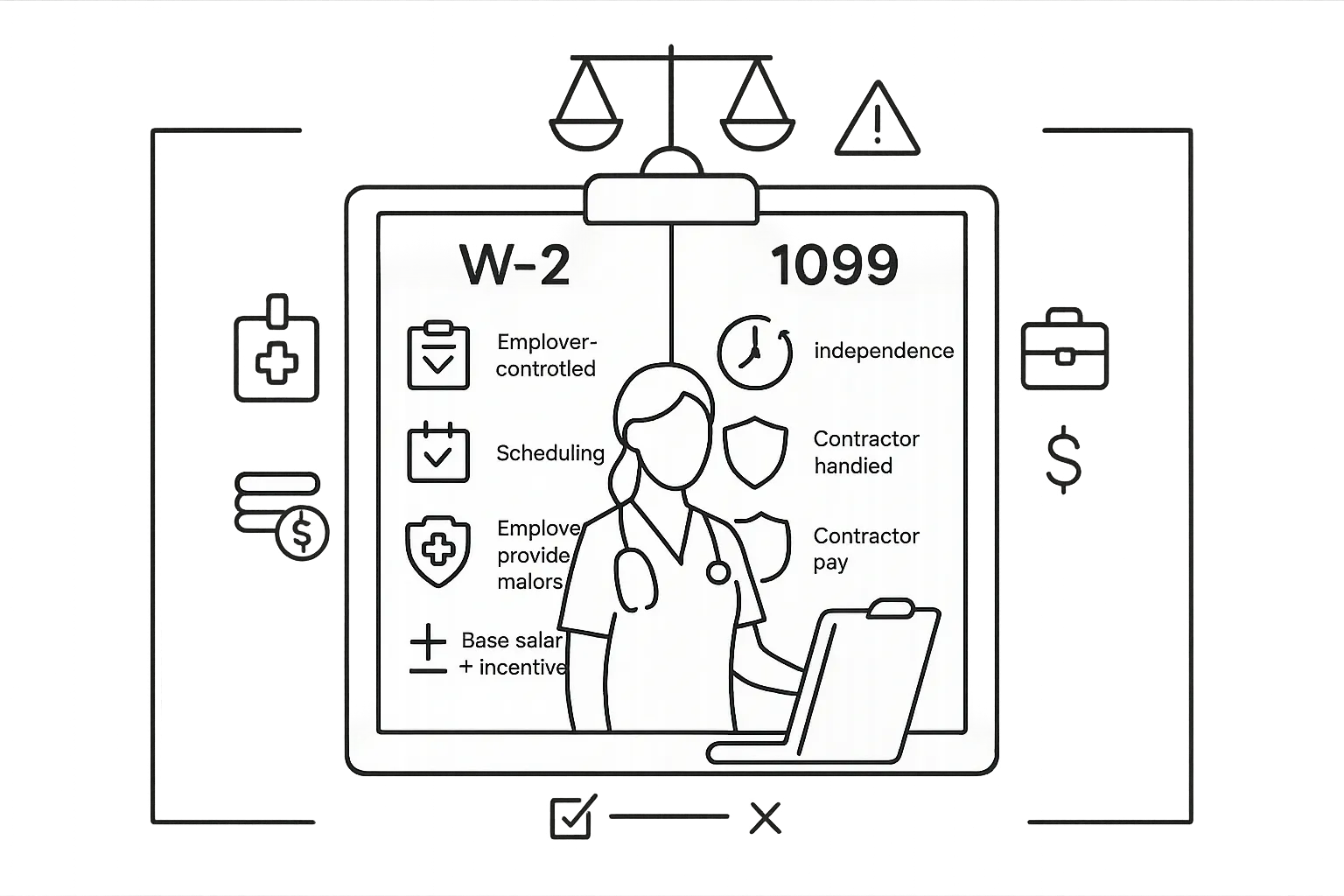
Employment agreements and independent contractor agreements allocate responsibilities differently. In a W-2 arrangement, the employer commonly exercises greater control over scheduling, workplace policies, billing systems, credentialing support, and malpractice coverage. Compensation may combine salary with productivity or quality incentives, while benefits can include health insurance, retirement contributions, and paid leave.
A 1099 agreement may offer more stated autonomy, but it can also shift taxes, benefits, insurance, and administrative responsibilities to the NP. The contract should be reviewed alongside the practical working relationship because the label used in the document does not resolve every classification concern. Nurse practitioners considering contractor work can benefit from a dedicated independent contractor agreement review before accepting those obligations.
Some arrangements combine features of both models. For example, an agreement may designate the NP as an employee while imposing aggressive repayment provisions or transferring expenses more commonly associated with independent practice. A contract review considers the full allocation of control, costs, benefits, insurance, and termination risk rather than relying only on the agreement’s title.
Essential Nurse Practitioner Contract Terms to Review
Compensation, Productivity, and Repayment Terms
Base compensation should identify the guarantee period, payment schedule, and any circumstances allowing an employer to reduce or recover salary. Productivity formulas should define the applicable RVU, collections, encounter, or quality metrics; explain who controls coding and billing; and state when calculations and reconciliations occur. A detailed NP compensation and productivity review can test whether the formula is understandable and whether the NP has access to the information needed to verify payment.
- Base salary: Confirm the guarantee period, pay frequency, adjustment rights, and whether compensation is subject to a clawback when the agreement ends.
- Collections or RVU pay: Determine how collections, adjustments, chargebacks, coding changes, and delayed billing affect the calculation.
- Bonuses: Identify whether each incentive is objective or discretionary, when it is earned, and whether it remains payable after notice or termination.
- Negative accrual and repayment: Review whether deficits carry forward, whether recoupment is capped, and whether resignation or termination accelerates a repayment obligation.
Signing bonuses, relocation assistance, training expenses, and other advances may also be subject to repayment. The agreement should state how repayment decreases over time, which termination events trigger it, and whether the employer can deduct the amount from final compensation.
Malpractice Insurance and Tail Coverage
The agreement should identify whether the employer provides claims-made or occurrence-based malpractice coverage. Claims-made coverage generally requires protection for claims reported after the underlying policy ends, while occurrence coverage generally applies based on when the incident occurred. Because policy language controls, the contract should clearly identify the applicable coverage and any separate tail obligation.
Tail responsibility can become a significant post-employment expense if the contract assigns it to the NP. The provision should explain who purchases the coverage, what events shift responsibility, whether alternative prior-acts coverage is permitted, and when proof of coverage must be provided. A focused malpractice and tail insurance review can clarify these obligations before they become part of a termination dispute.
Restrictive Covenants, Practice Terms, and Termination
Restrictive covenants may include non-compete, non-solicitation, confidentiality, and patient-related restrictions. Their practical effect depends on the language, duration, geographic reach, restricted activities, and triggering events. A review of the NP non-compete can help determine how the restriction may affect future opportunities in Albuquerque, Santa Fe, Las Cruces, or other New Mexico markets.
The agreement should also describe clinical duties, locations, schedules, call obligations, prescribing expectations, and any collaboration or other practice requirements. These terms should be evaluated against the NP’s role and applicable New Mexico requirements rather than assumed to be accurate because they appear in an employer template. Provisions that make an NP’s status dependent on another provider or an unspecified arrangement deserve particular attention.
Termination provisions should distinguish between for-cause and without-cause termination, define notice periods, and identify any opportunity to cure an alleged breach. They should also explain what happens to accrued compensation, bonuses, unpaid collections, benefits, malpractice coverage, patient records, and repayment obligations. When the agreement creates substantial exit risk, an attorney can provide a dedicated contract termination review.
Negotiation Priorities and Contract Red Flags
Contract negotiation should focus first on provisions that create the greatest financial, compliance, or mobility risk. The objective is not simply to request more compensation, but to determine whether the agreement clearly allocates responsibilities and whether the NP can reasonably comply with its terms. Important priorities commonly include transparent compensation calculations, limited repayment exposure, workable termination rights, clear malpractice obligations, and appropriately defined post-employment restrictions.
- Discretionary bonus language without objective performance standards or a defined payment date.
- Negative accrual that carries forward indefinitely or accelerates when the NP resigns.
- Collections-based compensation controlled by the employer without reporting, reconciliation, or audit rights.
- Tail insurance responsibility that changes based on broadly drafted termination language.
- Non-compete or non-solicitation provisions with vague restricted activities, locations, or triggering events.
- Scope-of-practice or professional terms that do not reflect the contemplated role or applicable New Mexico requirements.
Attorney review reframes the decision from whether the offer appears competitive to what the NP could lose if each clause operates as written. That analysis supports an informed decision about accepting the agreement, requesting targeted revisions, or reconsidering a position whose risks cannot be adequately clarified.
Contract Review Checklist and Attorney Review Process
An initial self-review can help organize questions before speaking with counsel. Nurse practitioners should identify the agreement type, calculate sample compensation under conservative assumptions, locate repayment and clawback provisions, confirm malpractice coverage, evaluate post-employment restrictions, and review termination rights. They should also compare the written duties and professional requirements with the position described during recruitment.
- Identify whether the relationship is structured as W-2 employment or 1099 independent contracting.
- Calculate a sample month or quarter under the stated compensation formula.
- Locate negative accrual, repayment, deduction, and clawback provisions.
- Confirm the malpractice policy type and responsibility for tail coverage.
- Review the duration, geography, restricted activities, and triggers of post-employment covenants.
- Check notice periods, immediate termination events, cure rights, and post-termination compensation.
- Compare clinical duties, practice locations, prescribing terms, and professional arrangements with the actual role.
Legal review is particularly useful when language is ambiguous, repayment or tail obligations could be substantial, compensation depends on technical formulas, or restrictive covenants could limit future employment. Chelle Law’s attorney-led process includes secure document submission, written commentary or proposed revisions, and a consultation addressing the practical implications of the agreement. The review focuses on clarifying risk rather than promising a particular negotiation result.
Have a New Mexico NP Contract Reviewed Before You Sign
Chelle Law reviews nurse practitioner employment and independent contractor agreements for compensation risk, malpractice obligations, restrictive covenants, termination terms, and New Mexico practice considerations.
Contact Chelle LawExplore Nurse Practitioner Contract Guidance
Review Chelle Law’s services, educational resources, and state-specific contract guidance for nurse practitioners.