
When a nurse practitioner accepts a position in Oklahoma—whether practicing in Oklahoma City, Tulsa, Norman, or another healthcare market—the employment or independent contractor agreement becomes the governing document for compensation, duties, malpractice coverage, termination, and post-employment restrictions. These provisions must also operate within Oklahoma’s regulatory framework, including oversight by the Oklahoma Board of Nursing and applicable requirements under Title 59 of the Oklahoma Statutes governing advanced practice registered nurses.
An Oklahoma nurse practitioner contract review clarifies how employer-drafted language interacts with state practice requirements and identifies where financial or professional risk may be embedded in the agreement. Subtle drafting differences can materially affect productivity compensation, repayment obligations, tail insurance responsibility, scheduling, and termination rights. Oklahoma also limits certain restraints of trade under 15 O.S. § 219A while permitting limited non-solicitation provisions, making the wording and practical effect of post-employment restrictions important to evaluate before signing.
Chelle Law provides attorney-led review focused on the terms that may affect earnings stability, regulatory compliance, liability exposure, and career mobility. The review can address compensation formulas, negative accrual, malpractice insurance, scope-of-practice provisions, notice requirements, restrictive covenants, and whether the agreement accurately reflects the intended working relationship.
Key Oklahoma NP Contract Review Takeaways
- Review the agreement before signing so tail insurance, repayment exposure, termination rights, and post-employment restrictions can be evaluated while terms are still being finalized.
- Confirm that base pay, collections, RVUs, bonuses, payment timing, chargebacks, and reconciliation procedures are defined in objective terms.
- Identify whether malpractice coverage is occurrence-based or claims-made and who must purchase tail coverage when the relationship ends.
- Compare a W-2, 1099, or hybrid classification with the actual control, duties, expenses, and benefits described in the agreement.
- Examine scope-of-practice, collaboration, prescribing, credentialing, and site-policy provisions for consistency with Oklahoma requirements and the intended clinical role.
- Scrutinize termination, repayment, non-solicitation, and non-compete language for vague triggers or obligations that could impair income or future practice options.
Employment and Independent Contractor Agreements in Oklahoma

Oklahoma nurse practitioners commonly encounter W-2 employment agreements, independent contractor agreements, and hybrid professional services arrangements. A W-2 agreement may provide a salary, benefits, employer-paid malpractice insurance, and established termination procedures. A 1099 agreement for telehealth, urgent care, locum, or other services may instead shift responsibility for taxes, insurance, business expenses, and benefits to the NP.
Hybrid arrangements require particular attention because an NP may be labeled an independent contractor while remaining subject to detailed scheduling, site, documentation, credentialing, and operational controls. Reviewing the independent contractor terms alongside the actual working arrangement helps identify inconsistent provisions and unexpected tax, benefit, indemnity, or insurance obligations.
Classification also affects who pays licensing expenses, continuing education costs, malpractice premiums, and tail coverage. The contract should clearly identify which party bears each expense rather than relying on assumptions based only on the employee or contractor label.
Oklahoma Scope of Practice and Regulatory Terms
Contract language concerning clinical authority should be reviewed in the context of Oklahoma nurse practitioner scope of practice, licensure, prescribing, supervision, collaboration, and other applicable state requirements. Agreements frequently require compliance with Oklahoma Board of Nursing rules, facility bylaws, credentialing standards, employer policies, and separate clinical protocols. These incorporated requirements can affect day-to-day autonomy even when they do not appear in the main compensation provisions.
A contract should accurately describe the NP’s specialty, clinical duties, prescribing responsibilities, documentation standards, and any required physician relationship. A focused supervision and collaboration agreement review can help identify provisions that exceed the anticipated role, conflict with another governing document, or leave responsibility for maintaining a required arrangement unclear.
Credentialing and privileging terms also deserve attention. The agreement should address who is responsible for applications and fees, whether compensation begins before credentialing is complete, and what happens if approval is delayed, limited, or denied. Similar clarity is important when employment depends on maintaining an Oklahoma license, prescribing authority, payer enrollment, hospital privileges, or facility access.
Compensation, Benefits, and Malpractice Coverage
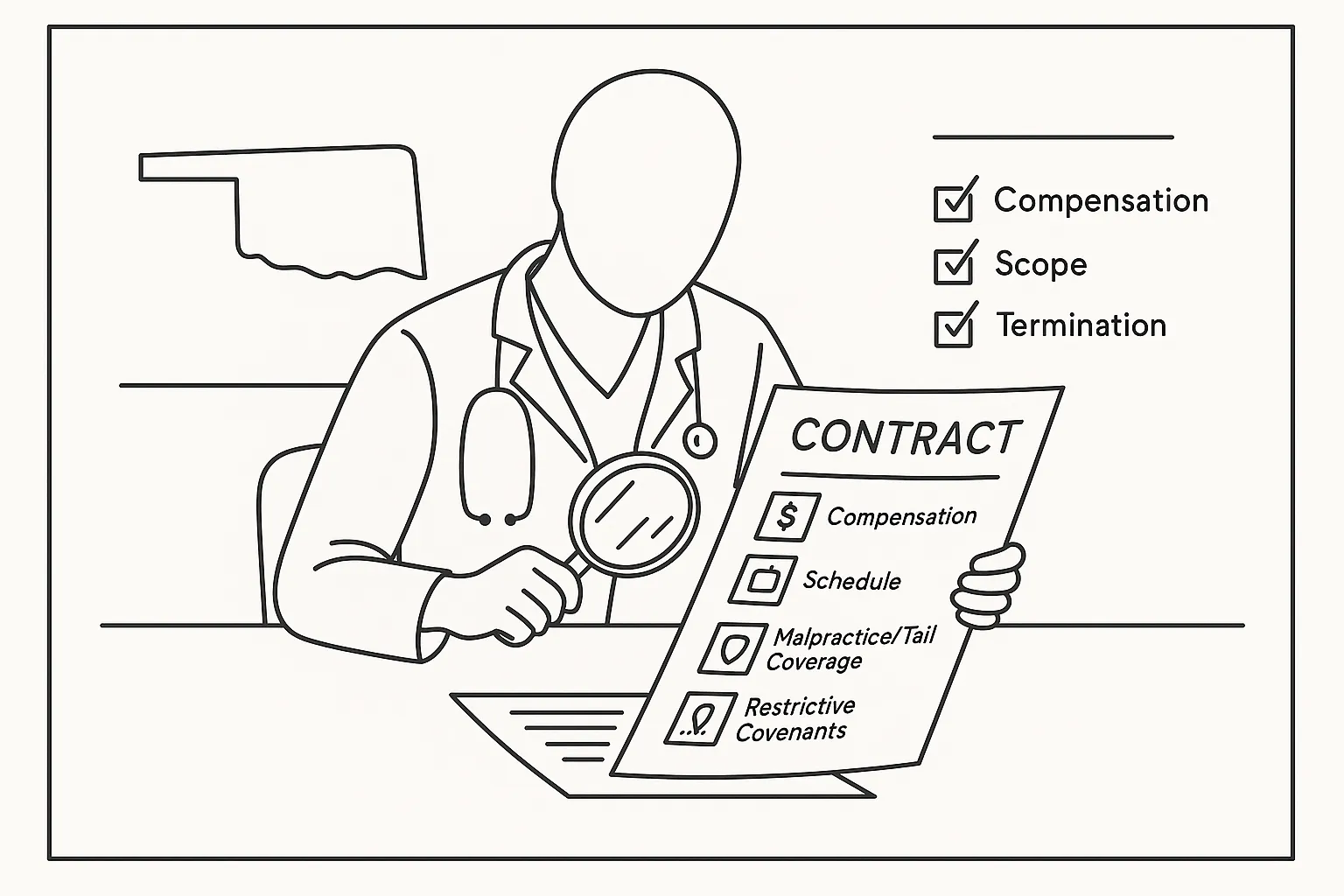
Compensation and Productivity Formulas
NP compensation may consist of a guaranteed salary, collections-based pay, an RVU formula, quality incentives, or a combination of these models. The agreement should explain how compensation is calculated, when it is paid, which services or codes receive credit, and whether the employer can change a conversion factor, benchmark, or bonus plan during the term. A compensation and productivity review is especially useful when the offer includes tiered bonuses, collections attribution, or year-end reconciliation.
- Base salary: Determine whether the salary is guaranteed, when it may be reduced, and whether an advance or guarantee can later become repayable.
- Collections: Define whether the formula uses billed charges, allowed amounts, or net cash received and how refunds, payer denials, delayed payments, and chargebacks are handled.
- RVUs: Identify the applicable RVU measure, credited CPT codes, conversion factor, threshold, reporting process, and treatment of services performed at different locations.
- Bonuses: Replace discretionary standards where possible with objective metrics, measurement periods, payment dates, and rules for bonuses earned near termination.
- Benefits and expenses: Allocate responsibility for licensing, prescribing registrations, board fees, CME, professional dues, travel, and relocation costs.
Malpractice Insurance, Tail Coverage, and Indemnity
An occurrence policy generally covers professional services performed during the policy period even if a claim is later reported. A claims-made policy generally requires the policy to remain active when the claim is reported, which can create a need for tail coverage after employment ends. The contract should identify the policy type, coverage limits, named insureds, covered activities, and the party responsible for tail insurance.
Tail responsibility may vary depending on whether the NP resigns, is terminated for cause, is terminated without cause, retires, or completes the agreement term. Because the cost can be material, the obligation should not be left to an unwritten policy. A dedicated malpractice and tail insurance review can also evaluate indemnification, hold-harmless language, defense obligations, and whether the employer covers claims arising from services performed within the NP’s assigned duties.
Schedule, Duties, Work Locations, and Classification
The agreement should state expected clinical and administrative hours, call obligations, weekend or holiday coverage, documentation duties, and whether the employer may alter the schedule. Vague requirements such as “reasonable flexibility” can permit significant changes without explaining whether additional time, call, or travel is compensated.
Multi-site assignments should identify the permitted locations, notice required before reassignment, mileage reimbursement, travel-time expectations, and how work at a different clinic affects productivity credit. This is particularly important when an Oklahoma practice operates facilities across Oklahoma City, Tulsa, Norman, rural communities, or other geographically separated markets.
The actual degree of control over schedule, location, equipment, documentation, billing, and clinical operations should also be compared with the agreement’s classification. Nurse practitioners weighing the practical differences between employment and contract work may benefit from reviewing the broader considerations in W-2 versus 1099 arrangements.
Termination, Repayment, and Post-Employment Restrictions
Termination Rights and Repayment Obligations
Termination provisions should define without-cause notice, for-cause events, any opportunity to cure a breach, and circumstances allowing immediate termination. The agreement should also explain what happens to salary, unused leave, earned bonuses, collections, and other compensation after notice is given or employment ends. A termination provision review can identify one-sided notice requirements, broad cause definitions, and clauses that permit compensation to stop before the NP’s obligations end.
Repayment provisions often apply to signing bonuses, relocation assistance, educational benefits, or compensation guarantees. The contract should state whether repayment declines over time and whether it applies after resignation, termination for cause, termination without cause, disability, or another separation event. Negative accrual and reconciliation clauses likewise require attention because they may create an alleged balance owed to the employer when productivity falls below a threshold or collections arrive after departure.
Non-Compete and Non-Solicitation Clauses
Oklahoma law and the agreement’s particular facts affect the treatment of restrictive covenants. The review should distinguish among non-compete, patient non-solicitation, employee non-solicitation, confidentiality, and interference provisions rather than treating them as interchangeable. Important terms include duration, geographic reach, restricted activities, covered facilities, patient definitions, triggering events, and any stated damages or penalties.
Restrictions can also affect telehealth, moonlighting, work for affiliated facilities, and communication with patients after departure. An Oklahoma NP should understand the practical reach of these terms before relying on a future opportunity in the same market. Chelle Law’s NP non-compete review evaluates the actual wording and its potential effect on professional mobility.
Attorney Review and Pre-Signing Priorities
Contract review is most useful before signing, ideally while the offer and final language are still being discussed. An attorney can identify provisions that shift financial or liability risk to the NP, explain their practical consequences, and propose clarifying language where appropriate. The review may focus on selected high-risk terms or examine the complete agreement, including indemnity, intellectual property, incorporated policies, and operational requirements.
Before accepting an Oklahoma position, confirm the following:
- The compensation formula, productivity credit, bonus criteria, reconciliation process, and payment dates are clearly defined.
- The malpractice policy type, limits, defense obligations, and responsibility for tail coverage are stated.
- Without-cause notice, for-cause standards, cure rights, and final compensation obligations are understandable.
- Signing bonus, relocation, education, and other repayment obligations identify the amount, schedule, and triggering events.
- Non-compete and non-solicitation language identifies the restricted conduct, duration, territory, and separation events that trigger it.
- Scope-of-practice, prescribing, supervision, collaboration, and credentialing provisions reflect the intended Oklahoma role.
- The work schedule, call coverage, locations, travel obligations, and expense reimbursement terms are documented.
- The W-2 or 1099 classification is consistent with the duties, control, benefits, taxes, and expenses described in the agreement.
Chelle Law offers flat-fee, attorney-led contract review intended to translate contract language into identifiable financial, regulatory, and professional risks. Although a review cannot guarantee a negotiation outcome, it can help an Oklahoma nurse practitioner make a more informed decision before accepting long-term obligations.
Have Your Oklahoma NP Contract Reviewed Before You Sign
Chelle Law can evaluate your compensation, malpractice coverage, termination rights, restrictive covenants, and Oklahoma-specific practice terms so you can understand the agreement’s risks before accepting the position.
Contact Chelle LawExplore Nurse Practitioner Contract Guidance
Review attorney-led services, practical contract resources, and state-specific information for nurse practitioners.