
When a nurse practitioner accepts a position in Oregon, the employment or independent contractor agreement governs compensation, job duties, malpractice coverage, termination rights, and post-employment restrictions. These provisions must also operate within Oregon’s professional framework, including oversight by the Oregon State Board of Nursing and statutory authority under ORS Chapter 678 governing advanced practice registered nurses. An attorney-led contract review helps an NP understand how employer-drafted language may affect earnings, regulatory obligations, and future practice opportunities.
Subtle drafting differences can materially change productivity compensation, repayment exposure, malpractice obligations, and termination outcomes. Oregon also has statutory limitations on non-compete agreements under ORS 653.295, including notice and compensation requirements. Chelle Law reviews Oregon NP agreements line by line to identify financial and professional risks before the clinician signs or begins negotiations.
Key Takeaways for Oregon Nurse Practitioners
- Confirm how base salary, collections, RVUs, bonuses, and reconciliation provisions work together before relying on the stated compensation figure.
- Determine whether the malpractice policy is claims-made or occurrence coverage and who must pay for tail insurance after termination.
- Review every repayment obligation for signing bonuses, relocation assistance, training expenses, and other employer-funded benefits.
- Compare job duties, prescribing responsibilities, and collaboration language with Oregon licensing and practice requirements.
- Assess termination rights, notice periods, and restrictive covenants together because these provisions collectively affect career mobility.
- Obtain all compensation exhibits, referenced policies, and insurance summaries so the entire arrangement can be reviewed rather than only the primary agreement.
Oregon Regulatory and Contract Context

Oregon nurse practitioners work in healthcare settings that range from large Portland-area systems to hospitals, clinics, and private practices in Eugene, Salem, and smaller communities. Regardless of location, the contract should accurately describe the clinician’s intended role and remain consistent with applicable Oregon licensure, prescribing, and scope-of-practice requirements. Vague language can allow an employer to expand duties, locations, or scheduling expectations without clearly addressing additional compensation.
Supervision or collaboration provisions deserve particular attention when they appear in an Oregon agreement. The contract should not create ambiguous obligations or assign responsibilities that conflict with the role approved by the Oregon State Board of Nursing. A focused review of supervision and collaboration terms can identify language that should be clarified before employment begins.
Contract review is therefore not limited to negotiating a higher salary. It is preventive legal work designed to protect income, reduce unexpected liability, support regulatory compliance, and preserve the ability to change employers or pursue another Oregon practice opportunity.
Contract Terms That Require Careful Review
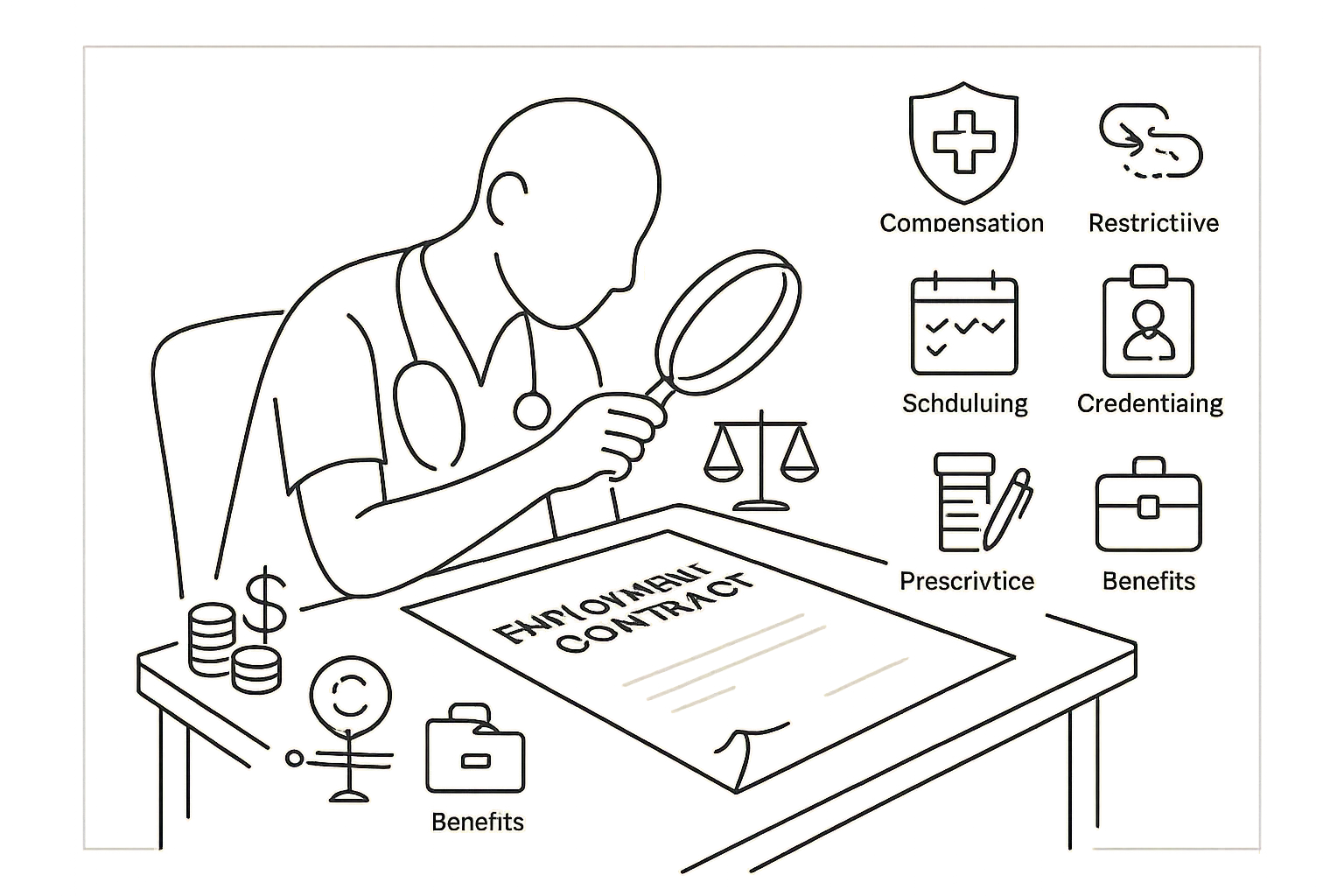
An Oregon NP agreement consists of interdependent provisions rather than isolated terms. A favorable salary may be undermined by an aggressive productivity threshold, while a reasonable termination clause may still create substantial exposure if it accelerates repayment obligations or shifts tail insurance costs to the clinician.
- Base salary, productivity formulas, collections, RVUs, bonuses, and negative accrual provisions.
- Job duties, work locations, patient volume, scheduling, call coverage, and administrative responsibilities.
- Malpractice policy type, coverage limits, tail insurance, indemnification, and reporting obligations.
- Contract term, renewal, without-cause termination, notice periods, and final compensation.
- Non-compete, non-solicitation, confidentiality, and other post-employment restrictions.
- Licensure, prescribing, credentialing, privileging, quality metrics, and collaboration requirements.
- Health insurance, retirement contributions, paid leave, CME support, professional fees, and relocation benefits.
Definitions, measurement periods, payment timing, and employer discretion often determine how these provisions work in practice. Every compensation schedule, addendum, policy, and exhibit referenced by the agreement should be included in the review.
Compensation, Productivity, and Repayment Risk
Many Oregon NP contracts use a hybrid compensation model consisting of guaranteed base pay plus a productivity component. Productivity may be based on collections, work RVUs, patient encounters, quality measures, or a combination of metrics. The agreement should explain which services receive credit, when reports are available, how adjustments are handled, and whether the employer can change the formula.
Collections-based compensation can be affected by payer delays, claim denials, billing errors, and employer collection practices outside the NP’s control. RVU compensation requires equally clear crediting rules, including which services count and whether administrative, telehealth, or other assigned work receives credit. A detailed NP compensation and productivity review can model the likely income and downside exposure created by these formulas.
Negative accrual and reconciliation provisions require special attention because they may allow an employer to carry a shortfall into a later period, offset future bonuses, or seek repayment. Signing bonuses, relocation assistance, loan repayment, and training benefits may also be treated as advances subject to clawback if employment ends early. The contract should define the triggering events, repayment period, proration method, and treatment of an employer-initiated termination.
Malpractice Coverage, Termination, and Oregon Non-Competes
Malpractice language should identify the policy type, coverage limits, named insureds, and responsibility for coverage after employment. A claims-made policy may require tail coverage for claims reported after the underlying policy ends, while occurrence coverage generally responds based on when the incident occurred. An NP should not assume the employer will pay for tail insurance unless that obligation appears in the agreement or an incorporated policy. Chelle Law offers a focused malpractice and tail insurance review for these provisions.
Termination clauses affect income continuity, benefits, repayment obligations, and the timing of a transition to another position. The agreement should distinguish without-cause termination from termination for cause, explain any opportunity to cure an alleged breach, and state what compensation remains payable after departure. A contract termination review can evaluate how notice requirements and repayment terms operate under different departure scenarios.
Oregon non-compete provisions must be evaluated in light of ORS 653.295 and the facts surrounding the proposed employment relationship. Even when enforceability is uncertain or contested, broad restrictions may delay a job change or create litigation risk. The review should address duration, geography, restricted activities, notice, compensation requirements, and related non-solicitation language. NPs facing these provisions can obtain a dedicated non-compete review before accepting the restriction.
Job Duties, Scheduling, Benefits, and Credentialing
The description of services should match the position discussed during recruitment. Review the expected clinical duties, patient volume, work locations, administrative tasks, charting requirements, telehealth responsibilities, and authority to assign additional duties. Schedule provisions should define regular hours, weekends, holidays, call coverage, and whether additional work generates separate compensation.
Benefits should be documented rather than left to informal assurances. Relevant terms may include health coverage, retirement contributions, paid leave, CME time and allowance, professional membership fees, licensure expenses, prescribing-related fees, and relocation assistance. If the contract incorporates an employer policy, the NP should obtain that policy and determine whether it can be changed unilaterally.
Credentialing and privileging language should use realistic timelines and identify what happens if approvals are delayed. Compensation should not be vulnerable to an indefinite delay caused by an employer, payer, facility, or credentialing process outside the clinician’s control. Quality measures and ongoing credentialing obligations should also be objective, documented, and reasonably connected to the NP’s assigned role.
Preparing for an Attorney-Led Oregon Contract Review
A complete review requires more than the signature page or offer letter. Before sending the agreement to counsel, gather the documents and information that define the proposed relationship:
- The complete employment or independent contractor agreement, including all addenda and exhibits.
- The offer letter and written communications containing compensation, scheduling, or benefit promises.
- Compensation schedules, RVU tables, bonus plans, and available productivity reports.
- Malpractice insurance summaries identifying the policy type and any tail coverage terms.
- Employer policies addressing leave, credentialing, termination, repayment, or professional expenses.
- Written information about expected locations, call obligations, patient volume, and administrative duties.
During negotiations, request written answers explaining how compensation is calculated, when bonuses are paid, which events trigger repayment, who pays for tail insurance, and how restrictive covenants apply after termination. Chelle Law provides written comments, practical risk summaries, and proposed language changes so Oregon nurse practitioners can evaluate the agreement with a clearer understanding of its financial and professional consequences.
Get Your Oregon NP Contract Reviewed
Before signing an Oregon employment or independent contractor agreement, have Chelle Law identify the compensation, termination, insurance, and restrictive covenant terms that may affect your income and career mobility.
Contact Chelle Law