
When a nurse practitioner accepts a position in Vermont—whether practicing in Burlington, Montpelier, Rutland, or another healthcare market—the employment or independent contractor agreement becomes the governing document for compensation, clinical duties, malpractice allocation, and post-employment restrictions. These agreements operate within Vermont law and the regulatory framework administered by the Vermont Board of Nursing, including provisions under Title 26 of the Vermont Statutes governing advanced practice registered nurses. A Vermont nurse practitioner contract review helps clarify how employer-drafted language interacts with those requirements and where financial or professional risk may be embedded in the agreement.
Even subtle drafting differences can materially affect productivity-based compensation, restrictive covenant exposure, and termination rights. Vermont has enacted statutory limitations affecting certain healthcare non-compete agreements under 26 V.S.A. § 463, making the language and circumstances important to review before signing. An attorney can also evaluate collections formulas, negative accrual provisions, tail insurance responsibility, notice requirements, and post-employment obligations in the context of the NP’s role and long-term career plans.
At Chelle Law, the focus is on structured, attorney-led risk assessment tailored to the agreement and Vermont practice environment. We examine the contract line by line to identify provisions that may affect earnings stability, regulatory compliance, and career mobility. Nurses entering practice for the first time can also learn more about contract review for new graduate NPs.
Key Vermont NP Contract Review Takeaways
- A Vermont nurse practitioner contract should be reviewed before signing to identify ambiguous drafting, repayment obligations, and provisions that may limit future practice options.
- Worker classification matters because W-2 employment and 1099 independent contractor arrangements allocate taxes, benefits, expenses, and liability differently.
- Compensation formulas should clearly define RVUs, adjusted collections, bonus thresholds, reconciliation periods, chargebacks, and any negative accrual.
- Malpractice provisions should identify the policy type, coverage limits, premium responsibility, and who must obtain tail coverage after the relationship ends.
- Termination, repayment, non-solicitation, and non-compete provisions should be evaluated together because their combined effect can influence when and where an NP can accept another position.
Agreement Structure and Vermont Practice Requirements

Employment and Independent Contractor Terms
The label “employee” or “independent contractor” is only the starting point. The agreement should be examined for who sets the schedule, provides the workplace and equipment, controls clinical and administrative processes, handles billing, and pays employment-related taxes. Classification can affect benefits, business expenses, insurance obligations, and liability exposure, so the written terms should accurately reflect how the parties expect the relationship to operate. NPs considering a 1099 position may benefit from a focused independent contractor agreement review.
The initial term, renewal process, and effective start date also require attention. Employers may use fixed terms that renew automatically unless notice is provided by a stated deadline. The agreement should explain whether the start date is tied to signing, credentialing completion, hospital privileges, or the first patient encounter because that date may control compensation guarantees, bonus calculations, repayment periods, and termination notice.
Scope of Practice, Licensure, and Collaboration Language
The contract should align the NP’s clinical duties with Vermont licensure, prescribing authority, scope-of-practice rules, and any applicable Board of Nursing requirements. Employer language may also impose duties beyond the regulatory baseline, including internal consultation, documentation, quality review, or physician co-signature procedures. Those operational requirements should be clear enough for the NP to understand how performance will be measured and whether compliance depends on support from another clinician or the employer.
Ambiguous delegation or oversight provisions can create problems when the contract conditions compensation or continued employment on requirements that are not fully defined. The agreement should identify each party’s responsibilities, who bears the cost of required arrangements, and what happens if the designated clinician becomes unavailable. Additional discussion of these issues is available in our guide to NP supervision and collaboration agreements.
Compensation, Bonuses, and Benefits
Base Pay, Productivity Formulas, and RVUs
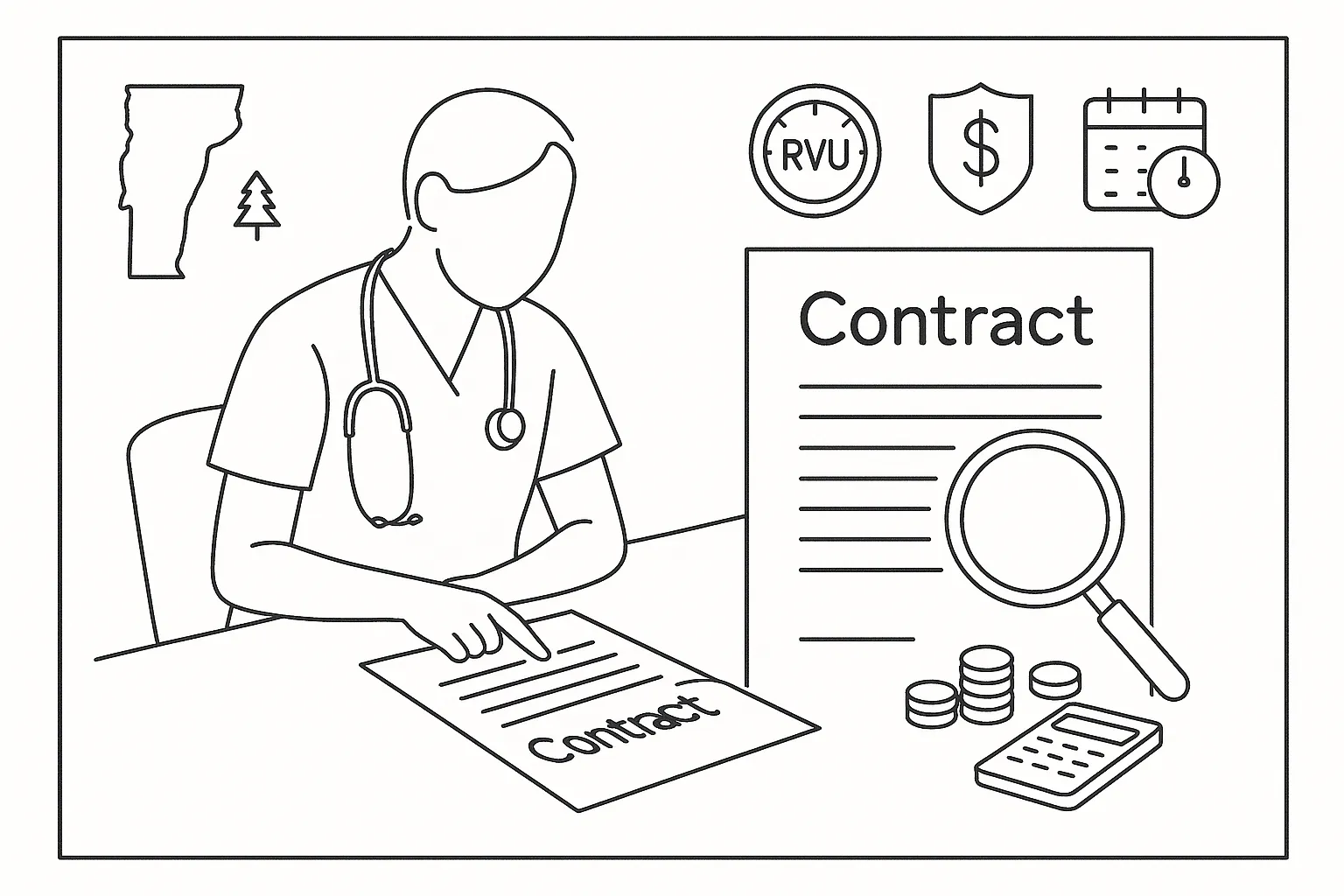
NP compensation may consist of a guaranteed salary, salary plus productivity, collections-based pay, or an RVU-based formula. Each model presents different risks. A collections formula should define adjustments for payer denials, refunds, discounts, chargebacks, and uncollected accounts. An RVU model should identify which RVUs count, the conversion factor, the productivity threshold, the reporting source, and when reconciliation occurs.
Sample calculations can help reveal whether the formula is understandable and whether the stated compensation is realistically attainable. Review should also address negative accrual, changes to productivity targets, employer control over coding or scheduling, and vague terms such as “billable encounter” or “adjusted collections.” Chelle Law provides a focused NP compensation and productivity review for agreements containing these provisions.
Bonuses, Repayment Obligations, and Benefits
Bonus provisions often depend on thresholds or data controlled by the employer. The contract should explain how performance is calculated, when the bonus is earned, when it is paid, and whether the NP must remain employed on the payment date. Signing bonuses, relocation assistance, loan repayment, and employer-funded training may be subject to full or prorated repayment if the relationship ends before a stated date. The repayment trigger should distinguish resignation, termination for cause, and termination without cause whenever the agreement supports those distinctions.
Benefits may be summarized in the contract while the controlling details remain in separate plan documents. Review should confirm eligibility for health coverage, retirement plans, employer contributions, paid time off, continuing education, licensing fees, and other promised benefits. In a 1099 arrangement, the agreement should make clear that the practitioner may be responsible for taxes, insurance, retirement planning, and expenses that an employer would otherwise cover.
Clinical Duties, Scheduling, and Practice Logistics
Full-time equivalency, patient-contact expectations, administrative time, call coverage, and telehealth assignments should be stated clearly. A contract may measure productivity through encounters or RVUs while also requiring evening call, cross-coverage, chart review, or administrative work that reduces available clinical time. The agreement should address whether those duties are included in base compensation, separately paid, or considered part of the productivity calculation.
Credentialing and privileging can also affect the start of employment and the timing of compensation. The contract should identify who prepares and submits applications, whether the employer assists with hospital privileges and payer enrollment, and what happens if approval is delayed or denied. Mandatory meetings, quality reporting, chart-completion standards, and maintenance of licensure should be defined so that the NP understands which administrative failures could lead to discipline or termination.
Practice location provisions should identify the primary site and any expectation that the NP travel, float, or cover multiple facilities. The agreement should also address equipment, telehealth technology, support staff, data security, and responsibility for professional subscriptions or licensing expenses. These operational details can directly affect workload and the practitioner’s ability to meet productivity targets.
Malpractice Insurance, Tail Coverage, and Liability
Malpractice coverage is one of the most consequential provisions in an NP agreement. A claims-made policy generally addresses claims reported while the policy is active, which may create a need for tail coverage after the policy ends. An occurrence policy generally applies based on when the incident occurred. The contract should identify the policy type, coverage limits, premium responsibility, and whether Chelle Law’s client or the employer must secure any required post-termination coverage.
Some employers require the NP to maintain a separate policy, provide proof of specified limits, or name another party as an additional insured. Review should address defense-cost allocation, gaps during suspension or transition, and whether malpractice expenses can be deducted from compensation. Because tail responsibility may vary based on how the relationship ends, these terms should be compared with the termination section. A dedicated malpractice and tail insurance review can help clarify that allocation.
Indemnification language can shift additional risk to the practitioner by requiring reimbursement of losses, defense expenses, or claims arising from specified conduct. Broad provisions should be reviewed for their scope, whether they apply to the employer’s negligence, and whether the agreement provides reciprocal protection. Open-ended indemnity obligations can create exposure beyond the malpractice policy itself.
Non-Competes and Other Post-Employment Obligations
Restrictive covenants may include non-compete, non-solicitation, confidentiality, and patient-contact limitations. A practical review considers the duration, geographic scope, covered services, patient restrictions, and whether the provision could affect realistic employment opportunities in Vermont. State law and the specific facts can influence how a restriction is analyzed, so the contract language should not be evaluated in isolation. Chelle Law offers a focused nurse practitioner non-compete review for these provisions.
Repayment obligations may operate alongside restrictive covenants. An NP who resigns could face a bonus clawback while also being limited in where the next position may be located. The agreement should state whether repayment is prorated, capped, or waived when employment ends without cause. If the contract includes a paid transition or garden-leave provision, the compensation and restrictions during that period should be clearly defined.
Post-termination duties may also include completing records, assisting with patient transitions, returning property, and maintaining confidentiality. Patient-care responsibilities are important, but the agreement should avoid vague obligations that extend indefinitely or require uncompensated work after employment. Transition duties should be coordinated with the final work date, compensation terms, and access to the systems needed to complete them.
Termination, Dispute Terms, and Timing of Review
Termination provisions should distinguish termination for cause from termination without cause and define the events that permit immediate separation. Cause definitions may address licensure problems, exclusion from healthcare programs, misconduct, failure to meet contractual duties, or other specified events. The agreement should also state whether the NP receives notice and an opportunity to cure certain alleged breaches before termination.
Without-cause notice affects income continuity, scheduling, patient transition, and the timing of a new position. Severance, when offered, may be conditioned on signing a release or complying with continuing restrictions. Review should compare the notice period with bonus eligibility, repayment obligations, malpractice coverage, and the duration of post-employment covenants. NPs already considering separation can obtain a focused contract termination review.
Arbitration, governing-law, venue, and attorney-fee provisions can affect the cost and process of resolving a dispute. An out-of-state forum or governing-law clause may increase complexity, while fee-shifting language may create additional financial risk. Common warning signs across the agreement include vague productivity calculations, employer-only control over bonus metrics, unclear tail responsibility, broad indemnification, sweeping restrictions, and inconsistent termination language. Reviewing the written offer before signing allows those issues to be addressed as preventive risk management rather than after a dispute or separation.
Get Your Vermont NP Contract Reviewed
Before signing an employment or independent contractor agreement, have Chelle Law evaluate the compensation, malpractice, restrictive covenant, and termination provisions that may affect your practice in Vermont.
Contact Chelle LawExplore Nurse Practitioner Contract Help
Review available legal services, practical contract resources, and state-specific guidance for nurse practitioners.