
Malpractice insurance is a foundational risk-management consideration for nurse practitioners (NPs). Whether you are accepting a first employment agreement, transitioning between practices, or evaluating an independent contractor engagement, the structure and wording of malpractice coverage can affect your income, licensing risk, and career mobility. This guide explains common policy types, coverage terms, tail obligations, and contract provisions that warrant careful review.
Key Malpractice Insurance Considerations for Nurse Practitioners
- Confirm whether coverage is claims-made or occurrence because claims-made coverage may require tail insurance for claims reported after the policy ends.
- Verify your insured status, retroactive date, coverage territory, exclusions, policy limits, and consent-to-settle language.
- Determine who pays premiums and tail costs, controls the defense, and selects counsel if a claim arises.
- Review indemnification, reimbursement, and premium repayment provisions for liabilities that may fall outside the insurance policy.
- Confirm that the policy covers the services, locations, telehealth activities, and outside work permitted by the agreement.
Why Malpractice Insurance Matters for Nurse Practitioners
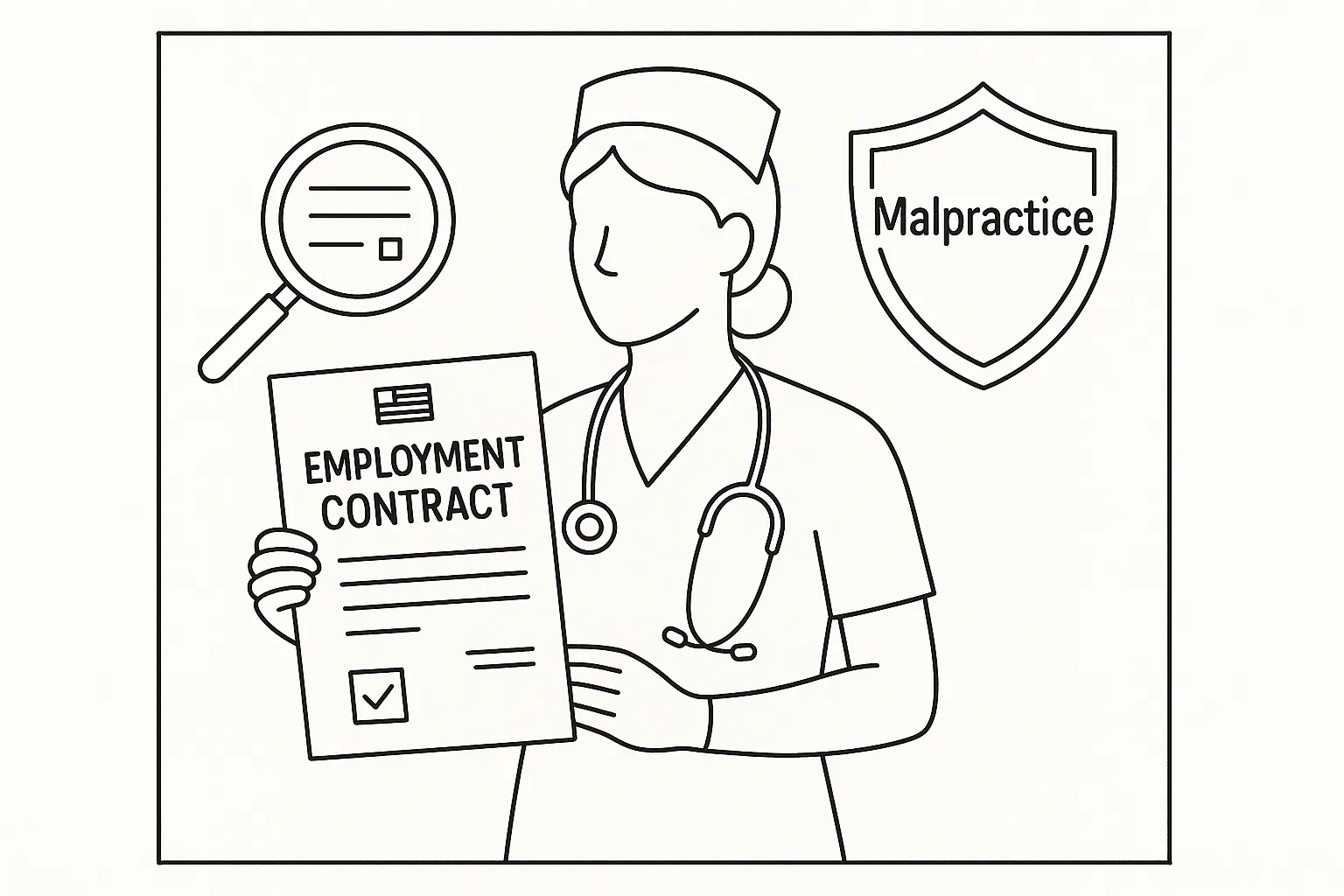
A malpractice claim can create defense costs, licensing concerns, reputational consequences, and long-term financial obligations even when the claim lacks merit. Employment agreements may allocate these risks by limiting the scope of employer-provided coverage, shifting tail costs to the NP, requiring premium repayment, or imposing contractual indemnification obligations.
Malpractice insurance should therefore be evaluated together with the employment or contractor agreement. A policy may appear adequate while the contract defines covered professional services narrowly, ties coverage to active employment, or assigns the NP liabilities that the insurer will not cover. A focused malpractice and tail insurance review can identify where the policy and agreement do not align.
Claims-Made vs. Occurrence Malpractice Coverage
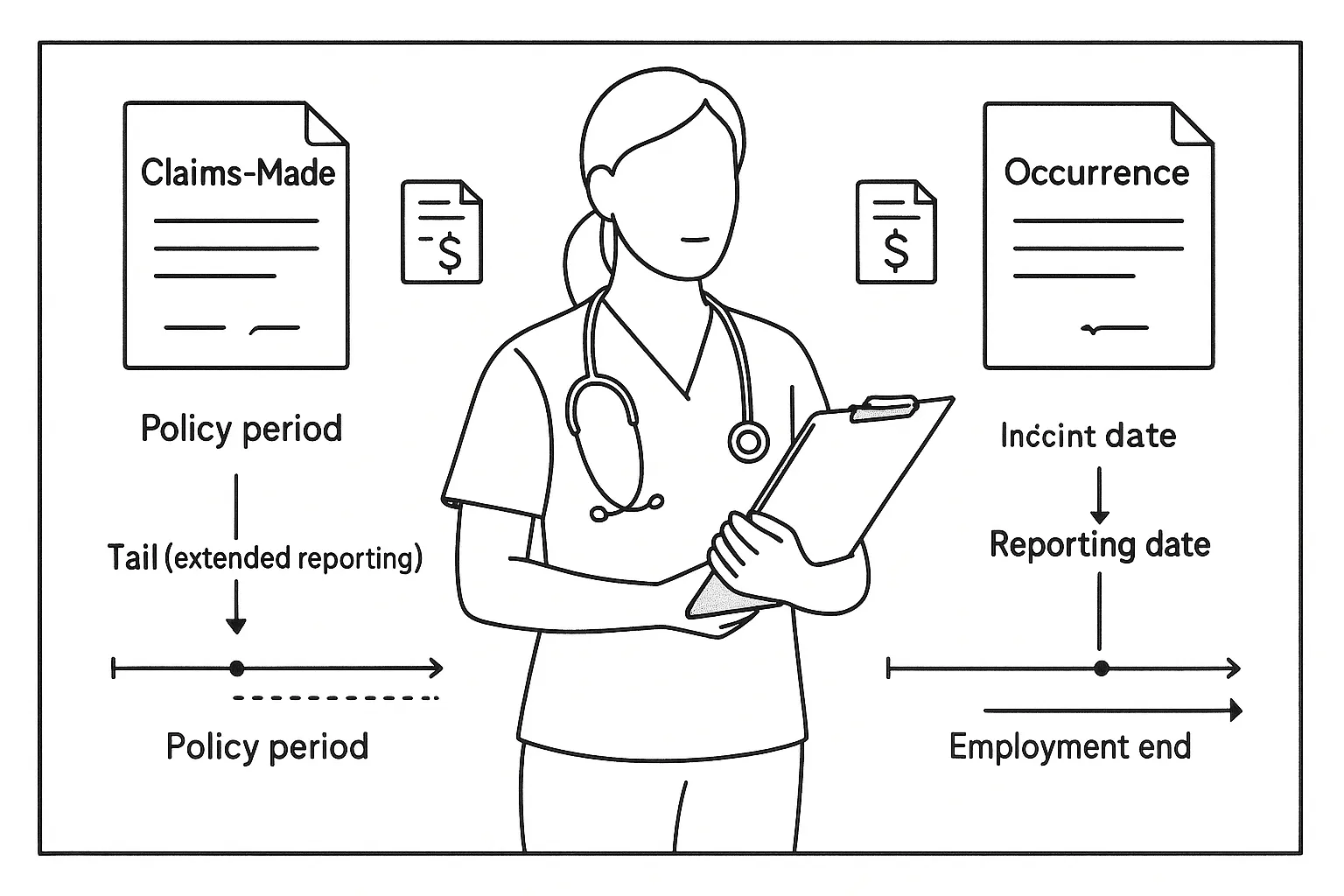
Claims-made and occurrence policies differ primarily in when coverage applies and how claims reported after employment are handled. Understanding that distinction is essential when evaluating post-employment exposure.
Claims-Made Coverage
A claims-made policy generally covers a claim only when the underlying incident occurs on or after the applicable retroactive date and the claim is made and reported while the policy remains active. When the policy ends, later-reported claims are ordinarily not covered unless prior-acts coverage or an extended reporting period, commonly called tail coverage, applies.
Occurrence Coverage
An occurrence policy generally covers an incident that occurs during the policy period even if the resulting claim is reported after the policy ends. This structure usually avoids the need to purchase tail coverage for incidents that occurred while the occurrence policy was active, although the policy’s limits, exclusions, and other terms still control.
Employers commonly provide claims-made coverage, making it important to understand the distinction between claims-made and occurrence insurance before signing an agreement.
Policy Terms and Contract Provisions to Review
The policy and the contract should be reviewed together. Important policy terms include who qualifies as an insured, the retroactive date, policy territory, covered professional services, exclusions, defense provisions, settlement authority, and the applicable limits and deductibles.
Insured Status, Retroactive Date, and Settlement Authority
Confirm whether the NP is a named insured or otherwise expressly covered under the employer’s policy. The retroactive date determines how far back coverage reaches under a claims-made policy, while consent-to-settle language determines whether the NP has input before a claim is resolved. Settlement decisions can affect professional reputation, reporting obligations, and licensing matters.
Coverage Territory, Professional Services, and Exclusions
Coverage territory and the definition of professional services should match where and how the NP actually practices. This is especially important for multi-state work and telehealth contract duties. Exclusions may address intentional or criminal conduct, fraud, sexual misconduct, services outside the authorized scope, or activities performed for an entity that is not covered by the policy.
Premiums, Defense Control, and Indemnification
The agreement should state who pays the premium, whether the NP must reimburse any costs after an early departure, and who selects counsel and controls the defense. An indemnification clause can create separate liability if it requires the NP to reimburse the employer for losses the insurer declines to cover. Premium repayment provisions may also operate as financial clawbacks when tied to continued employment.
Employer-provided coverage is often convenient and less expensive to the NP, but it may end with employment and provide the employer greater control over defense decisions. An individual policy may offer additional continuity or control, but it creates a separate premium obligation and should be checked for coordination with the employer’s coverage.
Tail Coverage and Post-Employment Liability
Tail coverage is one of the most significant post-employment issues under a claims-made policy. The contract may require the employer to purchase tail coverage, assign the full cost to the NP, or allocate responsibility according to whether the agreement ends through resignation, expiration, termination without cause, or termination for cause.
The provision should identify the triggering events, required reporting period, applicable carrier requirements, and deadline for obtaining proof of coverage. General language stating that a party will maintain “appropriate coverage” may not adequately establish who is responsible after the underlying policy terminates. A detailed guide to tail insurance for nurse practitioners can help clarify the practical issues involved.
Independent contractors should be particularly careful because a 1099 agreement may place the entire obligation to obtain and maintain coverage on the NP. The agreement should be reviewed for required limits, proof-of-insurance obligations, prior-acts coverage, tail requirements, and reimbursement terms. These provisions should also be considered as part of a broader independent contractor agreement review.
Policy Limits, Deductibles, and Premium Factors
Malpractice policies commonly state both a per-claim limit and an aggregate limit. The per-claim limit applies to an individual covered claim, while the aggregate limit caps covered payments during the applicable policy period. Deductibles and provisions governing whether defense expenses reduce the available limits can materially change the protection provided.
Premiums may vary based on specialty, procedures performed, practice setting, location, claims history, policy type, requested limits, and the scope of covered services. Telehealth, moonlighting, work at multiple facilities, and services performed for separate entities should not be assumed to fall within the primary employer’s policy. The coverage documents should be compared with the NP’s actual job duties and permitted outside activities.
Malpractice Coverage Checklist Before Signing
Before accepting an employment or contractor agreement, request the policy details and obtain written answers to unresolved coverage questions. At a minimum, review the following items:
- Confirm whether the policy is claims-made or occurrence.
- Identify the named insured, retroactive date, policy territory, and covered professional services.
- Review per-claim and aggregate limits, deductibles, exclusions, and the treatment of defense costs.
- Determine who controls the defense, selects counsel, and approves settlement.
- Identify who must obtain and pay for tail coverage after each possible type of termination.
- Check for indemnification, reimbursement, or premium repayment clauses that shift costs to the NP.
- Verify coverage for telehealth, moonlighting, multiple locations, and any other permitted outside work.
Legal review is particularly important when the agreement ties coverage to active employment, leaves tail responsibility unclear, contains broad indemnification language, or requires the NP to repay insurance costs. A comprehensive nurse practitioner contract review can evaluate malpractice terms alongside compensation, termination, restrictive covenants, and other provisions that affect the overall agreement.
Frequently Asked Questions
What is the difference between claims-made and occurrence malpractice insurance?
Claims-made coverage generally requires the incident to fall within the covered period and the claim to be made and reported while the policy or an extended reporting period is active. Occurrence coverage generally applies when the incident occurred during the policy period, even if the claim is reported later.
When does a nurse practitioner need tail coverage?
A nurse practitioner may need tail coverage when a claims-made policy ends and no replacement policy provides prior-acts coverage for the same services and retroactive period. The policy documents and contract should determine the exact requirement.
Who should pay for malpractice tail insurance?
Responsibility is determined by the employment or contractor agreement. Some employers pay in every circumstance, while other agreements assign the cost according to whether the NP resigns, the contract expires, or the employer terminates the relationship.
Is an employer-provided malpractice policy always sufficient?
No. An employer policy may limit covered services, locations, outside work, settlement authority, or post-employment protection. The NP should confirm insured status, limits, exclusions, defense terms, and whether tail or prior-acts coverage will apply.
Which malpractice insurance terms should an NP review before signing?
Important terms include the policy type, retroactive date, insured status, coverage territory, covered services, exclusions, limits, deductibles, defense costs, settlement authority, tail responsibility, indemnification, and premium repayment obligations.
Do independent contractor nurse practitioners need their own malpractice coverage?
Many independent contractor agreements require the NP to obtain and maintain an individual policy. The agreement should specify the required policy type and limits, proof-of-coverage obligations, covered services, and responsibility for tail or prior-acts coverage.
Have Your Malpractice and Tail Terms Reviewed
Chelle Law reviews nurse practitioner agreements to identify coverage gaps, tail obligations, indemnification provisions, and insurance costs before they create unexpected professional or financial exposure.
Contact Chelle Law