
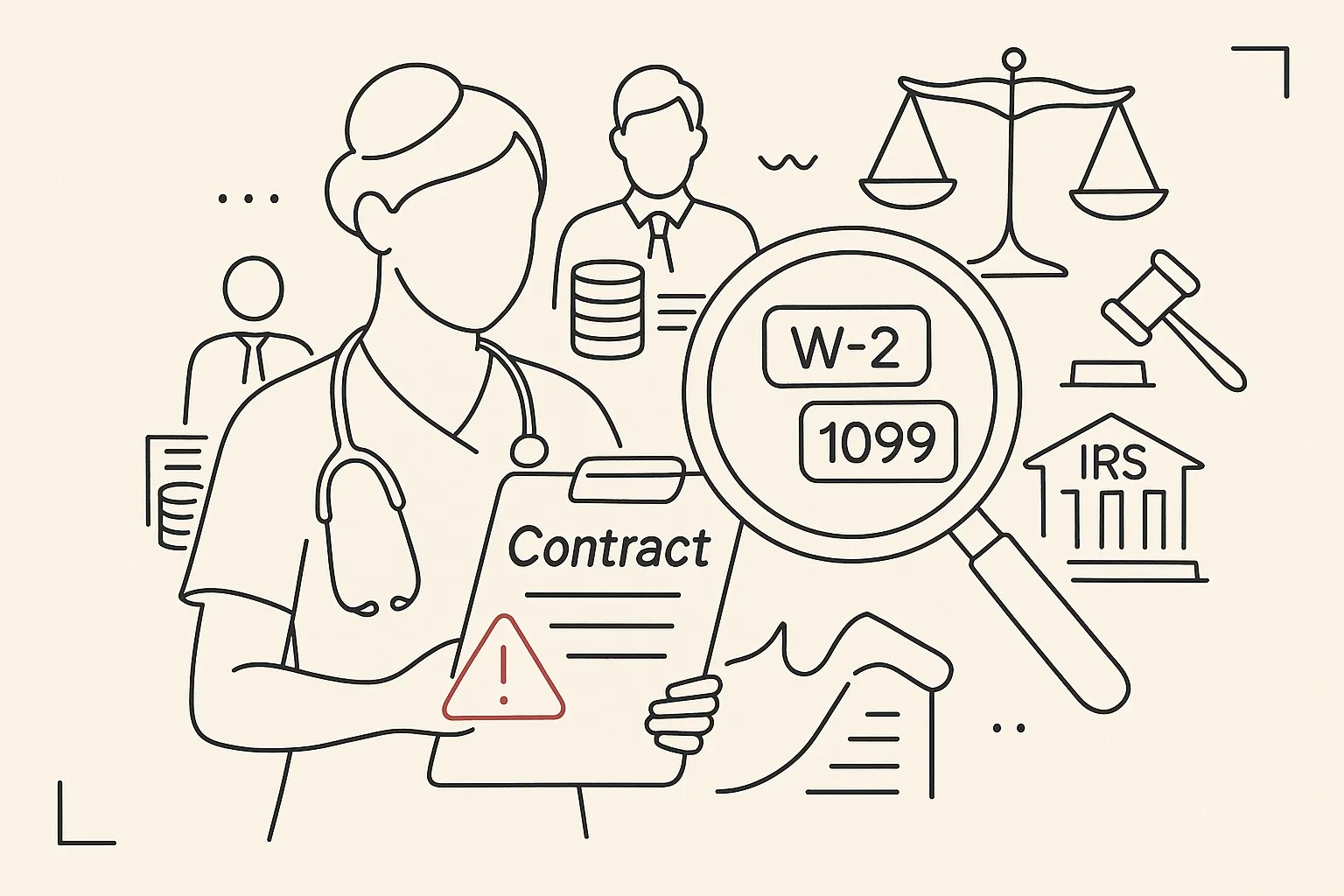
Determining whether a nurse practitioner (NP) is properly classified as a W-2 employee or a 1099 independent contractor requires more than reading the label at the top of an agreement. Classification reflects the actual working relationship, including who controls the schedule, assigns patients, establishes workplace requirements, handles billing, supplies professional resources, and bears the financial risks associated with the services.
The distinction matters because it can affect tax withholding, benefits, paid leave, workers’ compensation, malpractice coverage, business expenses, and access to employment-related protections. Compensation formulas, productivity expectations, supervision or collaboration arrangements, and mandatory scheduling provisions can also make a purported contractor relationship function more like employment. If the written terms do not match the day-to-day reality, both the NP and the practice may face financial and legal exposure.
Chelle Law reviews the complete agreement to identify how classification interacts with compensation, insurance, termination, restrictive covenants, and professional responsibilities. An attorney-led review can help an NP understand which obligations belong to the practice, which risks have been shifted to the practitioner, and whether the agreement accurately describes the proposed relationship before it is signed.
Key Takeaways
- W-2 and 1099 classification affects taxes, benefits, malpractice obligations, business expenses, and employment-related protections.
- Calling an NP an independent contractor does not resolve the issue when the practice exercises substantial control over scheduling, protocols, billing, or compensation.
- The contract should accurately reflect how the NP will work, who will supply resources, and which party will bear financial and professional risks.
- Compensation formulas, required schedules, insurance provisions, and termination rights should be reviewed together rather than in isolation.
- Early legal review can identify inconsistent terms before the relationship begins and obligations become more difficult to address.
W-2 Employment and 1099 Contractor Status
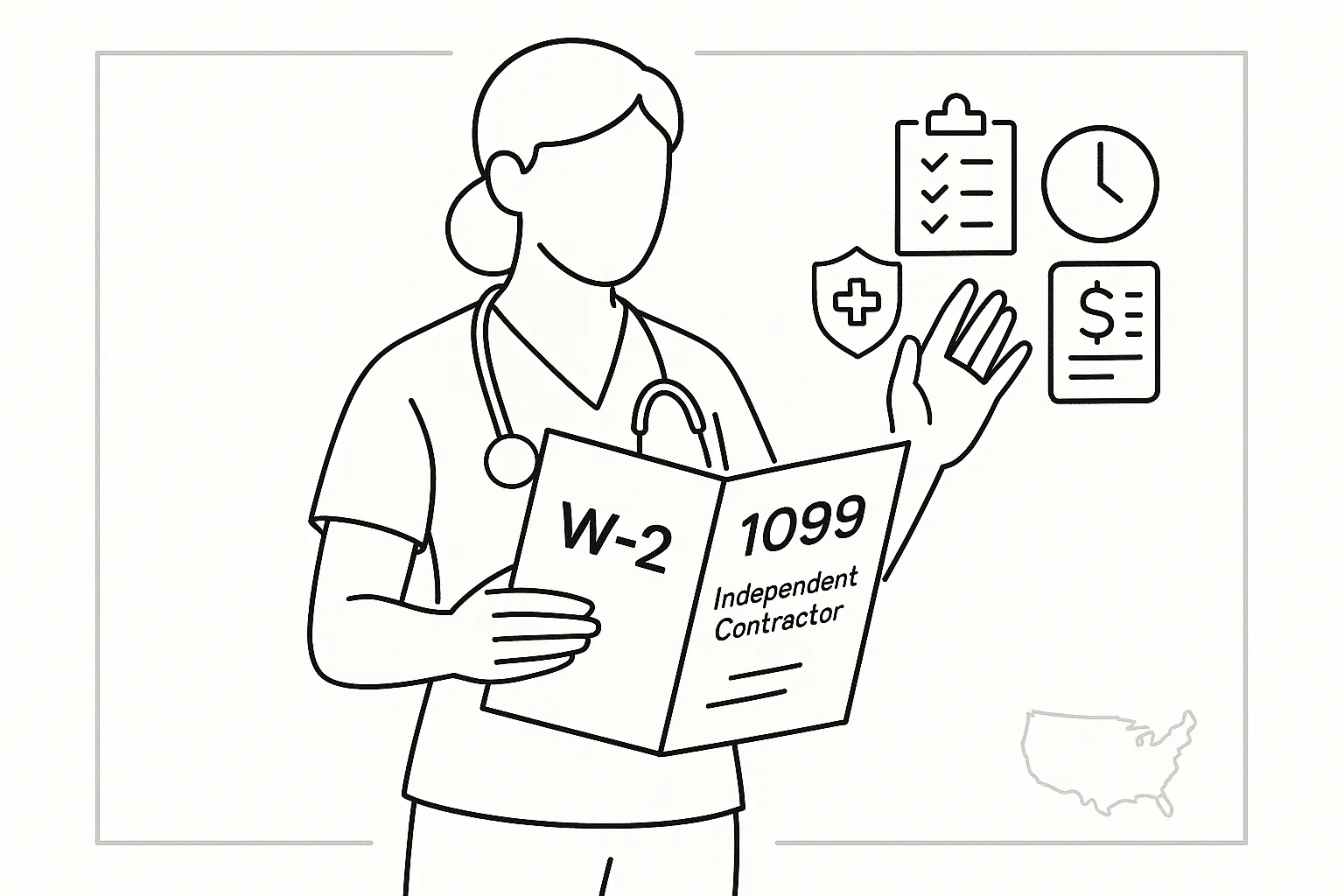
A W-2 employee generally has payroll taxes withheld by the employer and may be eligible for benefits offered through the practice, such as health insurance, retirement contributions, or paid leave. The employer commonly exercises meaningful control over the employee’s schedule, assignments, workplace procedures, and performance standards. The specific rights and obligations still depend on the agreement and the circumstances of the relationship.
A 1099 independent contractor ordinarily receives compensation without employee payroll withholding and is responsible for managing taxes, benefits, and business expenses. A genuine contractor relationship generally involves greater independence in how services are arranged and performed, although clinical obligations and licensing requirements continue to apply. NPs considering contractor work should evaluate the broader W-2 versus 1099 differences, not merely compare the stated compensation rates.
Healthcare arrangements can combine features of both categories. For example, a practice may use an independent contractor agreement while imposing mandatory shifts, detailed productivity requirements, exclusive service obligations, and employer-directed workflows. Because classification depends on the substance of the relationship, the contract’s terminology should be compared with the actual operational expectations.
Factors Used to Evaluate NP Classification
Government agencies and courts may apply different multi-factor standards depending on the legal issue involved. No single contract provision necessarily decides the outcome. The overall analysis commonly considers control, financial independence, and whether the relationship operates as employment in practice.
Control Over Schedule and Clinical Work
Control can include who establishes the NP’s hours, assigns patients, determines work locations, approves time away, and sets administrative procedures. Required clinical protocols, documentation standards, call obligations, and quality metrics may also be relevant, although some requirements may arise from patient-care, licensing, or compliance obligations rather than employment control alone.
The practical question is whether the NP has meaningful discretion consistent with operating an independent business or instead works within a structure directed by the practice. An agreement that grants theoretical flexibility but permits the practice to control every material aspect of the work deserves closer review.
Financial Independence and Opportunity for Profit or Loss
Financial factors may include how the NP is paid, whether the NP can provide services to other organizations, who bears operating expenses, and whether the practitioner makes an independent investment in the work. A higher contractor rate does not automatically compensate for self-employment taxes, unpaid time off, insurance premiums, licensing expenses, or the loss of employer benefits.
Productivity-based compensation can appear in either employment or contractor arrangements. The formula should explain how production is measured, when it is credited, whether adjustments can be made, and when payment is due. A separate NP compensation and productivity review can help assess whether the classification and payment structure operate consistently.
The Written Agreement and Working Relationship
The agreement may address the intended duration of the relationship, exclusivity, benefits, termination rights, insurance, equipment, billing, and the parties’ stated classification. Those provisions are important evidence, but they should match what the practice actually expects. A contract cannot eliminate misclassification risk merely by stating that the NP is an independent contractor.
NPs should compare representations made during recruitment with the final written terms. If the practice describes fixed shifts, mandatory meetings, employer-controlled patient assignments, or exclusive service requirements that do not appear clearly in the agreement, those differences should be addressed before signing. Chelle Law’s independent contractor agreement review evaluates the full allocation of responsibility rather than relying on the agreement’s title.
Contract Terms That Can Signal Misclassification Risk

Classification should be evaluated across the entire agreement. Provisions that appear routine when read separately can create a substantially employer-controlled relationship when combined. Important terms to review include:
- Scheduling and location: Whether the practice sets fixed hours, requires coverage at multiple sites, or can change the schedule unilaterally.
- Compensation: Whether the NP receives a salary, hourly rate, collections percentage, productivity payment, or another formula and who controls the supporting data.
- Billing and collections: Whether the practice bills under its systems, controls collection activity, and determines how adjustments affect NP compensation.
- Expenses and resources: Which party pays for licensing, continuing education, equipment, support staff, credentialing, supplies, and professional insurance.
- Outside work and exclusivity: Whether the NP may work for other practices or must obtain approval before accepting additional professional engagements.
- Termination: How much notice is required, whether either party may end the agreement without cause, and which financial obligations survive departure.
These terms should also be reviewed for internal consistency. For example, broad contractor responsibility for expenses may conflict with employer-like restrictions on scheduling and outside work. A line-by-line nurse practitioner contract review can identify where the agreement’s classification language and operational provisions point in different directions.
Financial and Professional Consequences of Misclassification
Misclassification can create unexpected tax obligations, benefit losses, reimbursement disputes, and questions about access to employment-related protections. An NP treated as a contractor may need to account for self-employment taxes and make independent arrangements for health coverage, retirement savings, leave, and business expenses. If the compensation rate was accepted without valuing those costs, the apparent financial advantage of contractor status may be reduced.
Disputes may also arise over unpaid compensation, deductions, expense reimbursement, or whether the NP qualified for protections typically associated with employment. The consequences depend on the governing law and facts, so the agreement should not promise certainty merely by assigning a label. It should clearly allocate responsibilities and avoid terms that conceal the economic reality of the relationship.
Malpractice Coverage, Restrictions, and Career Mobility
Malpractice obligations require particular attention in contractor agreements. The contract should identify who obtains coverage, which policy form applies, what limits are required, and whether the NP may owe for tail coverage after termination. NPs can use a focused malpractice and tail insurance review to understand how those obligations affect the value and exit costs of the arrangement.
Independent contractor status also does not prevent a practice from including non-compete, non-solicitation, confidentiality, or outside-work restrictions. Those provisions can limit future employment and business opportunities even when the NP receives no employee benefits. Because enforceability and practical impact vary, restrictive terms should be evaluated through a dedicated NP non-compete review before the practitioner relies on the ability to move freely after termination.
How NPs Can Review a Proposed Classification
Before signing, an NP should request the complete agreement and any incorporated compensation plans, policies, schedules, insurance requirements, or exhibits. Verbal explanations should be compared with the written contract, especially when the practice promises scheduling flexibility, outside-work rights, benefit eligibility, or reimbursement that does not appear in the final document.
- Identify every provision describing employee or contractor status and note any inconsistent language.
- Calculate the value of taxes, benefits, unpaid leave, insurance, and professional expenses rather than comparing compensation rates alone.
- Confirm who controls scheduling, locations, patient assignments, billing, productivity data, and outside professional work.
- Review malpractice coverage and any tail obligation that may arise when the agreement ends.
- Examine termination, repayment, non-compete, and non-solicitation provisions for obligations that may continue after departure.
- Seek legal and tax guidance when the proposed classification does not match the anticipated working relationship.
Legal review is especially important when a practice presents a contractor agreement with fixed full-time hours, exclusivity, substantial employer control, or significant financial obligations. Counsel can explain the contractual exposure and identify questions that should be resolved before work begins. Tax advice may also be appropriate because contract review and tax planning address different aspects of the classification decision.
Frequently Asked Questions
Does signing a 1099 agreement automatically make an NP an independent contractor?
No. The agreement’s label is relevant, but classification generally depends on the complete working relationship. Control over scheduling, assignments, billing, expenses, outside work, and other practical factors may be considered alongside the written terms.
Is a higher 1099 rate always better than W-2 compensation?
No. The comparison should account for self-employment taxes, health coverage, retirement benefits, paid leave, malpractice premiums, professional expenses, and unpaid administrative time. The higher stated rate may not produce greater net compensation after those costs are included.
Can a 1099 NP be required to work a fixed schedule?
A contract may contain scheduling requirements, but extensive practice control over fixed hours, locations, and assignments can be relevant to classification. The schedule should be reviewed together with the other financial and operational terms rather than treated as the only deciding factor.
Who pays for malpractice insurance in an independent contractor agreement?
The agreement should specify whether the practice or the NP obtains and pays for coverage. It should also identify required limits, the policy type, and responsibility for tail coverage or other post-termination protection when applicable.
Can an independent contractor agreement include a non-compete?
Yes, a practice may include restrictive covenants in a contractor agreement. Their enforceability and practical effect depend on the language, governing law, and circumstances, so the restrictions should be reviewed before the NP signs or plans future work.
When should an NP seek legal help about W-2 or 1099 classification?
Legal review is useful before signing when the agreement’s label appears inconsistent with the proposed schedule, control, compensation, insurance, or exclusivity terms. Early review can identify financial and professional obligations before the relationship begins.
Review Your NP Classification Terms
Chelle Law can review how W-2 or 1099 classification affects your compensation, malpractice obligations, termination rights, and professional flexibility before you sign.
Contact Chelle LawExplore Nurse Practitioner Contract Guidance
Review legal services, practical contract resources, and state-specific guidance for nurse practitioners.